Read the blog post here: https://paulcarneyartist.blog/2026/07/08/where-does-mathematics-come-from/
Pip: Paul Carney’s Blog asks the kind of question that sounds simple until you’re three paragraphs in and suddenly reconsidering the nature of reality over your morning coffee.
Mara: That’s a fair summary. Paul Carney takes on where mathematics actually comes from — whether it’s something we invent or something we uncover — tracing the argument from ancient geometry all the way down to atoms and forces.
Pip: Let’s start with the geometry of everything.
Where Does Mathematics Come From?
Mara: The central tension here is an old one: is mathematics a human invention, or does it exist independently of us, waiting to be found? The post opens with a Plato quote that sets the stakes immediately.
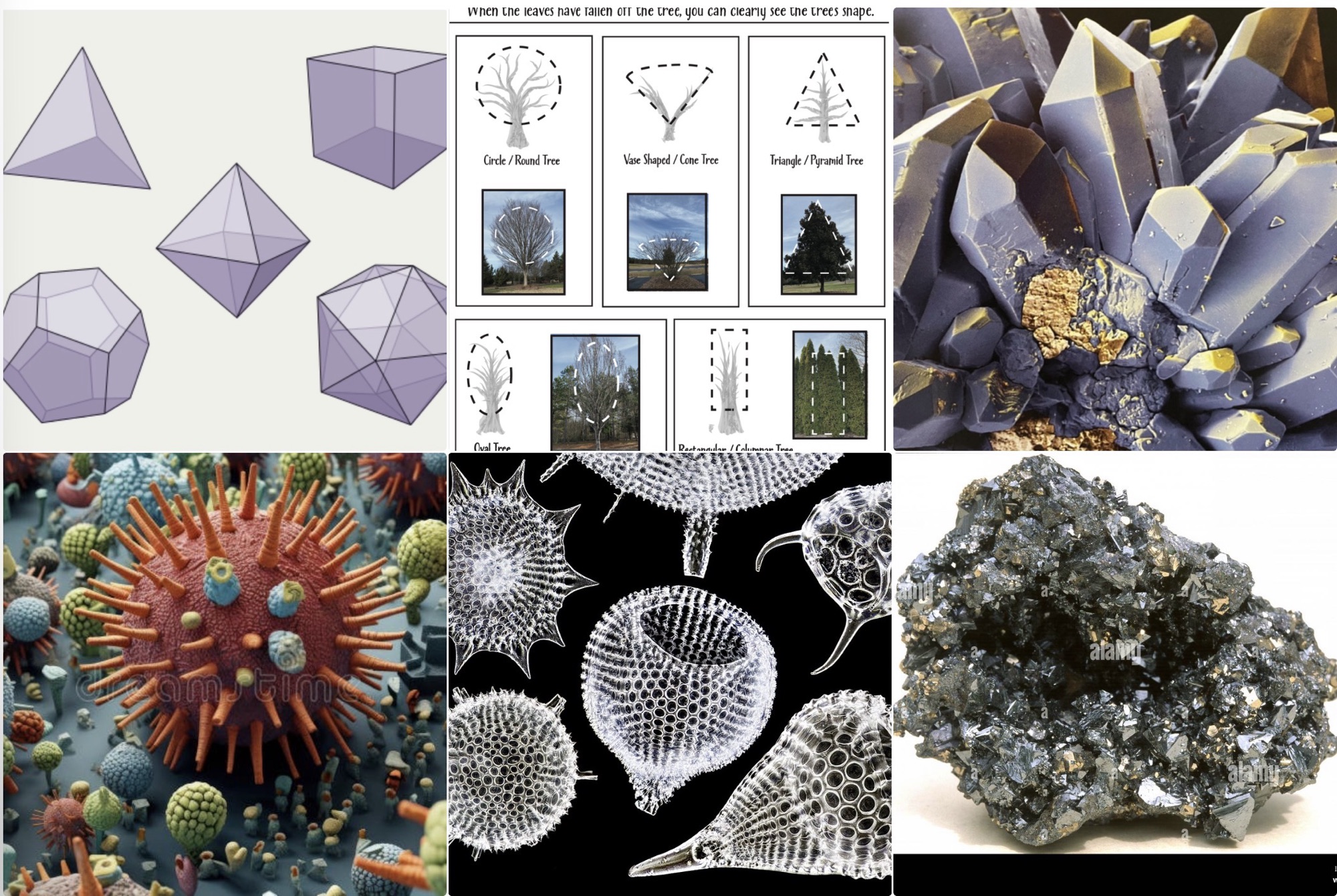
Pip: And Plato doesn’t ease you in gently. The quote reads: “In the grand blueprint of the cosmos, the gods employed geometry as their divine language. The tetrahedron sparked the flames of fire, the cube laid the earth’s foundation, the octahedron whispered to the winds, and the icosahedron flowed through the waters.”
Mara: So the ancient framing assigns a Platonic solid to each element — fire, earth, air, water — and the dodecahedron to the universe itself. The post then asks whether that instinct was poetic license or something more structurally accurate than it looks.
Pip: Turns out, more accurate. The post walks through how minerals crystallize into perfect cubes and octahedra because atoms pack efficiently into crystal lattices — not because anyone designed them to, but because forces acting on matter produce the most stable configuration.
Mara: The same principle scales up. Single-celled radiolarians form icosahedral skeletons for structural efficiency. Many viruses encase their genetic material in icosahedral shells. The geometry keeps reappearing because it works, not because it was chosen.
Pip: Which is where Kurt Gödel enters, and things get philosophically uncomfortable in the best way.
Mara: Gödel’s completeness theorem showed that no formal system can capture all mathematical truth or verify its own consistency. His second theorem directly challenged the idea that mathematics is purely a human construction — mathematical objects, he argued, exist objectively and independently of our mental acts.
Pip: So the Vienna Circle spent years building a tidy logical framework, and a twenty-year-old walked in and proved the frame couldn’t hold everything inside it.
Mara: The post doesn’t land on one side. It notes that imaginary numbers are an invention — and yet without them, we couldn’t calculate flight paths. The modern answer is that mathematics is now a product of both discovery and invention.
Pip: The post’s final move is the one that lingers: fundamental forces are invisible, particles are more like excitations in a field than solid objects, and everything we experience as physical is essentially empty space held together by forces we can’t see.
Mara: The conclusion is careful but direct — the deepest mathematical principles are being discovered, not invented. As the post puts it, we are “unravelling a mysterious, enigmatic, mathematical riddle that transcends our mere humanity.”
Pip: The geometry was always there. We just needed the right questions to see it.
Mara: And enough humility to admit the framework we built to describe it will always have gaps. More to unravel next time.


Leave a Reply