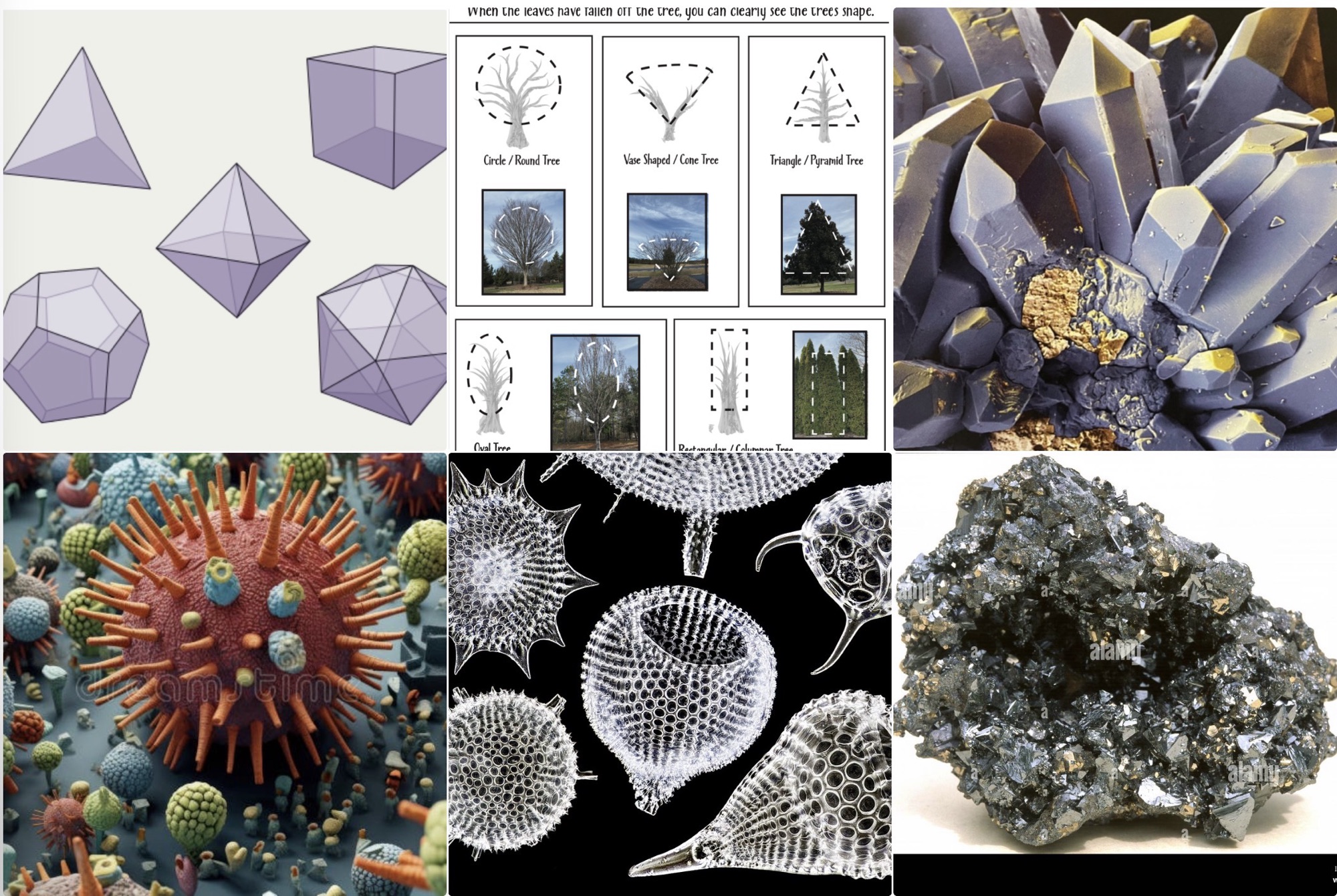
“In the grand blueprint of the cosmos, the gods employed geometry as their divine language. The tetrahedron sparked the flames of fire, the cube laid the earth’s foundation, the octahedron whispered to the winds, and the icosahedron flowed through the waters. As for the dodecahedron, the gods used it to roll the dice on the universe’s fate. Such is the playful wit of celestial architects.” Plato

As a child, I remember being very frustrated by construction toys such as Lego and Meccano. In my young mind, they were too limiting. They just wouldn’t do what I wanted. I couldn’t create curves or mould them into the interesting shapes I had in mind, and I was too restricted by their angular, geometric design. For me, Lego was frustrating, not fun.
In the late 19th century, the artist Paul Cezanne said that everything in nature is formed from the sphere, the cone and the cylinder. His reduction of forms to simple, blockish structures became the basis of George’s Braques and Pablo Picasso’s Cubism. Of course, these guys were simply building on ideas the Ancient Greeks such as Pythagoras, Theaetetus and Plato had described millennia before them: that mathematical rules and patterns were the basis for everything around us.
Ancient mathematicians stated that the world was constructed from three-dimensional shapes that became known as Platonic solids: cubes, tetrahedrons, octahedrons, icosahedrons, and dodecahedrons. But, while there are only five combinations of regular polygons that meet the criteria for Platonic solids, there are of course other 3D shapes, such a cylinders, spheres and cones, it’s simply that these other shapes aren’t as symmetrical.
It’s a strange, counterintuitive concept that the whole world is constructed from regular, ordered shapes, because when we think of something like say, a tree, or a plant, we don’t immediately associate them with geometrical shapes. It’s only when you zoom out and look at them from a distance that you begin to see that they do indeed have a regular structure.

Of course, perfect versions of Platonic solids and other shapes, do not exist in nature, only approximations, but that did not stop one of the greatest mathematician of the 20th century, Kurt Gödel from being a Platonist, which emphasises the existence of abstract forms that are distinct from the physical world. As a 20 year-old man, Gödel took on the might of the Vienna Circle and in particular German mathematician David Hilbert, to disprove their theory that all mathematics came from observations of the natural world, and that mathematics and logic could encapsulate all phenomena. He brilliantly dismantled their arguments in his famous completeness theorem which showed that no formal system, however carefully designed, can capture all mathematical truth or certify its own reliability. His second theorem disproved Hilbert’s argument that mathematics is only a human construction – mathematical objects and facts, he said, exist objectively and independently of our mental acts and decisions.
These arguments still rage on, some believing we invent maths, others saying we discover it. In fact, the modern world is now so complex that it has become a product of both natural and invented maths. Imaginary numbers for example, are an invention, and yet we couldn’t fly airplanes without them because they are used to calculate flight paths.
Where does mathematics come from? Why is the world so precise, ordered and mathematical?
The answer to that comes from the nature of matter itself. Much like my childhood Lego, the basis for everything in the world around us are the small atomic building blocks that arrange themselves into the mathematical physical matter we are familiar with. Unlike my Lego, natural forces act upon atoms to create a myriad of 3-Dimensional shapes, rather than simply oblong blocks.
Molecules bond according to electronic laws of attraction and repulsion which in turn creates elaborate formations and patterns. A good example of this are carbon molecules, which under high pressure, form various configurations, from hexagonal rings, to tetrahedral, three-dimensional networks.
Minerals too, frequently crystallise into perfect cubes, octahedral, trapezohedral or dodecahedrons, all of which come from the efficient packing of atoms in crystal lattices. Move a few levels up from atomic structures and you will find microscopic, single-celled organisms such as radiolarians that form astonishing three-dimensional skeletons that approximate dodecahedral or icosahedral structures. These shapes provide the most efficient support and protection for the organism. Many viruses too, encase their genetic material within a shell that is shaped like an icosahedron, or other Platonic shapes.


While these structures may appear astonishing to us, they are the result of dynamic forces acting upon matter to create the most efficient structure. The apparent mathematics we see in the world around us derives from the effect of four fundamental forces upon the properties of seventeen elementary particles.
From atomic, minute, molecular structures come larger, mathematical structures based on similar principles. In short, things stick together in response to forces acting on their own, intrinsic properties; just like cupcake icing being formed from a bag of liquid icing forced through a serrated nozzle. The raw material is just sweet, sticky gunk – the end product is sculpturally sublime!

The deepest, most profound aspects of our mathematical universe then, are being discovered and revealed, rather than invented. Mostly. It is as though there is a hidden mathematical landscape that underpins everything in the world around us. And, while we have invented language and symbols to describe the maths around us, those principles are nevertheless intrinsic.
Some people assign sacred, religious meanings to these geometric systems and in many ways I understand where they are coming from, because bizarrely, these forces and particles aren’t even tangible, physical things. Fundamental forces are invisible, and particles are more like points in space; excitations; bursts of energy within a field, with only a probable location, not a tangible physical certainty. Everything we think of as solid is in fact, empty space held together by invisible forces. So the fact is that matter, the components of which can be in two places at once, or communicate across vast distances instantly, seems pretty divine to me.
Of course, this is a matter of opinion, but it seems evident to me that the mathematical fabric of the universe is built on things that go beyond what we can ever hope to fully comprehend. We aren’t inventing this reality, we are unravelling a mysterious, enigmatic, mathematical riddle that transcends our mere humanity – ingenious as we may be. What you do with that information however, is a matter for your own, personal faith.
Sources
Hannah Fry’s Magic Numbers, Amazon Prime
Where to Find Platonic Solids in Nature, Biology Insights


Leave a Reply