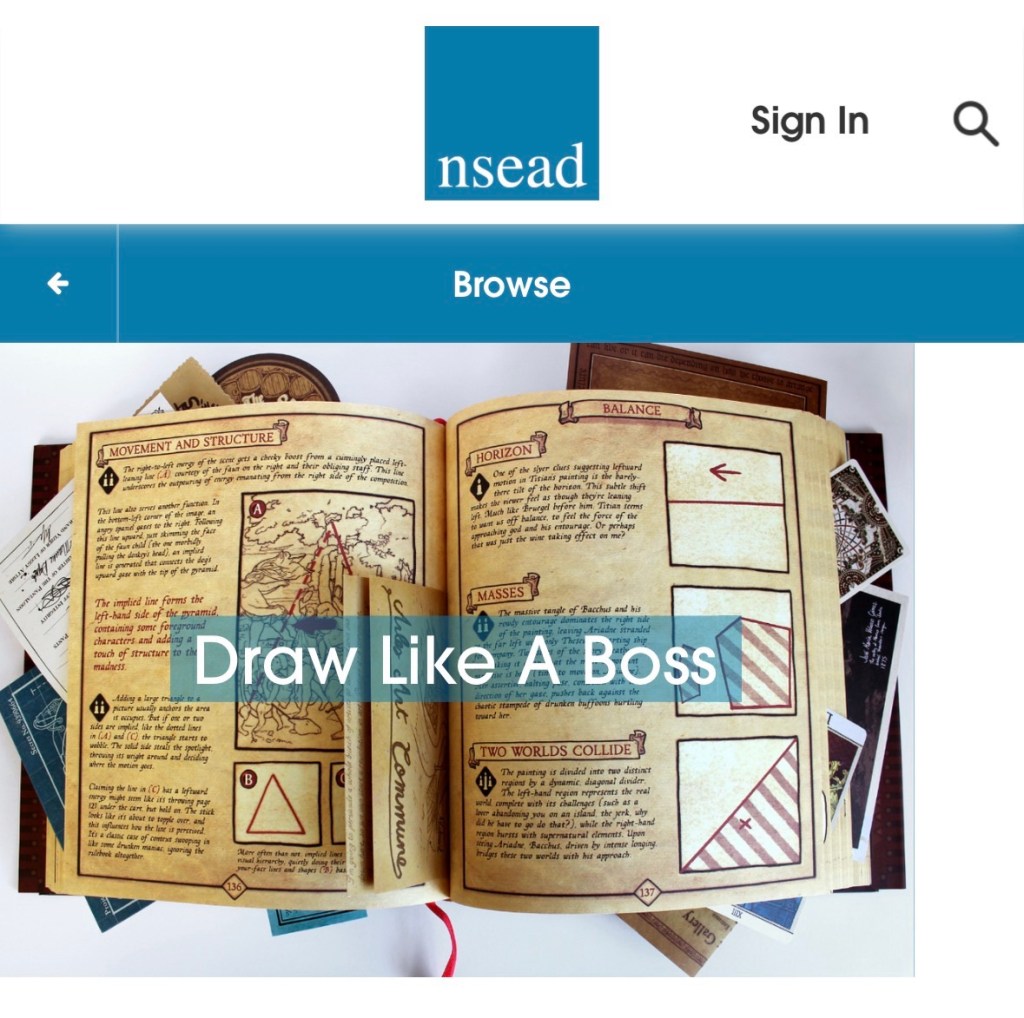
The following interview was given between author of Draw Like a Boss, Ashley Edge, and Paul Carney, former art and design educator, now art practitioner and author, for the NSEAD art educator magazine and website. Ashley and Paul explore the purpose of drawing and learning to draw, including explicit instruction. The full interview can be found here.
Paul Carney: There are many approaches to teach drawing. Can you talk me through yours? What is the over-arching philosophy behind the design, content and structure of the books?
Ashley Edge: When you learn, you’re literally reshaping your brain. It’s internal world-building. I see drawing education as a landscape with its own territories, cultures and challenges. I want people to sit at their desks and feel they’re on a journey toward a summit, the mountain is the central metaphor of the book. I’m not interested in students trying to memorise a concept only to forget it five minutes later; I want them to encounter theory as a living character. Drawing is visual, and it should be taught that way.
PC: Why do you think people should learn to draw? After all, in your book, you admit that most adults cannot draw and see it as a genetic talent, and these days you can use AI to generate images. If so few people draw, is it even important now? Is drawing just a peculiar, old-fashioned hobby?
AE: In the first book, I begin by attempting to do away with the idea that genetics plays a part in someone’s ability to draw. And, although most people can’t draw to a high level, by practicing in a certain way and having the right learning resource to motivate them, there is nothing to stop them from doing so. Talent is a useless word because it either masks the hard work someone has put into getting to a high level or it gatekeeps students from ever thinking they can pass a certain threshold. Picking up a pencil is the first step, internalising the basic principles is the next. After that, you can draw.
As much as AI casts a shadow over creative jobs, the good news is that drawing, like meditation and the appreciation of craft and aesthetic, is never going away. Drawing is more important than ever because it can be used to temper our fast-paced lives. Going slower at certain points in a day is a healthy thing to do. It encourages mindfulness, and allows us to work through emotions and experiences and channel these ideas onto paper. If creating art was purely about the conclusion or the act of selling it later, then AI poses a great threat. But art is as much about the journey as it is about ‘having the thing’ later.
There’s been plenty of talk about AI being a tool like Photoshop, but Photoshop can’t paint the picture for you: therefore, AI is not a tool in the same way. It is more like a crutch that you can lean on, but the more you come to rely on it the more you come to outsource your own creativity to a machine and risk the atrophy of your own artistic voice.
Drawing enables people to ‘see’, which is very different from the act of just ‘looking’. I wouldn’t trade that gift for anything. I know what it feels like to get a drawing to the level where I feel like I am reaching into the paper and sculpting the forms. Drawing is pure alchemy.


 Paul Carney’s Blog
Leave a reply to Paul Carney Cancel reply