By Paul Carney
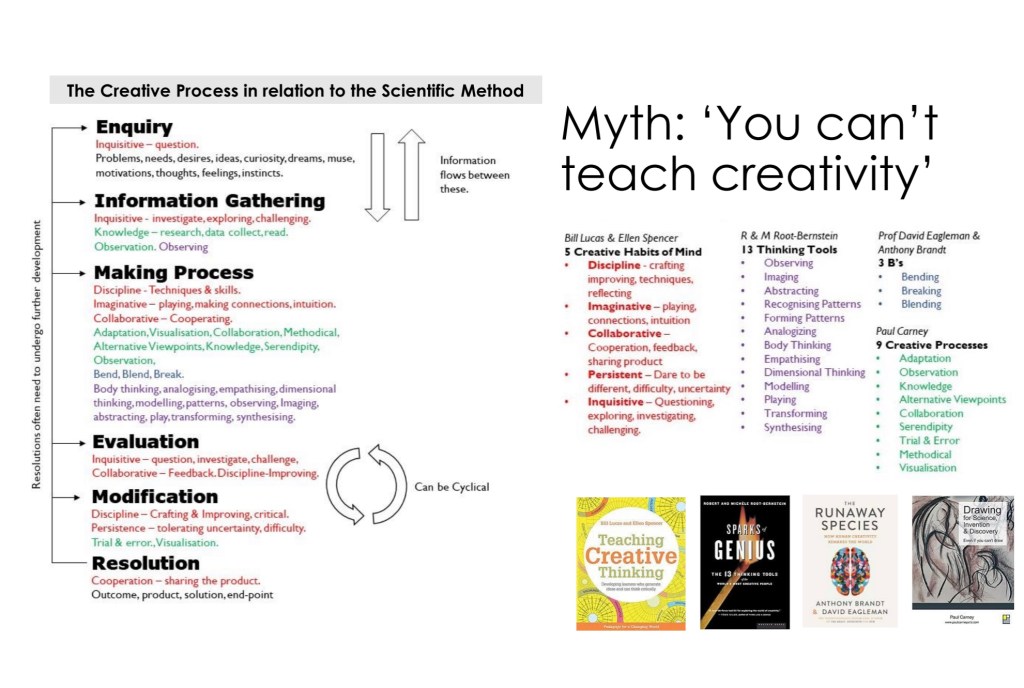
Some very knowledgeable people say ‘you can’t teach creativity’. You can. As a creative teacher, I teach people how to be creative all the time.
I can teach you the historical processes by which inventions and discoveries came into being, so that you might use them yourself one day. I can teach you how to use different types of play such as conceptual blending, mimesis or reduce and rebuild. I can teach you about the different types of imagination and give you exercises to develop them. I can teach you how to create things using a systems approach if you’re more analytical, or critical thinking skills to solve problems. I can show you how to be more divergent, then become convergent when the time is right. By learning about different creative approaches you can become more confident at using them yourself.
We are all creative. Creativity is an important part of all our lives. When we decorate our homes, when we redesign our garden, when we put together a new outfit for a wedding, when we design a new cycle route or workout, design a new spreadsheet at work, or even a new playlist for the car. We’re all consumers of creativity too; TV, film, music, books, fashion, furniture and commercial goods. Creativity is inherent in us. We are constantly seeking out creative forms; we are constantly being creative ourselves. Few of us will ever make or invent something profound or important, but we can enrich our lives further by learning how to be more original and purposeful when we create.
We use knowledge when we are creating, but knowledge alone doesn’t make us creative. If it did, then the most knowledgeable people would always be the most creative and this isn’t so. Creativity, as I’ve said on many occasions, is knowledge in action. It’s doing stuff with the things we know. It’s playing with knowledge, inventing things with it, building on it, prodding, testing and poking it to see ‘what happens if…’ This doesn’t come about from simply learning facts and information.
The idea that we can’t create something until we have a certain body of knowledge is mistaken. Very young children show us that and they keep reminding us of their creative capacity as they grow, constantly coming up with new and fascinating creations in Minecraft, drawing pictures or inventing things, writing stories, songs or making stuff. Children have the capacity to create things from the tiniest pieces of knowledge and this shows us that knowledge and creativity work in symbiosis with each other. Which comes first, humming a tune in my head, knowing the scales or playing it on a piano? The answer is that one is not more important than the other, or prior to it, they are entwined with each other and interdependent. We teach something, we creatively apply it. In short cycles, again and again, learning and playing, playing and learning. They aren’t exclusive or hierarchical.
Creativity is inventing, it’s innovating, it’s making the right choices, making original choices, solving problems, it’s dreaming and imagining, playing and being absurd. If we don’t teach this, if we eliminate it from education then we diminish our capacity to create, and when we do that we become less human, because everything in our world has been created. If you believe we can’t teach creativity then I think that’s very sad indeed.
Paul


 Paul Carney’s Blog
It would be great to hear your thoughts about this