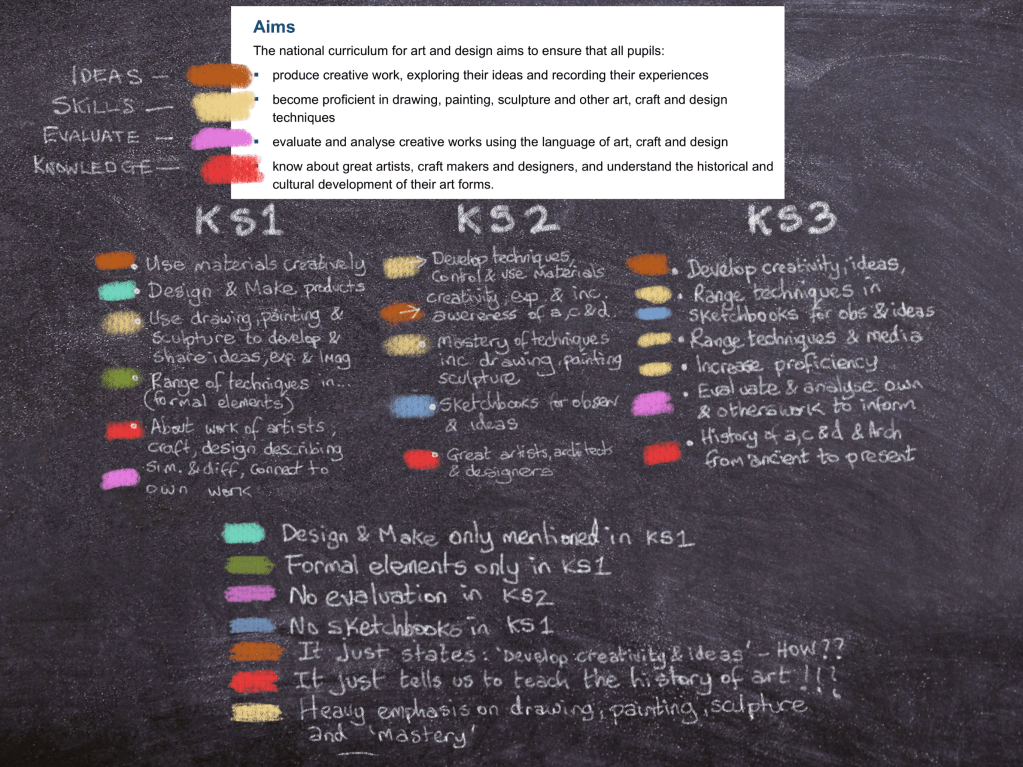
Schools all over England are being judged by Ofsted on their ability to sequence learning and progression in the subject, despite the fact that the national curriculum for art and design in England isn’t properly sequenced and it’s progression of knowledge is shambolic.
As a subject expert, I find this to be an appalling pressure to place on schools, especially when you consider that most primary schools in England do not have specialist teachers of art. In fact, it is very common for schools at this level to employ art subject coordinators who are either very inexperienced or are not teachers at all, but HLTA’s.
I’ve been doing and teaching art and design for forty years and I find it extremely difficult to sequence the subject. Even experts cannot completely agree on how to do it.
Teachers would need the support of a very robust national curriculum to help guide them, when in fact what they have to rely on is not fit for purpose.
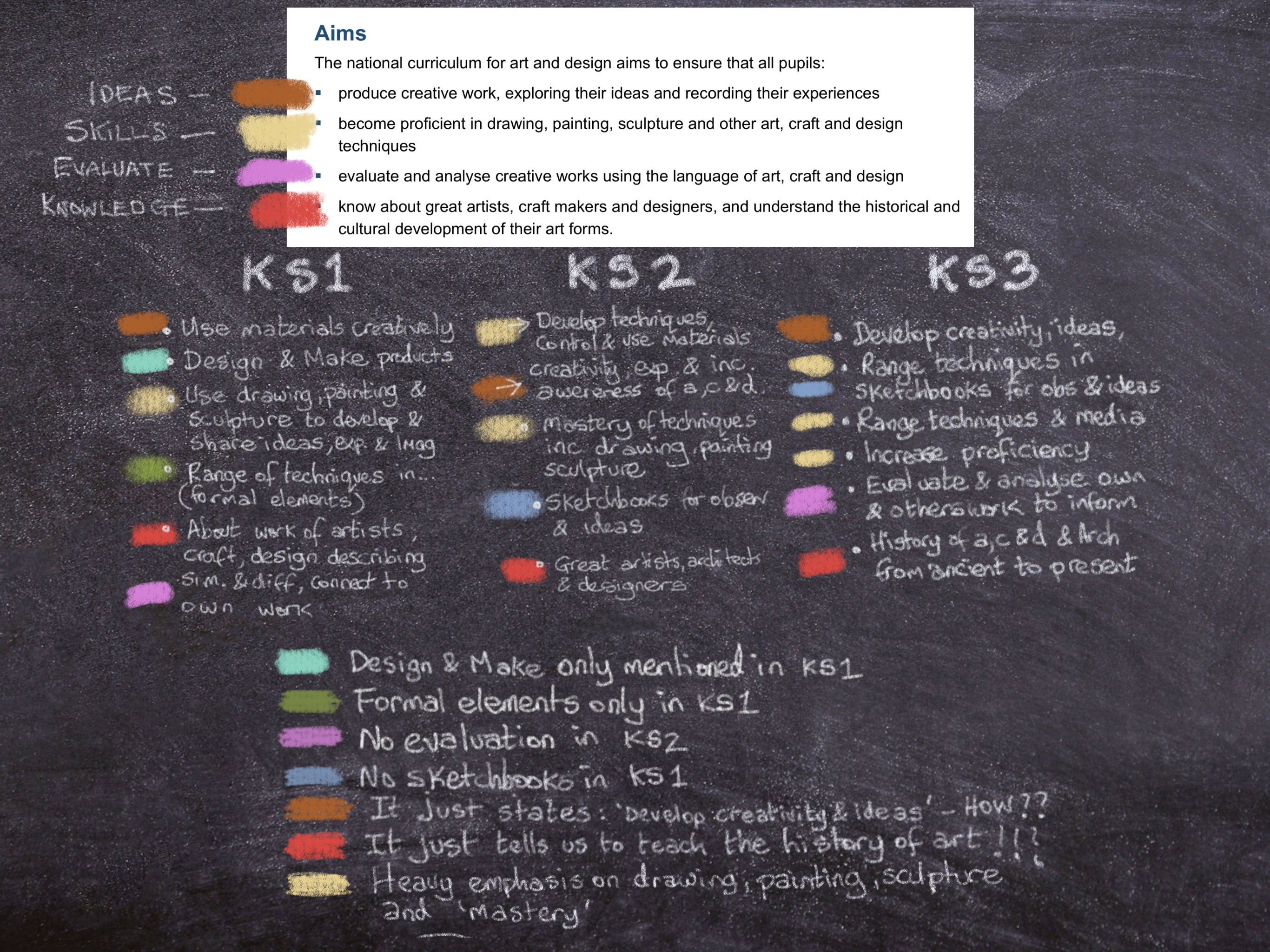
As you can see from my diagram, skills (in yellow) and factual knowledge (in red) feature heavily, although there is limited attempt to state what these are. Art and design comprises of a wide range of skills, drawing, painting, ceramics, textiles, printmaking, the huge field of design, architecture, digital art, photography, collage and another huge area, 3D making. Yet, all that is stated to be taught is drawing, painting, sculpture and ‘other media’. I don’t know many schools that teach much sculpture which alludes to carving and shaping materials such as wood, stone, metal or plaster. There is no support for schools to define what skills should be taught in each year group as there is in core subjects.
Similarly with knowledge, this is an enormous specialist field covering all of human history and no support is given to non-specialist teachers on what artists, craftspeople, designers and architects they should teach in any year. The aims descriptors state that pupils should learn to discuss art using the language of art and design, yet nowhere does it state what that is. Are teachers supposed to guess?
It gets worse.
Design and make, is only ever mentioned in key stage 1, then barely mentioned again. Design is a hugely important area of the subject since we are called art AND design, not art OR design.
Formal elements, the bedrock of art and design from inception to professional artists are only mentioned in key stage 1 then never again.
Sketchbooks are not required in key stage 1. Why?
Evaluation, another critical area of our subject, is mandatory in key stage 1 and 3 but isn’t featured in key stage 2.
This is before I even get to ideas, imagination and creativity which are just stated as things pupils must develop, but no indication at all as to what this means in practice. Imagine if the curriculum just stated: ‘teach algebra’ without any further support!
Despite all of this completely shoddy sequencing and progression produced by the Department for Education, they fully expect schools to be able to do it, and Ofsted will judge your school on it. It really is unbelievable.


 Paul Carney’s Blog
It would be great to hear your thoughts about this