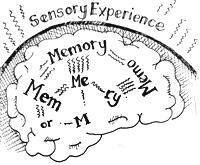
Memory is an emotional, sensory and experiential process. Spaced retrieval is one way we can remember better, but there are other techniques have been shown to be just as, if not more, effective.
The first way we remember anything is via sensory memory: a few hundred millisecond snapshot or flash memory of sensory data. We extract relevant information from this to move to short term memory and it gives us a quick initial impression of a new scenario.
Short term memory lasts for about 20 seconds and clumps 6 or 7 small pieces of information together to create more complex thoughts in working memory. STM is verbal (aural) and Visuospatial. Most research has been done on Verbal STM though the brain stores STM information in two separate places and both are equally important. Yet in schools we seem to place more emphasis on Verbal STM.
I don’t see as much emphasis being placed on our visuospatial memory yet evidence shows we remember pictures better than words.
Long term memory has two types: declarative and implicit. Declarative memory is again divided into areas that work in tandem: semantic and episodic. Semantic, facts have come to dominate education. However, long term memory is not only semantic but episodic too.
Episodic memory is most often represented in the brain by visual images, narratives, perspectives of self and temporal events though emotions are central to episodic memory too.
The amygdala, the emotional centre of the brain is adjacent to the hippocampus used for memory consolidation. We are less likely to remember neutral facts than those presented in a calm, soothing emotional manner or in a highly excitable state (the latter is not usually conducive to the maths classroom, but may be relevant to drama, English, history or PE).
Emotions help prioritise, consolidate and focus what is being remembered. We store LTM’s by meaning, so we naturally remember stimulating information more than neutral information. This means that how pupils feel about the learning environment is important, yet the emotional aspect of learning has often been derided in recent years in the UK.
Retrieval of LTM is done through the thin outer layer of the brain where all memories are stored – the cerebral cortex. The cerebral cortex has 12 highly efficient information centres nicknamed the ‘Rich List’ because they are so important.
These information centres aren’t like organised filing cabinets but rather like jumbled connectives of personalised meaningful associations based on our own experiences and brain structure. Retrieval therefore, has unique aspects to it, what works for one person may not work for others.
Reinstatement A process known as Reinstatement is key to memory. Reinstatement is where we link disparate sensory information together, so that we don’t just remember facts, but also where we were when we learned them, or how we felt or we link smells, touch and sounds for example. This sensory aspect of memory could be extremely useful for classroom learning. People remember things better if they are in the same location as when they learned them, or if they smell the same scent as when the memory was formed.
Episodic memory is also heavily involved in our imagination. We rearrange and repurpose episodic memories into new scenarios to help us with foresight and planning. Imagination is a vital skill and I’m not sure we are prioritising it enough.
Stories and metaphors We also cannot underestimate the effectiveness of story telling on memory, the power of visualization or the importance of metaphor to memory, all of which have been extensively researched but aren’t used enough.
Dopamine Implicit memory, or procedural memory works by automatically making associations between memories and heavily influences our behaviours. Dopamine production is central to this function which is essential for movement, learning and motivation. Research has shown that Dopamine is a powerful factor in learning. In fact, people are better at learning information that they are curious about. How much does drilling knowledge from the front help stimulate dopamine production and motivate curiosity?
Gestures Neuroscience has found that gestures are not merely important as tools of expression but as guides of cognition and perception. Do we use them effectively enough?
Drawing, as a method to help retain new information, is more effective than re-writing notes, visualization exercises or passively looking at images yet again, its potential is diminished through lack of use. There is hard evidence to show how effective drawing is in memory but prominent educationalists dismiss it as not being relevant. https://www.edutopia.org/article/science-drawing-and-memory
Visual Associations and Mind Palaces These are well established techniques to remember large amounts of information. The technique involves visualising unusual associations with the item to be remembered then fixing these in an imaginary place or space in your mind. I’m just not sure how much teachers use these techniques.
Dual Coding and information diagrams are techniques that have found favour in schools and brilliant educationalists such as Oliver Caviglioli have developed some excellent ways to improve these strategies in schools. What is important to note here though is that our brains can hold many more pictures than they can words, which makes the teaching of visual language really important. Pictures don’t just speak a thousand words, they hold a thousand memories too. https://www.pnas.org/content/95/5/2703
Forgetting Our brains, are also designed to prioritise some information in order to avoid overload, so forgetting things is vitally important. We shouldn’t be making students afraid of forgetting but rather understand how and why we do and how to adapt to it. We need to forget things and we will by default forget almost everything we don’t use, which makes selecting the information you want to place into long term memory important. Cognitive Overload can occur from too much drilling and testing of irrelevant information.
Low stakes testing and repetition can greatly increase memory retention but they are one way of many to improve memory.
Learning should be a rich experiential tapestry instead it is becoming a homogenised blanket of high factual skill that dampens creativity.
Memory is like a huge web linked to our senses, thoughts and feelings.
Semantic memory and episodic memory aren’t working separately. They cooperate together and support each other to aid recollection. Imagination, emotions and sensory information work together in different ways to create who we are.
Memory is an emotional, sensory and experiential process.
Memory
Evidence
How the Brain works – New Scientist
Drawing as a method to help retain new information
https://www.sciencedaily.com/releases/2018/12/181206114724.htm
We remember pictures better than words
https://www.pnas.org/content/95/5/2703
Gestures as guides of cognition and perception https://www.quantamagazine.org/how-the-brain-links-gestures-perception-and-meaning-20190325/
States of curiosity
https://www.cell.com/neuron/fulltext/S0896-6273(14)00804-6
On memory and metaphor https://link.springer.com/article/10.3758/BF03198454

 Paul Carney’s Blog
You must be logged in to post a comment.