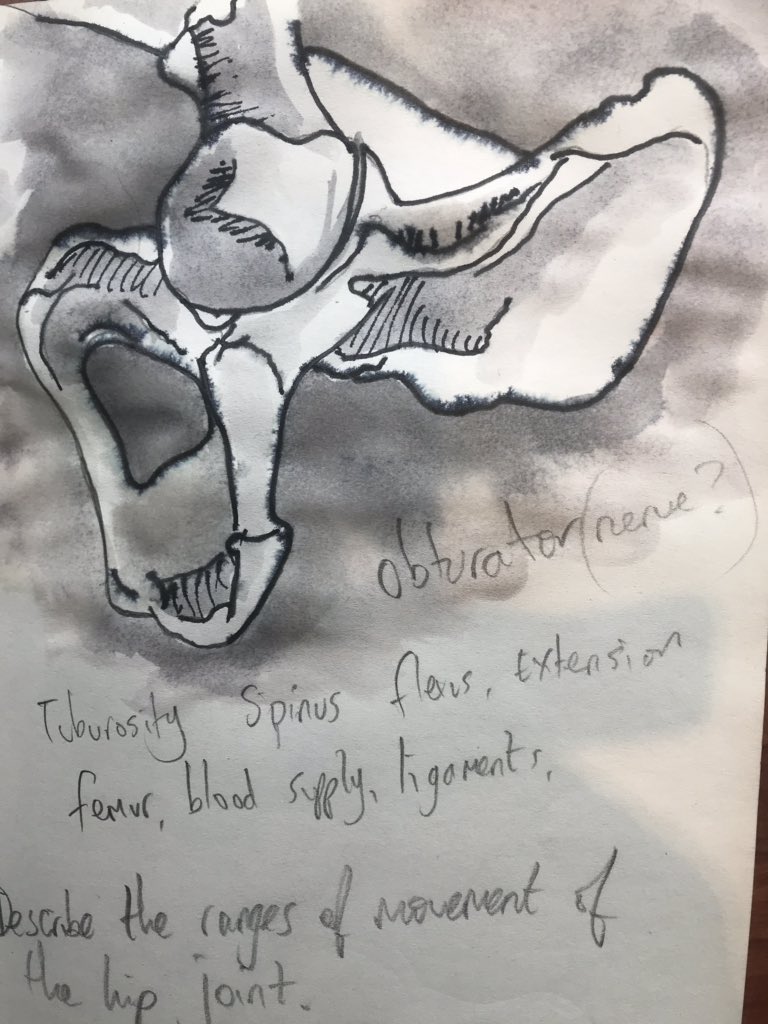
I observed a second-year medical students’ practical anatomy session at the school of medical education, Newcastle University in May 2019 under the tutelage of Doctor Joanna Matthan.
It was a great honour to be given an insight into this important area of study and I was impressed by the faculty team’s professionalism and respect to the sensitive nature of work they do. The session focus was hip and leg anatomy and four stations were set up in the room that students rotated through, spending twenty minutes in each station working with anatomy experts on different aspects. One workstation was primarily 3D digital anatomical models, another was investigation, enquiry based and two others focussed on teaching anatomy through inspection of body parts from patients who had donated their bodies to medical science.
I had no predetermined agenda for my visit; I was merely invited to observe the session with no expectations of an outcome or focus. However, I decided to take my drawing equipment with me and I was pleased I did.
What struck me immediately was the high level of knowledge of anatomy, the language and terminology and the rigour of expectation from teacher to student. It was clear that there was a high threshold to be attained by students. This was evidenced not only in the identification of anatomical parts, but also the understanding of their purpose and function. As you would expect, some students were more vocal and assertive at answering lecturer questions, others less so, which only really tells you who is more confident at speaking in groups, rather than who knows the most. However, there appeared to be some who knew more than others as you would expect.
Long Term Memory then is a key component of anatomy. Students need to be able to retain and retrieve huge amounts of technical information as well as developing an understanding of function. And since LTM is largely visual semantic, anything that helps us improve our ability to visually encode aural, written information will aid memory improvement. This was evident in the workshop areas, which were rich in visual information from pictures, photographs, digital presentations, models, casts and body parts.
Informal drawing was also evident as an ongoing, instinctive learning tool. Instinctive, fluid, gestural drawing is used to visualise thoughts, explain anatomical processes, movements and purposes. In my short visit; senior lecturers used drawing and visualisers to record lessons to fellow lecturers, teachers used drawing to expand on and articulate their explanations to students, students used drawing on whiteboards to reinforce and strengthen their understanding of what was taught.
Drawing is an existing, embedded and essential tool for communication, thinking and learning in anatomy, despite it not being formally taught, probably because anatomists are constantly trying to visualise what cannot be easily seen. There appears to be no requirement for the teaching of artistic skill beyond basic shape construction and diagrammatical rendering. There is no need for aesthetics in the kind of drawing anatomists employ, as soon as the drawing has conveyed the required meaning it becomes redundant and in this way the drawings are temporary.
So is there any need or point in improving drawing skills in medical students or increasing their awareness of its function?
Clearly, medical students appear to be successful in doing what they do. They assimilate complex course material and qualify as medical professionals, perhaps continuing to use drawing via diagrammatical, informal means in their professional practice. High degrees of drawing ability might be utilised by some, talented medical professionals that will invariably draw praise and attention, but I’m interested less in skillful aesthetical drawing and more in drawing for purpose, in drawing as a communication tool and drawing to aid memory and improve learning.
If drawing can do this then it makes sense to understand how best to employ it and maximise its efficacy.
In their 2018 paper ‘the surprisingly powerful influence of drawing on memory’ Fernandes, Wammes and Meade state that drawing to be learned information enhances memory and is a reliable, replicable means of boosting performance. Gains are greater than mnemonic techniques, semantic elaboration, writing, visualisation and tracing. They believe that drawing improves memory by promoting the integration of elaborative, pictorial and motor codes facilitating creation of a content-rich representation. In short, drawing can help us break down complex information, reduce cognitive load and help us better understand information, so aiding memory.
Students will probably draw diagrams already in their studies, they will ‘read’ pictures, models and photographs, but they will almost certainly be a haphazard, uneven distribution of drawing skills. Some will feel confident and fluent at drawing to illustrate, others less so. This is probably because they critically judge their own drawings against ‘artistic’ aesthetic criteria that they learned in school. But Fernandes, Wammes and Meades’ research found that the quality of outcome of the drawings had no impact on the efficacy of the retention and recall of information. So it doesn’t matter how good or bad the drawing is, only that it is helping the students to encode information.
Fernandes, Wammes and Meades’ research looked at singular words or definitions but I see no reason why this cannot be expanded into more complex text. The makers of medical textbooks will employ artists to draw diagrams to illustrate text. This is a valuable encoding exercise but it is not the illustrator who needs the lesson, it is the students. Asking the students to make their own drawings of medical processes will therefore be a very valid exercise. I’m sure this is done already in anatomy courses, but can it be done more effectively? How might teachers utilise drawing in their work to aid memory retention? Drawing has been shown to be the most effective memory encoding tool we have, it’s cheap, instant and simple enough to do. It seems illogical not to pursue this further.
The benefits of drawing for anatomy:
- Drawing is the most effective way to encode short-term, aural into long-term, visual semantic memory.
- Drawing forces us to deliberate and consider more effectively, that which we are studying.
- Drawing aids the transference of information, reducing cognitive load.
- Drawing helps us express complex four-dimensional processes and actions across space and time, in two-dimensional, more easily understood, forms.
Two big issues face us when considering improving drawing as a tool for learning in the medical sciences; artistic expertise and time.
From my own artistic experience I would say that what is required is not formal art training but rather illustration techniques, which are very different. Artists attempt to bring something new and expressive to what is known; illustrators try to depict what is known into more personal, yet easily understood formats. We aren’t trying to introduce artistic, creative expression into medical studies, rather enabling greater confidence to learn, understand and communicate knowledge through visual encoding. There is no need to produce pretty pictures, only to improve the transference of information. Prior misconceptions that drawing is a skill for the talented few need to be challenged and any expectations of high-quality outcomes overcome. Drawing needs to be seen as a tool for learning, distinct and separate from artistic expression.
If existing, informal drawing can be greater enhanced during the learning process alongside other memory aids it should improve students’ ability to retain and recall information.
References:
the surprisingly powerful influence of drawing on memory’ Fernandes, Wammes and Meade, 2018.
Philosophy of Biology; Drawing and the dynamic nature of systems, Gemma Anderson 2019.
The Idiot Brain, Professor of neurology Dean Burnett, Guardian Faber publishing 2016
WordPress Blog; Paul Carney www.paulcarneyarts.wordpress.com
Following pages; sketches by Paul Carney made from the visit. Please feel free to use and share with acknowledgment.
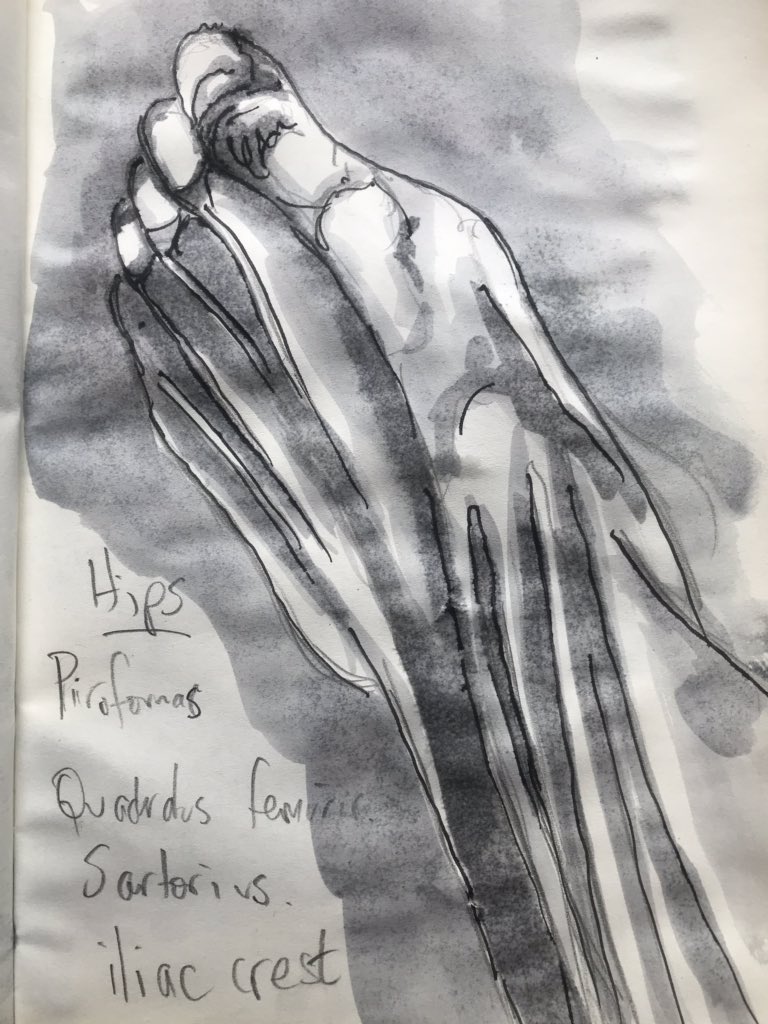
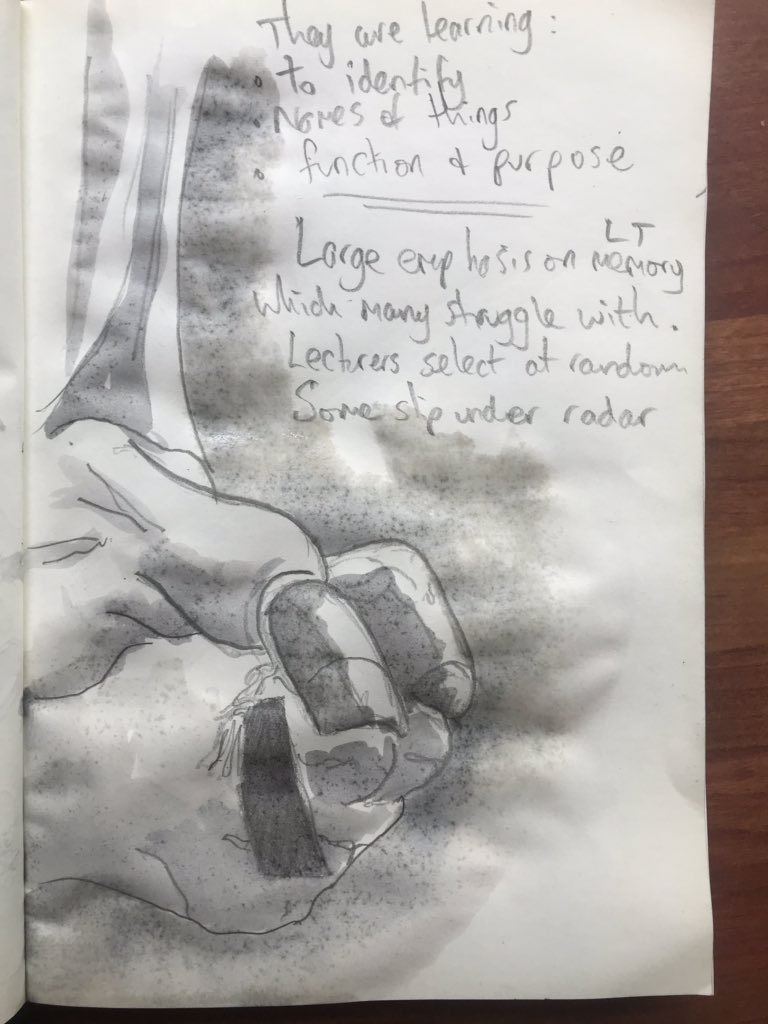
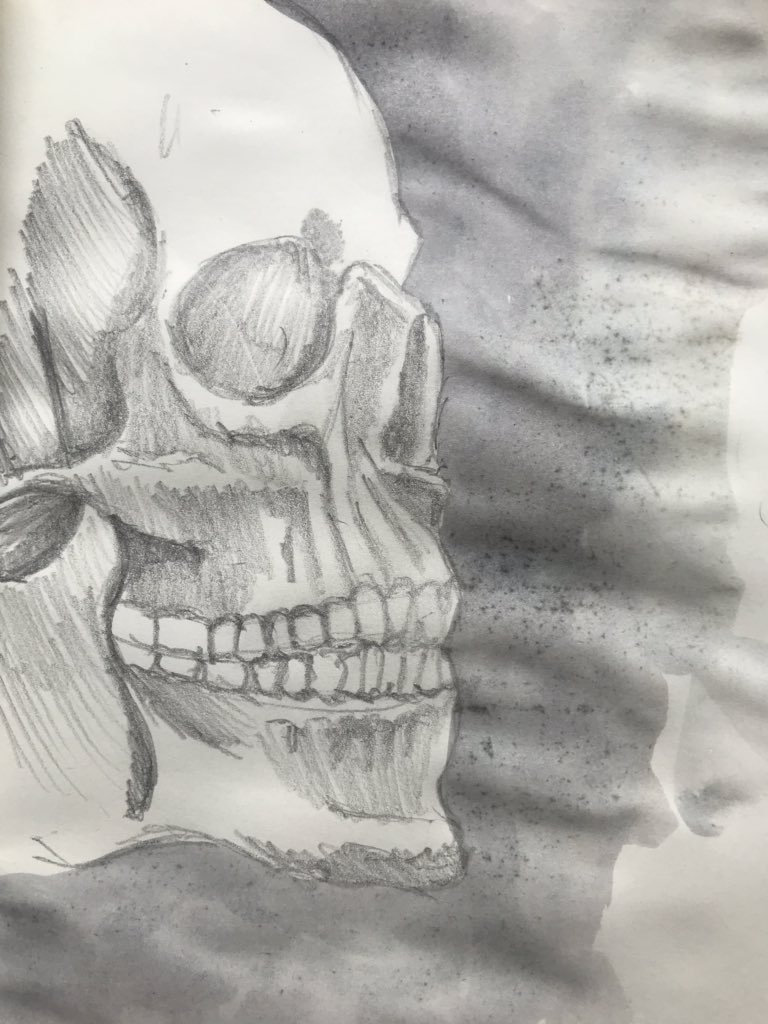
Paul Carney
Ammendum
I decided to try the effectiveness of using pictures to aid memory. I have no prior medical knowledge and as a 56 year old man who is not in full time education I’d say I struggle to remember and recall complex information and names.
I chose a text to remember at random from a medical dictionary. I decided to study the term for ten minutes, then recall it after intervals of one minute and one hour :
Ataxia is defined as an inability to maintain normal posture and smoothness of movement. Neurologic symptoms and signs such as seizures and movement disorders (eg, dystonia, chorea) may accompany ataxia. Consequently, many variations are encountered in the clinical phenotype, ranging from findings of pure cerebellar dysfunction to mixed patterns of involvement reflecting extrapyramidal pathways, brainstem, and cerebral cortical involvement.
I took notes about this term of which I was completely unfamiliar, then I broke it down into key words and phrases. I assigned small thumbnail drawings to some of the key terms as shown in the photo
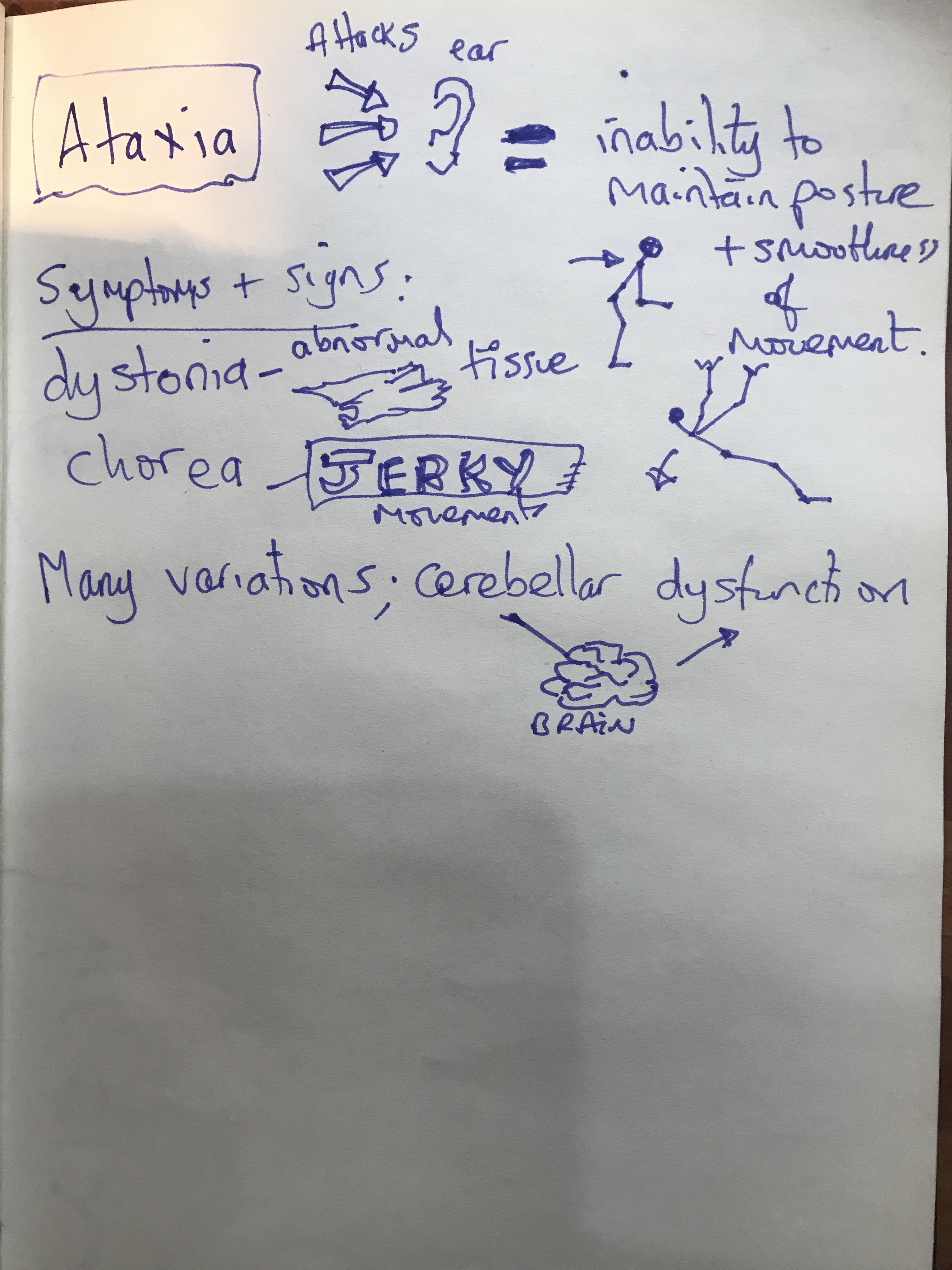
I closed the notes and after one minute I tried to recall what I had written. I was able to successfully remember most of the information but I did not recall the terms; dystonia and chorea though I remembered the symptoms.
I then spent 5 minutes re-drawing my notes and going back over them.
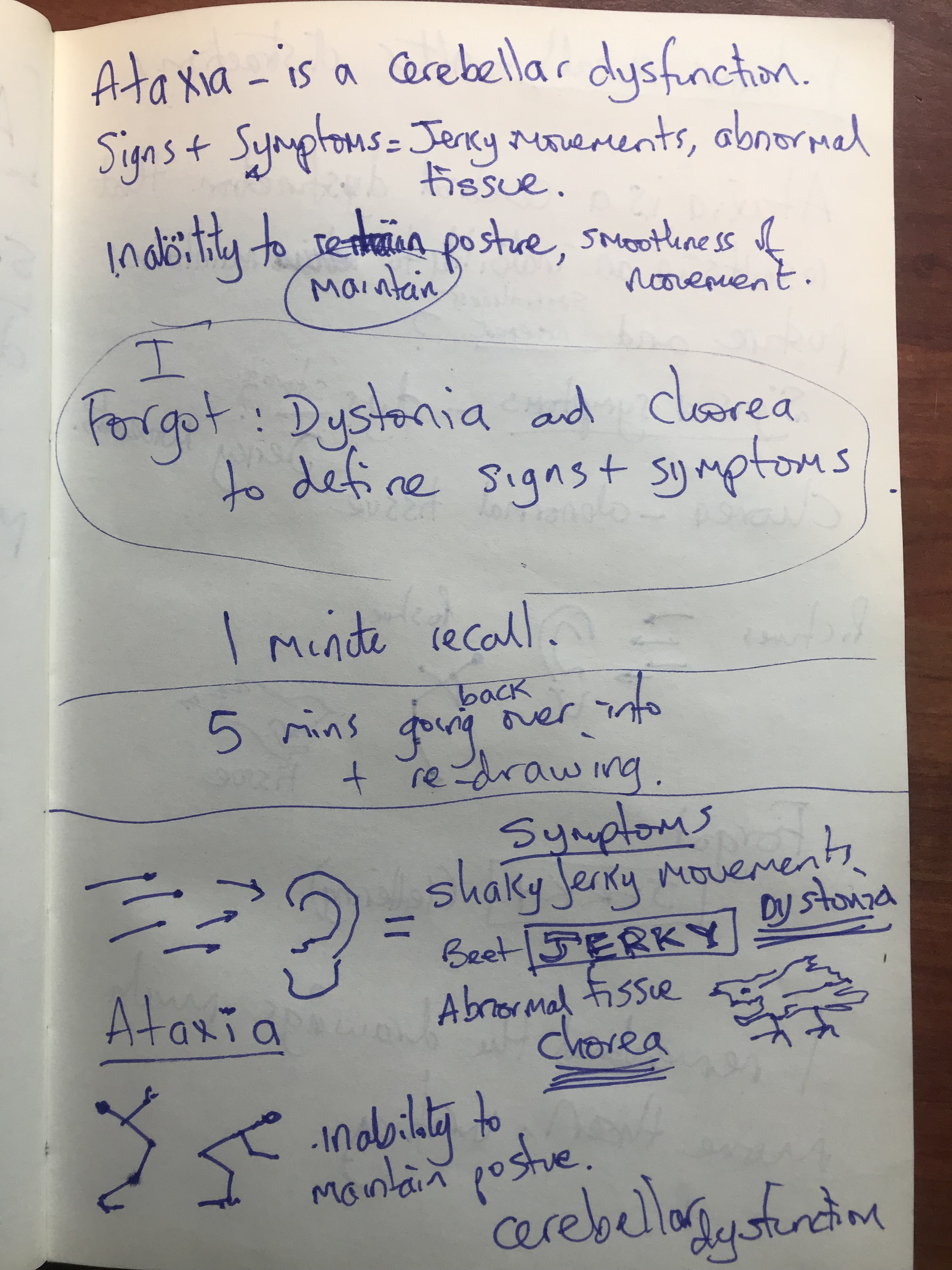
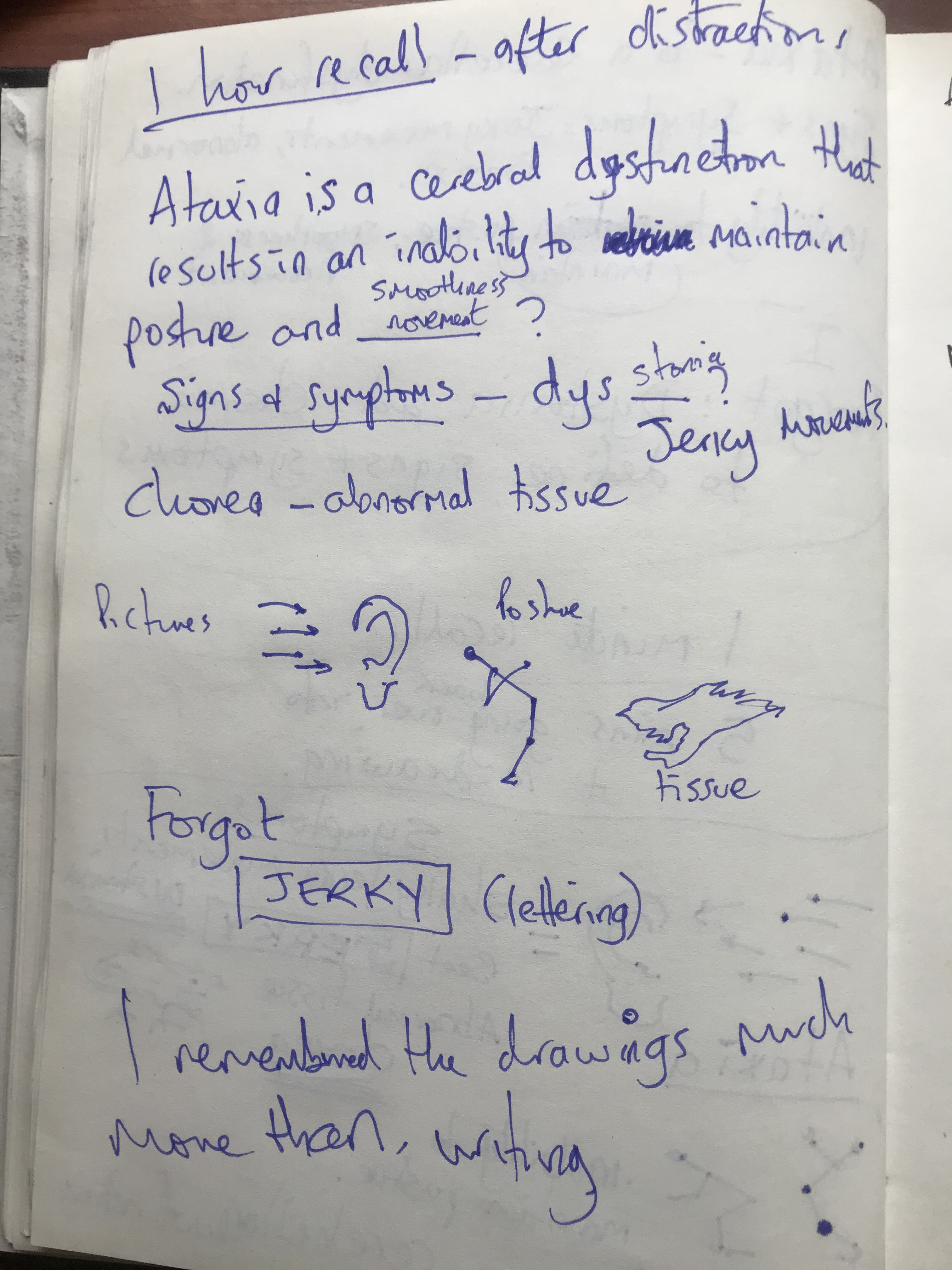
Finally, after one hour I tested myself again and found I could easily remember the main term Ataxia and define its symptoms, but I struggled to recall the two symptoms Dystonia and Chorea. what is interesting is that I remembered the information I had drawn pictures for much more easily than that that I had merely written, supporting the research claims.

 Paul Carney’s Blog
It would be great to hear your thoughts about this