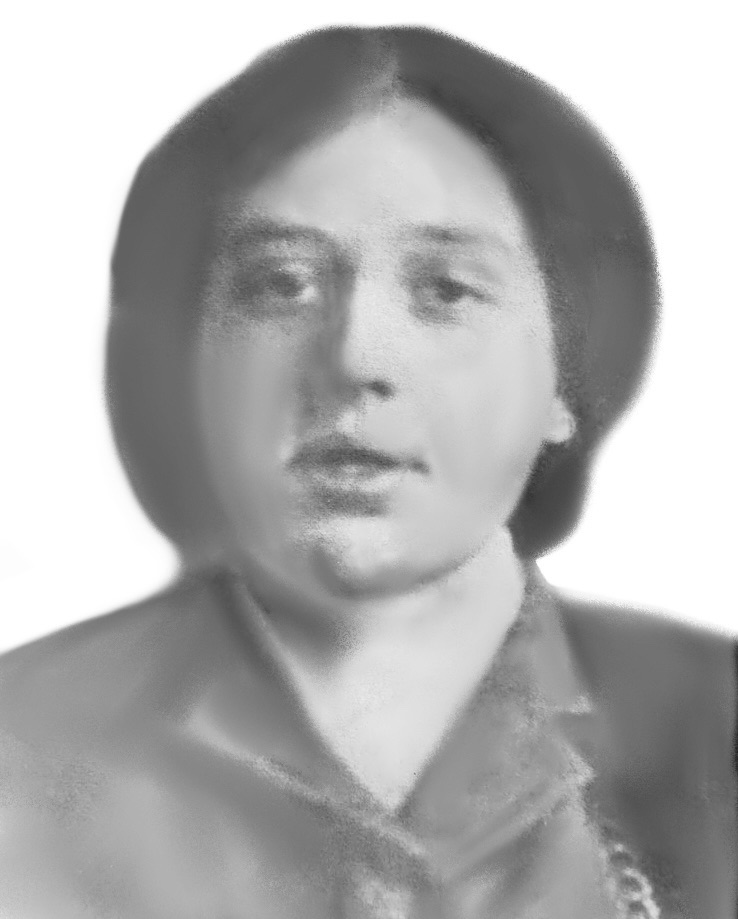
8th April 1882 – 29th April 1944


Mary Jane Cavanagh was born on 9th April 1882 in Stockton-on-Tees. In the 1891 census, the family were living at 20 Haffron Street, which was a poor, working-class area. Their Dad Robert was from Manchester and worked in the ironworks. Their Mam Louisa was from Wales. There were nine of them living in a two-up, two-down street house, with no hot water, no central heating, an outside toilet, and a tin bath. Life was hard.
In 1906, aged 24, Mary began ‘keeping company’ with a local man, Albert Skerrit, who was two years younger than she was. Albert had been totally smitten with Mary and plied her with expensive jewellery and money. For a poor working girl like Mary, it must have been exhilarating, and she must have felt excited at her future prospects with Albert, but it was all to come crashing down rather dramatically.
In 1906, Mary broke off her engagement to Albert Skerrit after 18 months of courtship, for ‘good reasons’. We don’t know what those reasons were, but they must have been serious for Mary to break off her engagement. Given that Albert was frequently seen to abuse and cruelly mistreat his future partner, we can make good guesses as to why.
Whatever the reason, it’s fair to say that Albert was distraught. He followed her about and threatened her to take him back or he’d kill them both. She refused, and it became so bad that she had to take Albert to court. It was probably a civil court, but nevertheless, they both had solicitors, so it must have been serious and costly.

It may seem like that is the end of the story, but alas, we know from date records of the birth of her daughter Lilian that Mary Jane Cavanagh was pregnant on 13th September when this hearing took place. She must have been about 2 months, so she probably did not even know she was pregnant, or at least only suspected she was. She almost certainly didn’t know it when she pressed charges or broke off the engagement to Albert. She may have looked at things differently if she’d known, but a reconciliation was unlikely after this court case.
Things were about to get a lot worse, however, because three months later, Albert took Mary to court to get jewellery and money back that he’d given her when they were engaged.

It’s clear that by now the animosity between them would have been severe. Mary was five months pregnant in this second court case, and it would have been obvious. For him to continue to pursue his claim against the mother of his child shows a complete lack of compassion, especially since he knew she was using it to buy medicine and food. In addition, she had paid him most of the money back anyway. The fact that he lost this second court case as well, makes it no surprise that he didn’t put his name on the birth certificate or support his child. At that time, an unmarried father could only be named if he consented.
Either way, Mary found herself pregnant with an illegitimate child to an aggressive, violent man who was openly hostile to her. On 19th April 1907, she gave birth to her only daughter, Lilian. Mary still lived with her mother and father on Haffron Street, but it’s fair to say that the baby Lilian was treated shamefully by the strict Catholic community she was part of. According to the church at that time, having a child outside wedlock was considered a sign of depravity, and the child was believed to be a ‘defective child’, tainted by that depravity. In the eyes of the church, baby Lilian was nulius filius: the ‘child of nobody’ and she had no rights. Her local church, St. Mary’s, was literally at the bottom of her street, so to be illegitimate in their congregation was rather shocking. As a result, Lilian was rarely allowed to play out and socialise with other children. She was lucky. Most mothers of illegitimate children had their babies taken away to be adopted or they were sent to the workhouse, which was only a hundred yards away from their house. Clearly, Lilian’s mother Mary Jane and her parents, closed ranks and protected her from religious and societal pressures.
In the 1911 census, when Mary was 29, she was still living at home on Haffron Street with Lilian, who was aged 4. Her parents were retired at this point, though Mary worked in a factory. According to family testimony, Mary’s strict, matronly sisters appear to have been rather judgemental on her poor daughter, Lilian. While they never completely cut her off, she was treated quite harshly by them and was still ostracised by her religious community. Mary, however, protected her only daughter. She spoiled her and gave her everything she could. Little Lilian was not short of adoration and devotion from her mother, but she lived her whole life under a cloud of guilt and shame.
We don’t know if Albert tried to make contact with the family regarding his daughter Lilian, but it seems unlikely. Albert married another woman around two years later, and they had a child together. That marriage broke down and Albert was repeatedly in court for cruelly mistreating his wife. While it seems that he did provide financially for his daughter Ann, we can be fairly sure that Lilian had little or no contact with her half-sister Ann Malcolm Skerrit, who eventually settled in Kent. We also know that Albert fought in the First World War in Egypt and France, and he fought at the Battle of the Somme, where he was shell-shocked and discharged on health grounds. Albert Skerrit may not have been a good father, or husband, but he was a decorated war hero nonetheless.
There were no heroics for Mary. As a single mother at a time when such a thing was a source of shame, she was unlikely to ever meet another suitor, and so it proved. In the 1921 census, Mary was still living at her mam’s house, but her dad had recently died, and there was just her, her mam, and her 14-year-old daughter Lilian. The shame surrounding Lilian is still evident however, since they lied on the 1921 census and said that both of Lilian’s parents were dead. There is some good news however, since Mary’s mam Lucilla runs a corner shop and becomes a pillar of the community, known affectionately as Big Gran, (Mary Jane becomes known as Little Gran). The shop eventually dwindled as Big Gran’s customers ran up credit debts they did not pay. She was too kind for her own good.
As a final twist in this tale, Mary’s daughter Lilian was caught up in a similar situation herself, for she too fell pregnant outside of wedlock. Luckily for her, her betrothed Frederick Davis was a loving, honourable man who quickly married her, and honour was restored on 19th August 1930.
In the 1939 census, Mary was 57 years old and living with another man, Robert Ward, on Airton Street, which is near to where she’d lived all her life. She may have finally found love, but we are unsure what the relationship was between them. Her daughter Lilian can be found living on the same Haffron Street, Stockton, where she grew up. She is married to Frederick Davis and has three children: Frederick, Dennis, and Lilian. Two doors down from them is one of the aunts who made her life difficult as a child, and also her cousins.
Mary never married and died aged 62 in 1944. Her daughter Lilian moved to a new house on Laurel Road, Primrose Hill and then again to a new council house on Hardwick in the early 60s. Lilian had a long, prosperous life with her husband Fred in a house with a front and rear garden, which Fred loved. And, just like her own family, hers never lived far from each other. Her daughter lived next door to her, and her son just down the road.
But, just as Mary adored her little Lilian, that love echoes back to her through time because we, her loving great-grandchildren, acknowledge the enormous courage and bravery of a young woman who refused to tolerate an abusive relationship and overcame the prejudice and social stigma of her community to raise her only child with the love and compassion she deserved. And we, her great-grandchildren, are lucky enough to share in that love.


Leave a Reply