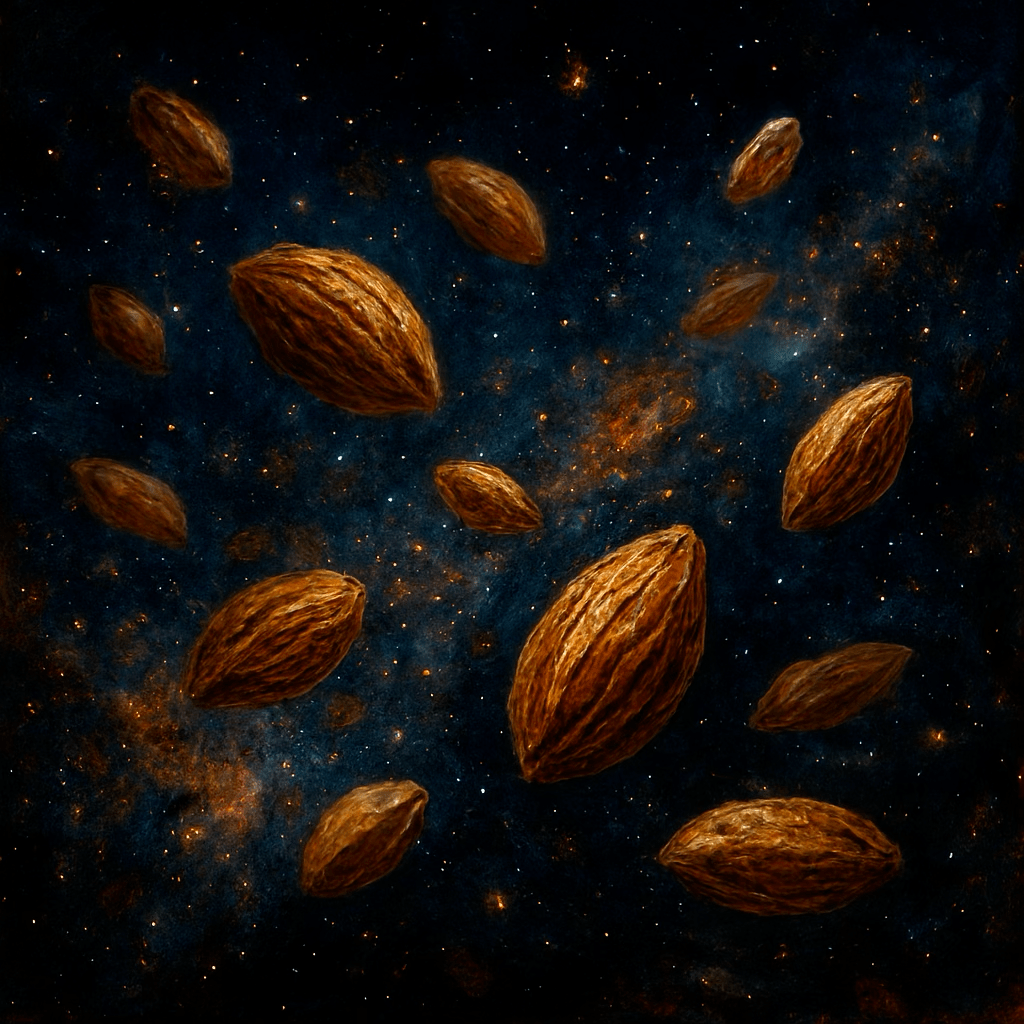
Scientists have confirmed that the universe is pulsing with the chemical ‘seeds’ of life. It seems as though the potential for life to evolve is ubiquitous throughout the cosmos. So, what does that say about our own existence?
A few years ago I converted a small patch of my garden over to a wild flower area. I wanted to give a little back to nature and to encourage wild plants, grasses and insects to thrive my garden. To say I’ve been rewarded is an understatement. The area hosts many native plants and insects, including wild carrot, ragwort and ferns, none of which were planted by me. They must have blown on the wind or been carried by birds. I find it exhilarating and inspiring that nature has found a way of filling my garden with its own particular brand of gratuitous joy.

For the longest time I’ve believed in pseudo-panspermia: the idea that the building blocks for life exist throughout the universe and are distributed by cosmic dust, meteoroids, asteroids, and comets. Now, I think it’s important here to stress that I’m not talking about alien visitors coming along and terraforming our planet, but an entirely organic process where the building blocks of life are distributed naturally, resulting in abiogenesis. Evidence for this has been growing and growing, most recently from the asteroid Ryugu which visited us in 2020. Samples taken from it confirms that all five canonical nucleobases – the molecular ‘letters’ that spell out genetic information in DNA and RNA – were present. Many scientists are now taking seriously the idea that the basic chemicals for life, like water, are being distributed throughout the universe by astral bodies.
That’s an incredible thought. It implies that, rather than us being alone, the whole universe is potentially alive. Of course, this doesn’t mean aliens are visiting us on a regular basis. The incredible distances between stars, and the limits of light speed travel, place constraints that any life forms would find extremely difficult to overcome. It’s also because, despite the building blocks of life being present, it still takes enormously favourable conditions for life to find its way.
Take Earth for example. Our sun is a fairly rare G type star. What makes it even more unusual is that it is extremely calm and stable compared to others stars of its type. And then there is our position within the Milky Way’s galactic habitable zone – a narrow ring around the centre of the galaxy that is just right for life and which minimises supernovae exposure and gravitational chaos. The metallicity of the Sun also provides the exact chemicals needed to create a rocky planet with a large iron core, which in turn generates a protective magnetic field. We also just happen to have a uniquely useful moon to stabilise our axial tilt, and four gas giant planets in our solar system act as a cosmic vacuum cleaner, sucking up harmful debris. We really did hit the winning lottery numbers four-in-a-row.
But, if the wild plants in my garden are anything to go by, life will find a way. Weeds for example, can only grow in the cracks between my patio paving stones. The concrete slabs place limits on where, and how large, they can grow, just as dark matter in the universe forces matter into galaxy filaments. That said, I’m sure that life will take hold in all manner of extreme and remote places, from the moons of Mars to the oceans of Uranus. If we are looking for complex life, it’s one thing for bacteria to colonise, but quite another for it to evolve into complex life forms capable of space travel. Then again, given there are trillions of stars in the universe, it is certain to happen in numerous places.
In my mind, this is further proof of intention and purpose to the universe. It’s incredible enough that we find ourselves living on an earthly paradise revolving around the sun, but even more staggering to think the whole universe may be full of life. The idea that this is a cosmic accident, a fluke of random chance that just happened to produce a vast cosmic breeding ground hospitable to life, is so ridiculous as to be absurd. Our big, beautiful Earth is evidence enough for me, but that the whole universe is alive with purpose and potential makes me even more certain that we are all children of divine intention. I’ve yet to be convinced otherwise.


 Paul Carney’s Blog
It would be great to hear your thoughts about this