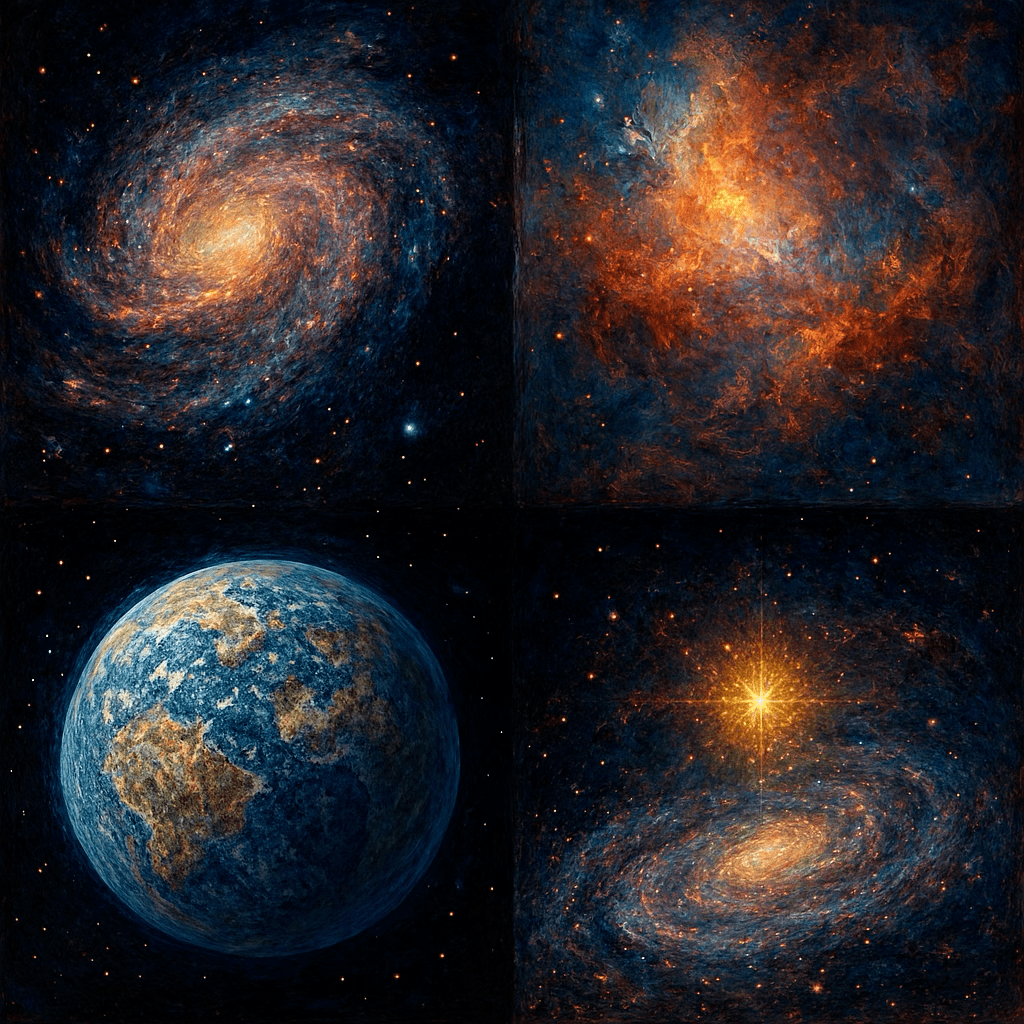
The universe is an incredible, awe-inspiring, and as far as we know, completely unique place. The circumstances that led to its creation were mind-bogglingly precise and extreme. For example, the early universe was created in a tiny fraction of a second from an extraordinarily rapid inflation. This miraculous event is so profound, so special, so wondrous, that some people (me included) have taken it to mean that the universe must have been designed and made. After all, why would all of this happen for no reason?
Most cosmologists, however, don’t think like that. They invoke the anthropic principle, which argues that fine-tuning observations about the universe are limited by the fact that we only live in a universe capable of developing observers in the first place. That is to say, we can’t claim that this universe is unique, special, or tailor-made for us because that viewpoint is biased. If multiple universes exist (and they do mathematically at least), then we just happen to live in a version of the universe where everything went right and became hospitable to life.
The anthropic argument goes that if we encounter a series of clocks with the exact time of our birth on them, it’s tempting to assume someone did it on purpose, but it may just be coincidence. Or as Stephen J. Gould said: ‘the claim that the universe is fine-tuned for life is like saying that sausages were made long and narrow so that they could fit into hotdog buns.’ That is funny, but it omits the fact that hot dog buns were indeed made to fit hot dogs. Perhaps creation then is just a matter of perspective.
This, to me, however, just pushes the conundrum one step further back to: who the hell made the multiverse?
Because the anthropic argument is saying: we just got lucky to live in this version of the universe. All the fine-tuning scenarios are just chance. The universe doesn’t need a designer because there are multiple universes, some of which failed, some which may be better. There is nothing special about us or our universe. We are just products of random chance.
Alternately, if you believe in God, you may believe: The events that led to the formation of the universe are so precise, so incredibly remote and unlikely, that it had to be orchestrated. For that we are eternally grateful and thankful. While we cannot know all the reasons and purposes behind its formation, or the true nature of its creator, we know from the nature of the world we live in, that it has value, it is positive and affirming. God is good, the universe is special, our world is significant, life is a gift.
This gives us two opposing arguments about the origins of the universe. Is it purposeful or incidental? The answer to that question is not to be found externally in the universe, it can only be found in you. You form and create the answer, it isn’t an external, verifiable premise you can authenticate.
Kant’s Copernican revolution stated that we do not simply discover the world. We actively shape the way it appears to us. The universe may indeed be out there in all its glory, but our interpretation of it is ours, and ours alone, to construct. Now, Kant used this logic to argue that God cannot be an object in the universe because He cannot be known to us. But, just because something lies outside of our grasp, it does not mean we cannot venerate it. The Tao is unknowable and so is the Brahman, yet they have been worshipped for thousands of years. God may not exist within the universe, but that does not mean He doesn’t exist.
For my part, I choose to believe in a Supreme Creator. You may choose to believe there is nothing at the root of all this stuff we call a universe. You might have no reason to believe in a Higher Power. It may suit your lifestyle to be so nihilistic. Or you may not know or care. The truth is, there is no single truth. Whatever you believe, one way or the other, it doesn’t matter because it doesn’t have an effect on the grand scheme of things one little bit. All we can affect is that which we can affect, and you, you have the power to affect your own version of reality. Literally, you write your own story.
So, which story is worth the most? Is believing in nothing as good as believing in something?
No. Not in my opinion, it isn’t.
Until you have believed in God, I mean really given yourself to God heart and soul, you cannot comprehend what it is and why it is so profound. You can dismiss faith, undermine it, and call it all manner of names, but you are rubbishing something you haven’t any understanding of. Faith is beautiful, amazing, and immeasurable. It literally brings meaning to your existence.
Love is like this. We give love our own meaning, we weave narratives into it, elevate it, objectify it, write sonnets and poems about it. Love becomes something huge, important, and meaningful in our lives, and yet it is in actual fact a mere chemical, hormonal attraction. Despite this, when you are in love, it consumes your heart and soul. It transcends mere biology.
You can choose to see the universe in this way. You can choose to believe that the whole universe is a freakish accident without purpose, or the latest in a long line of universes. Or, you can choose to believe it is deliberate. A gift from a Supreme Creator that has created the conditions in which love can thrive. This is what cosmologists are desperate to avoid. Under no circumstances do they want to acknowledge the belief that this wondrous creation is unique, divine, purposeful, and intentional. I think this is a real pity, because it does not mean you have to abandon one iota of science; you just have to see it all from a different perspective.


 Paul Carney’s Blog
It would be great to hear your thoughts about this