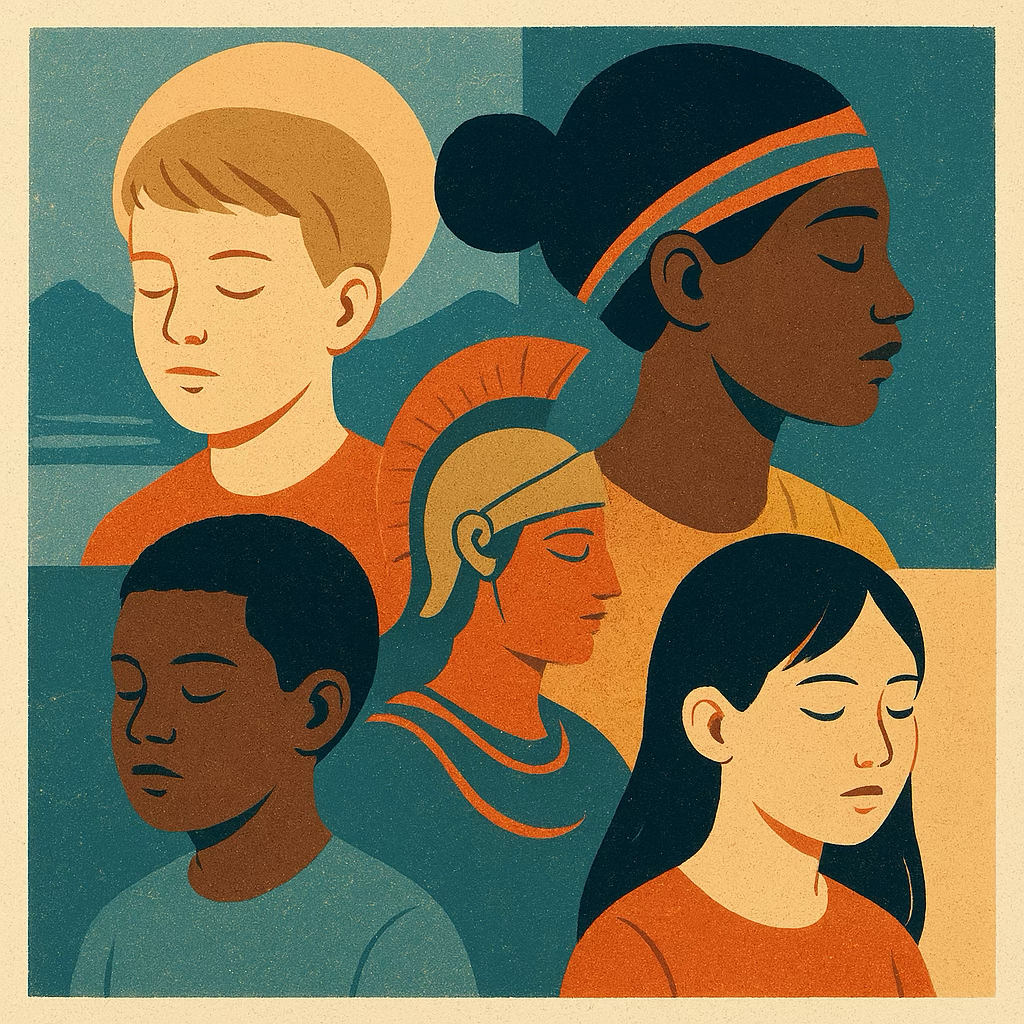

There are many compelling cases of children who recall past lives. They are able to provide such convincing accounts and details of events that are not easy to dismiss. One such case is that of James Leininger, a young American boy who had nightmares of being trapped in a burning plane that was crashing into the sea. Between the ages of two and five, he named aircraft types, a ship called Natoma, a pilot friend, and identified himself as ‘James’. Details of his memories were later linked to World War 2 aviator James Huston Jr. There are hundreds, if not thousands, of other such examples, in which typically young children are able to recall incredible details about past lives they surely could not have led.
Usually, these are dismissed as autosuggestion or the product of subliminal messaging. Flights of fancy, as they used to call an overactive imagination. In my experience of working with young children, they are simply not capable of constructing such elaborate myths and sustaining lies to so many people, for so long, so convincingly. Perhaps child psychologists may disagree with me.
Beyond recounting and checking details, it’s difficult to provide any hard evidence for these stories, but a piece of research by neuroscientists Peter Jonas and Victor Vargas-Barroso of the Institute of Science and Technology Austria (ISTA) holds some intriguing possibilities. Most of us think of our brains as being relatively empty upon birth; neurons and networks of memories growing and developing as we age and encounter new experiences. We certainly don’t think of them being the other way around— packed full of neurons that hone and alter themselves as we grow, but that is exactly what the researchers found. In their work, they discovered that brains (in mice at least) do not start out as empty slates, waiting to be filled up as they make their way through life, but rather they are born full, and they pare down circuits upon experience as they age. The researchers specifically looked at region CA3 in the hippocampus, which has a specific role in memory.
Now, it’s important to stress that the researchers were not stating that brains are full of tangible memories on birth; they are saying that the neurons that create and store memories are densely packed when we leave the womb. Nevertheless, it seems as though the mechanisms to enable complex memory storage are present in newborn babies, which is itself quite incredible.
If, as some scientific hypotheses hold, consciousness arises from a dynamic electromagnetic field, it may just be possible for consciousness to exist outside the body. Some research on out-of-body experiences suggests it might. Perhaps it is possible then that memories might just transfer from person to person. This is pure speculation of course, but it may just explain the fascinating phenomenon of children who remember past lives. Maybe, just maybe, they were born with them.
Sources:
Popular Mechanics – the brain is not empty at birth
Neuroscience News Hippocampus brain development
Popular Mechanics – out-of-body experiences


Leave a Reply