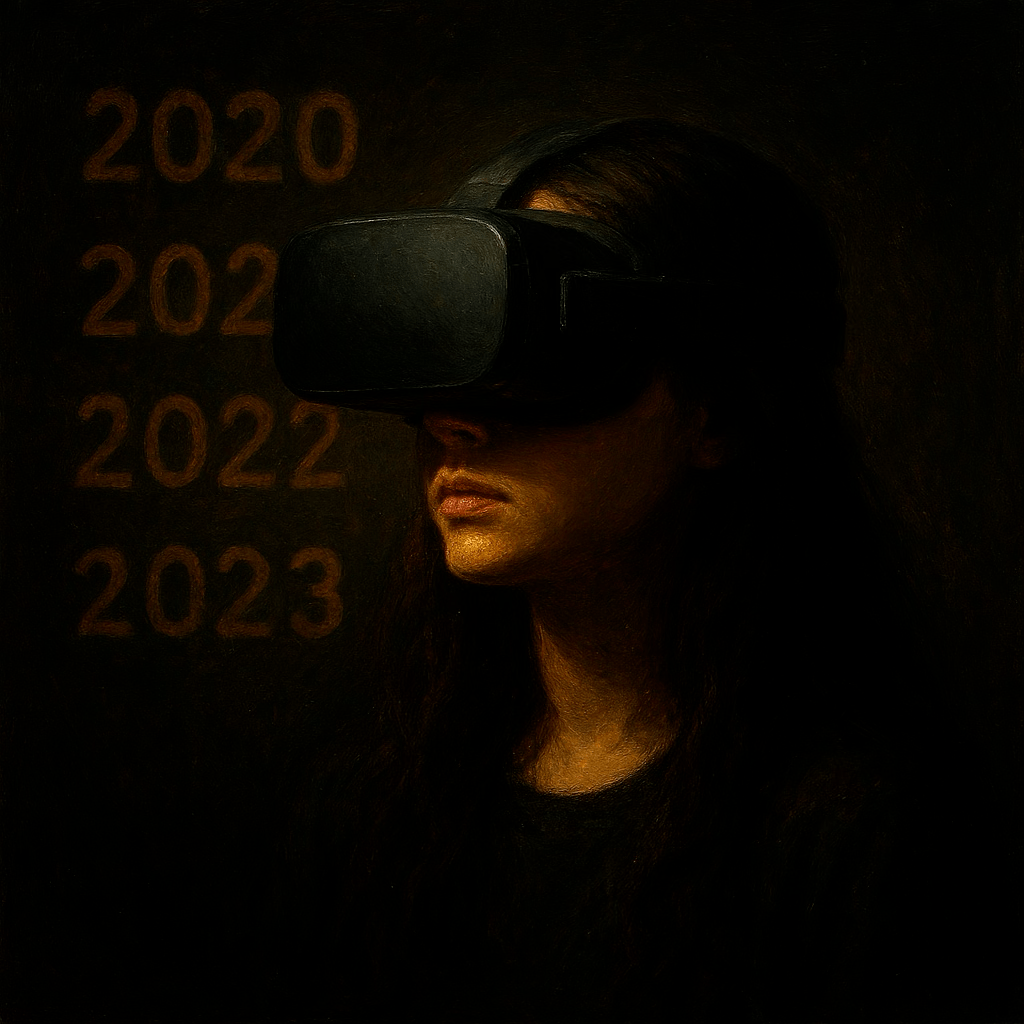
Priya paused before putting the sleek, black headset over her weary, hungover eyes. A sudden surge of reflux engulfed her mouth, no doubt a residue from last night’s ill-advised kebab. Her stomach was churning, and her head was pounding. She was deeply regretting that late-night tequila slammer contest with Pete and his friends, especially since it happened on a work night. As it was, she’d barely dragged herself out of bed, stumbled into the shower, and bussed it into work. She hadn’t even considered breakfast, let alone check her blood sugar levels.
‘I’ll be okay,’ the diabetic reasoned foolishly. ‘Always put off till tomorrow what you can’t be bothered to do today,’ she joked to herself. She was thirsty and unduly sweaty, but she didn’t pay the symptoms much heed. Her mind was too focused on the tumultuous events that led to that ill-advised drinking binge. Her long-standing boyfriend, Dan, had rejected her carefully prepared marriage proposal, leaving her heartbroken, dejected, and forlorn.
“I just think we’re coasting, Pri,” Dan had said, by way of explanation. “You’re happy to drift along, but I want something more. I’m still young. I want to live a little.”
“That’s totally unfair, Dan,” Priya sobbed. “Just because I’m happy with our relationship as it is, doesn’t mean I’m coasting. I want adventure too.”
‘You say that, but I know differently. I know you, Priya. You love routine, familiarity, and…”
“You’re saying I’m boring?”
“No, not exactly.”
“That means yes, doesn’t it? I’m sorry I’m not more adventurous for you, Dan, but my diabetes means I have to stick to routines. It keeps me alive.”
“Exactly! That’s what I’m saying. You’re lovely as you are, Pri, it’s just not enough for me anymore. I’m sorry.”
The words stung with all the venom that only the truth can inflict. Priya knew Dan was right. She was predictable. She was boring. She knew it deep down in her heart, and nothing she could do could change it. She broke down in tears just after Dan had left the bar, leaving her alone with her sorrows. The arrival of Pete and his tequila-drinking mates served as a fine distraction and the perfect opportunity to prove Dan wrong, even if he wasn’t there to witness it.
All of that was painfully churning around in her mind when the futuristic-looking headset was placed over her eyes by the attending technicians. She eased back into a prostrate position in the sumptuous reclining chair; a long black cable linking her, and fifty others, to the large, powerful machines behind them.
Priya was a ‘retina rider’: a scientist and historian who, using the phenomena of quantum entanglement between photoreceptor cells in the retina, could literally see through the eyes of people across time and space. The headset allowed her to piggyback the incoming light in people’s brains, while the subjects themselves were completely unaware their retinas were being accessed.
However, since what people saw only accounted for around thirty percent of this light, interpreting and analysing what was ‘seen’ was difficult and highly specialised. Hence, researchers like Priya had undergone years of training. While studying, she’d learned what people ‘see’ is largely constructed from feedback loops using memory and prior knowledge. However, since the retina riders only accessed incoming light into the retina, they did not have access to a person’s thoughts and feelings, or sounds and other sensations. This meant they had to be wary of making 21st-century assumptions about historical images and scenes. In addition, images were often hazy and blurred, making interpretation even harder.
That said, they had the incredible privilege of being able to see through other people’s eyes. It was something she never tired of. Another difficulty, however, was that they rarely latched onto key, important witnesses to historical events. Typically, they connected with ordinary bystanders who had limited perceptions. They may be able to travel back to a particular time and place, but finding a firsthand witness to that event was like looking for a needle in a haystack. It was a bit like looking for someone who’d actually been to one of the Sex Pistols’ first gigs.
On the plus side, the headsets enabled the wearer to roam through specific periods in history, hopping from witness to witness, while the host quantum computers scanned for other potential entanglement links. This usually gave them multiple perspectives from which to piece together evidence. And, in a direct challenge to determinism, no one had travelled into the future, and even then, the furthest anyone had gone back in time was seventy-three years. This was just after the end of the Second World War, which historians naturally found very frustrating. Still, the technology was still in its infancy, and developers were confident it was only a question of time before they were able to go back even further.
While Priya drifted off in the chair, experience had taught her to stifle her own conscious awareness and allow the machine to take over. The sudden rush of scenes and images on start-up had long since frightened her. She let the machine do its thing, allowing it to bounce intermittently from person to person within the specified time and location of this particular jump, to find a stable connection. Her speciality was South African politics, and she was especially looking for evidence of the Soweto Uprising in 1976. It was a gruesome mission, involving the deaths of many innocent people, including children.
Priya soon began seeing more stable images. Her own vision faded, and she saw the dusty streets of 70s Soweto, and on them, happy black faces, smiling, laughing, singing songs of solidarity and defiance. She couldn’t hear what they were saying, of course, but she had learned to lip-read as part of her studies and could make out enough words to follow what they were saying. They were protesting for the right to do their college studies in their own language. They didn’t want to have to learn in Afrikaans—the language of oppression and white rule. The day would end, of course, so cruelly for them. All their beautiful hopes would be viciously and violently stubbed out, not to be realised for another twenty years.
Priya had piggybacked onto the vision of a young mother clutching her little girl, and the woman’s eyes nervously darted back and forth: from police to protester, from daughter to danger. In her peripheral vision, she could just make out the armed police loading their tear gas and cocking their rifles, menacing and foreboding, deadly and destructive. In front of her was a large crucifix fixed to the wall of the nearby church— their intended destination. Tension began to rise in the 500-strong procession as the police closed in, some protestors defiantly singing on, others edging back, warily holding onto their children as the uniformed guards laughed and sneered at them from the sidelines. The police began pushing, punching, and kicking them. Protestors at the front became angry. The police pointed their weapons. Protestors charged. Tear gas was fired. Bullets soon followed. The crowd ran. Panic set in. Her daughter began crying as shots ripped through the air. Screams and cries punctured the peaceful atmosphere, and she ran in the only direction open to her. The church. She didn’t make it. Even though she was simply an onlooker, Priya thought she could feel the bullet rip through her own chest, so entangled in the woman’s consciousness was she. She saw the blood on the young woman’s hands, saw her daughter similarly struck, gasping for breath, struggling for life. Blood spilling from both their innocent bodies. The sheer horror, the shock, and trauma of what was happening, coupled with Priya’s own precarious physical state, sent her hurtling headlong into a diabetic coma. She lost consciousness. Her heart rate accelerated even further, and she was struggling to breathe.
The problem was that none of the army of technicians and scientists in the room noticed Priya’s predicament until some time later. While all of the riders had their vital signs constantly monitored, it wasn’t unusual for them to have elevated breathing and heart rates due to the sheer excitement of their experiences.
“Rider 21’s heart rate is spiking,” a technician said to her immediate supervisor eventually.
“Yeah, she’s in Soweto 1976, riding a pretty big wave event. I’m not surprised she’s finding it tough. Keep an eye on her. She’ll be fine.”
In the meantime, Priya was spinning dangerously out of control. Unfettered by conscious restraints, she began drifting through time and space, her comatosed state only accelerating her ability. From Soweto 1976, she jumped to London 1969. Crowds of people had stopped traffic on Savile Row to watch a rooftop concert by the Beatles. She was in the crowd, one of many who were excited by the music, but not able to see the band due to their elevated position. Seconds later, she was watching a black-and-white TV screen as Neil Armstrong walked on the surface of the moon. Then she was seeing through the eyes of a construction worker, building what she realised must have been the Berlin Wall. On and on she spun through time and space, where images and scenes flashed before her eyes like a high-speed slideshow on a perpetual loop. She was a soldier in what must have been the Korean War, then she was in Russia around the time of Stalin’s death. Next, she was standing at a roadside in London, waving a Union Jack flag for the Queen’s Coronation street procession. Very soon, she broke through the seventy-three-year barrier, to celebrate VE Day in Paris. She stormed the beaches on D-Day and witnessed the attack on Pearl Harbour. Other events followed, and then she went back even further, to the 1920s and then through the First World War and beyond.
It was around this time that the technicians realised something was wrong.
“Sir, you need to come and look at rider 21’s monitor. She’s spiralling. I think something is wrong. Her vital signs are highly elevated. Priya is a registered diabetic. I think she could be comatose.”
“Never mind that, she’s broken through the time barrier. Oh my word, she’s passed through into the 19th century! This is incredible.”
“Sir, I strongly advise you to pull her out. She could go into cardiac arrest.”
“What? Pull her out? God no. Leave her in there. I want to see how far she goes.”
“Sir, that’s contravening regulations. We must immediately…”
“Ok, ok. Ring emergency services, but leave her under until they get here. Can’t do any harm, can it?”
As they waited for medical support, Priya continued hurtling through time and space, latching onto incredible moments in history: she saw the Battle of Waterloo and the Napoleonic Wars, the French Revolution, then the American Revolution. She marvelled at the first steam engines and the Industrial Age. Then came the English Civil War and the Age of Enlightenment. She stood in the court while Galileo was tried for heresy and sailed on Columbus’s ship, the Pinta, as he discovered the Americas.
The onlooking technicians could hardly believe what they were seeing either. All other riders were pulled from their shift, and soon the whole room was avidly fixed on the monitor registering Priya’s incredible journey. The dates were just numbers counting down on a giant digital clock, the glowing places on the map just lights illuminating a screen, but the significance of what they represented was not lost on the historians. Priya wasn’t only witnessing history, she was making it.
The arrival of the emergency services served to break everyone out of their trance-like fixation. Priya was gently detached from her headset and her journey was over. She was then attached to other machines that would support her breathing and fuel her hydration. A tracheotomy was fitted, her heart rate dropped, and she was rushed under blue light conditions to the nearest hospital.
Sadly, Priya would never recover from her ordeal. Doctors switched off her life support machine several days later. There was an inquest naturally, and the University was found to be negligent, which only served to tighten up regulations and create a mountain of bureaucracy. Nothing could bring Priya back. The record books would preserve Priya’s legacy as the greatest time traveller in history. It was a feat that would never be repeated. At least up until now. What did not make it into the history books was the irony that Priya had lost the love of her life because she was deemed to be not adventurous enough, when she had in fact been on the greatest adventure a human mind had ever experienced.
But what of her lost love, Dan? Ah well, that would be me, your humble storyteller. For what it’s worth, I went backpacking in Australia but eventually settled down to a mundane life in suburbia. How ironic is that? I never did marry. I always said it was because I never found the right one, but in the reality of cold and dark twilight hours, when my old memories came back to haunt me, I knew I had let the love of my life slip through my fingers. No one ever came close to Priya. It was a hard and brutal fact that gnawed away at me my whole life. I thought on many occasions that if only I could travel back in time, to that bar room, many years ago, when my beautiful Priya girlishly and giddily proposed, I would have said yes in an instant. But I didn’t need a time machine to remember her beautiful, hopeful face. It was etched into every fibre of my being. Every thought. Every memory. All of them were tainted by my amazing, courageous adventurer who had loved me with all her heart and been cruelly lost to time.


 Paul Carney’s Blog
Leave a reply to Paul Carney Cancel reply