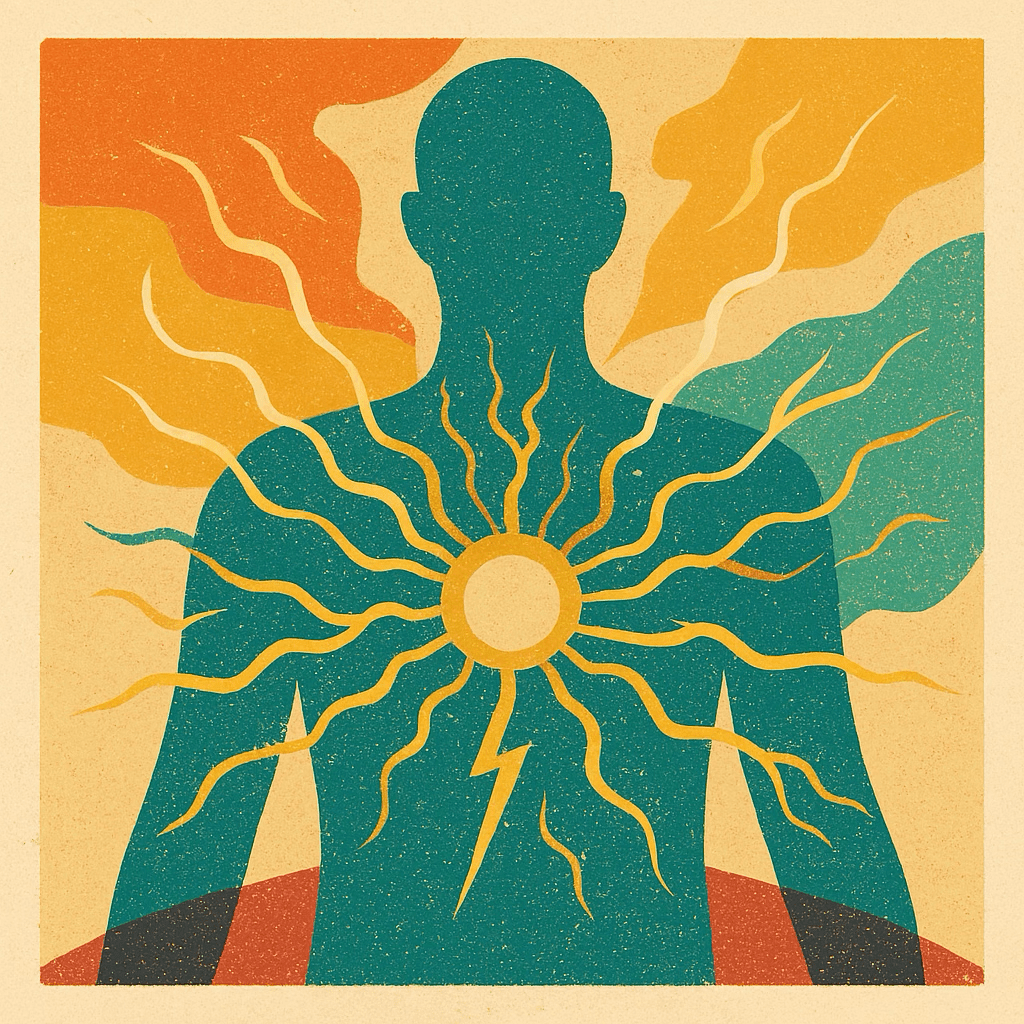
What is the mysterious spark of life that drives all of life on Earth?
Throughout recorded history, thinkers and natural philosophers have commented on the innate, energetic spark that is imbued within all living things. Eastern and Western civilisations have simultaneously described a will to live, an internal life force, a spirit, or soul, existing in all living creatures. But what is it, where is it in the body, and where does it come from?
A will to live and a will to die
Observing the will to live in the very young is awe-inspiring. I’m privileged enough to have seen both my children’s births and to be an integral part of theirs, and my granddaughter’s life. Watching children grow is as miraculous a thing as I’ve ever witnessed. It certainly injects life into these old bones, I can tell you. To also learn about the biology of egg fertilisation and the process of reproduction makes it even more miraculous. Life truly is amazing.
Sadly, I’ve had personal experiences of life at the other end of the spectrum too, through the death of parents, grandparents, and close friends. My friend and neighbour Joe, at the age of 85, decided he no longer wanted to live. Wracked with pain and disease, he gave up food and water and went to bed to die, but it took six torturous months to realise his pitiful ambitions. Months that none of those watching will ever forget. When that will to live leaves our minds, it seems to take a long time before the body follows suit.
Vitalism
Baruch Spinoza described our internal life force as conatus: the inclination of a thing to exist and enhance itself. Henri Bergson referred to it as élan vital – the vital force. Arthur Schopenhauer elaborated on it further, writing that it represented an irrational, blind, incessant impulse without knowledge, that drives instinctive behaviours. He called it the will to live, and the term caught on. This description of an internal life force was known as Vitalism – the idea that living organisms possess forces and properties which may not be physical or chemical.
After centuries of debate, evidence, and experiments, the argument was settled in 1828, when Friedrich Wöhler synthesised urea (an organic compound formed in the liver to excrete nitrogen) from inorganic chemicals. Here was the final nail in the coffin for the idea that living matter needed the spark of God to ignite it. Something lifeless was brought to ‘life’ by chemistry alone. Wöhler showed that everything we see inside living organisms is the result of scientific laws – physics, chemistry, and biology. The Vitalist claim that our innate life force was evidence of God’s work – that it was proof of a spirit, or a soul, or that there was some supernatural, sentient force at work inside us, was debunked. It seemed as though we are nothing more than biological machines.
Bioelectricity – The true spark of life
However, this is not to say that a spark of life does not exist. Bioelectricity most certainly does, and in us mammals, it takes the form of ion channels that flow through cells in our bodies. It has taken huge leaps of science to detect, so imperceptible is it. Nature is incredibly efficient, whereas humans have only been using electricity for a couple of hundred years. Biochemical signatures are incredibly faint, typically ranging from -40 to -90 millivolts as they pass through the body, whereas a domestic steam iron uses 2000 watts of power to work. No wonder they were so difficult to find!
Bioelectricity is the vital spark that has been described since ancient times. Ancient writers were correct in their observations, just not in their reasons why it occurs. Our internal energy is not the spark of God, a soul, or a supernatural force, but the transfer of chemical signals between cells. Schopenhauer’s will to live, therefore, is all around us and within us. It permeates through every terrain on Earth and probably throughout the universe too. But it isn’t the result of a soul or a supernatural spirit; it’s chemistry in action.
That seems like the end of our story. Mystery solved. Case closed. Or is it? Yes, this tells us that all living things have a bioelectrical signature, but it still doesn’t tell us why they have it or where it comes from. This is important because people put their faith in it and invest their whole lives in the answer. We need to dig deep, into the microscopic world to look for answers.
Brilliant bacteria
It isn’t only in complex organisms such as humans where this will to live is apparent. Single-celled bacteria possess similar determination. Despite not even having a nucleus or central nervous system, let alone a brain, these abundant organisms are the architects of life on Earth. They have evolved a huge array of cunning strategies, including producing toxins to kill competitors, hibernating until favourable conditions return, switching genes on and off, and shielding themselves from antibiotics. They do all of this by employing chemical receptors and signal pathways to move towards chemical attractants or away from harmful repellents using tiny, hair-like flagella. The source of energy for bacteria, the stuff that gives them their will to live, is the ubiquitous energy molecule ATP, created using respiratory enzymes in their cell walls. It’s astonishing to think of really, but human beings also break food down into ATP to create usable energy for cells, and this process of energy production is used universally throughout all cells in the living world.
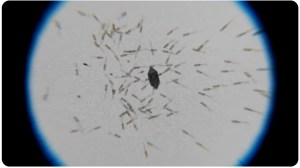
Even more incredibly, this isn’t the end of the bacteria will to live story. Other organisms known as bacteriophages exist that infect, replicate, or devour bacteria in a kind of microscopic arms race. And then there are viruses, which aren’t technically alive because they are not capable of independent replication. However, don’t tell them that, especially when they infect a host. This microscopic biological battle, this struggle to survive, is how we stay alive and how we die. It’s how we become infected with viruses and how the tiniest organisms can kill huge hulking giants such as ourselves and other large beasties. The will to live is rife, from the microscopic to the macroscopic.
Profound proteins
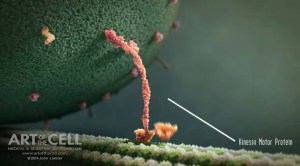
I find it hard to accept that all of this complex behaviour is simply the result of brainless chemical transfers, but that’s what the science is telling me. Take proteins, for example. About a million times smaller than a single-celled bacterium, they perform a myriad of functions in larger organisms, from growth and maintenance to digestion and metabolism. They are like the engine rooms of life. Watch a kinesin motor protein carrying a large molecule over a microtubule, and it is breathtaking. To be clear, there is no brain involved here, no higher agency, or conscious intent. They perform their tasks by pure instinct, based purely on their shape and structure it seems. And they evolve this shape and structure themselves, twisting, folding and contorting themselves into helixes, spirals and doughnut shapes, to name a few. But how do they know what to do? What agency motivates them to do what they do? Just saying ‘they evolved’ to do it, doesn’t cut the mustard.
Imagine that someone steals your beloved new car and crashes it into a wall. They go to court, you’ve got all the evidence, and they get convicted. The judge asks them why they did it. ‘Dunno. Just did,’ comes the reply. You’d quite rightly be hopping mad at that vacuous response to their mindless violence. This is what evolutionary science is telling us. It describes how things happen, when they happen, and where, but it cannot tell us why, because ‘why’ is not a testable hypothesis. That said, I’m not overly fond of saying – ‘God did it’ either, even though I believe in God. It’s a lazy answer that curtails any form of curiosity. What I want to ask God is: ‘Yeah, but why?’
Emergence
Maybe this is the answer to our mystery of why life is imbued with such an apparent will to live. Life just happened accidentally and complex behaviours automatically emerged out of the basic ingredients.
Perhaps this complex behaviour is simply a by-product of being alive. Maybe it just occurs automatically as soon as you push the on switch. Computer programmers who build artificial neural networks such as Hopkins Networks experience this phenomena. As soon as they are switched on they begin teaching themselves and self-learning. What’s amazing about AI’s is that they don’t just regurgitate what they have been told. They take it in, process it, and reach their own distinctive understanding — and no one knows why.
The problem with this, is that it still doesn’t explain why things, even non-living things, have such agency. It doesn’t tell us why particles organise into crystals, gases and other forms. It doesn’t explain why atoms organise themselves into every conceivable form of matter in the galaxy using nothing more than the laws of attraction and repulsion. What is causing this self-organisation? Why does everything in the universe possess such profound agency?
The quantum solution
Ladies and gentlemen, the solution I give you to our conundrum is – (drum roll please), the quantum field; the mysterious force that propels everything from molecules to the Milky Way’s.
I think heard a groan from the quantum physicists at the back of the room there. Yeah, I know, everyone is invoking quantum woo-woo to explain everything these days, but bear with me.
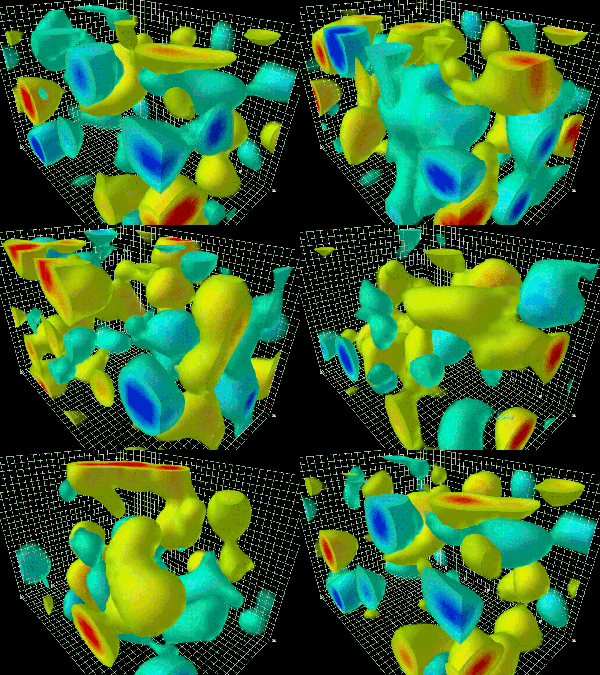
This fundamental force, the fabric of the universe itself, gives rise to all matter, all particles and all energy. Everything we know, all that we see, touch, hear and taste, all of it comes from this seething, foaming, bubbling cauldron of quantum excitations. The particles that form atoms are the result of the presence of energy states which both create and annihilate them. Some of these excitations must be huge, some must be incredibly stable, or else we wouldn’t have ancient matter in the form of rocks, and they all must obey strict rules, however strange those rules may be, or we wouldn’t have the tangible reality we experience day to day.
The quantum field has been with us since the dawn of time. It is the bringer of all things, and yet it is impersonal, more like a carrier or a host than a personified God. What we can say about it is that it is a force with positive, life-affirming qualities. It is a creative and productive force. From it, a universe of great value has manifested. Those who do not believe in Gods, will believe it an incidental, perhaps even accidental, force without rhyme or reason. For those of us who believe in such things, it is the provider of everything that is magnificent and beautiful about the world. It is the instigator of all life and the cause of all things, and yet we still do not know its motives. We cannot see, hear, or feel this force, but we can see the footprints it leaves behind in every cell in our body. It is in our DNA. It is in our bioelectrical spirit. It is our life force and our very will to live. For us believers, it is the handiwork of the Gods.
Sources
Putting ourselves back into the equation, George Musser
Are viruses alive? Microbiology Society 2016
Chemotaxis – bacteria moving towards a food source
A kinesin motor protein carrying a large molecule
Doc Brown physics info on electrical devices
Emergence – Wikipedia
Are We Electrical Beings? The Science of Bioelectricity
Vitalism – Wikipedia
The structure of our proteins informs how we function Harvard Medicine
How do atoms form? The conversation


 Paul Carney’s Blog
Leave a reply to The will to live – Site Title Cancel reply