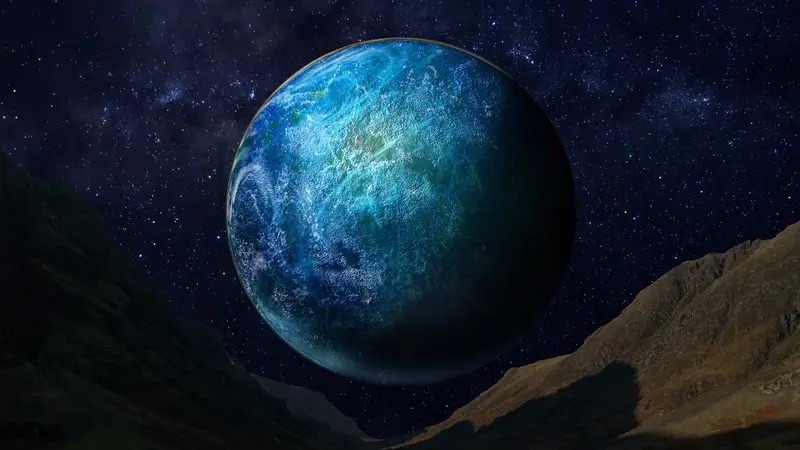
124 light years away, there is an ocean-filled world which is eight times bigger than Earth but only half as dense. Called planet K2-18, it orbits its host star every 33 days. It has optimal temperatures for life, and, even though it has a hydrogen-rich atmosphere, carbon has been detected there. In addition, scientists have detected a molecule called dimethyl sulfide, or DMS for short, which is the gas that gives beach areas their distinctive smell. The gas is produced by phytoplankton on Earth, and is estimated to be thousands of times stronger, over ten parts per million, on K2-18b.
There is a 0.3% probability that these gases occurred by chance. For it to be definitive proof of life, it would need to be 0.06%. That said, 97% certainty is pretty incredible, and one that makes you wonder.
Prof Madhusudhan, of Cambridge University’s Institute of Astronomy, said he was surprised by how much gas was detected.
“The amount we estimate of this gas in the atmosphere is thousands of times higher than what we have on Earth,” he said. So, if the association with life is real, then this planet will be teeming with life.”
Prof Madhusudhan went further: “If we confirm that there is life on K2-18b, it should basically confirm that life is very common in the galaxy.”
Featured Image. Credit CC BY-SA 3.0, via Wikimedia Commons
Source:


 Paul Carney’s Blog
Leave a reply to David Pearce Music Reviewer Cancel reply