A short story.
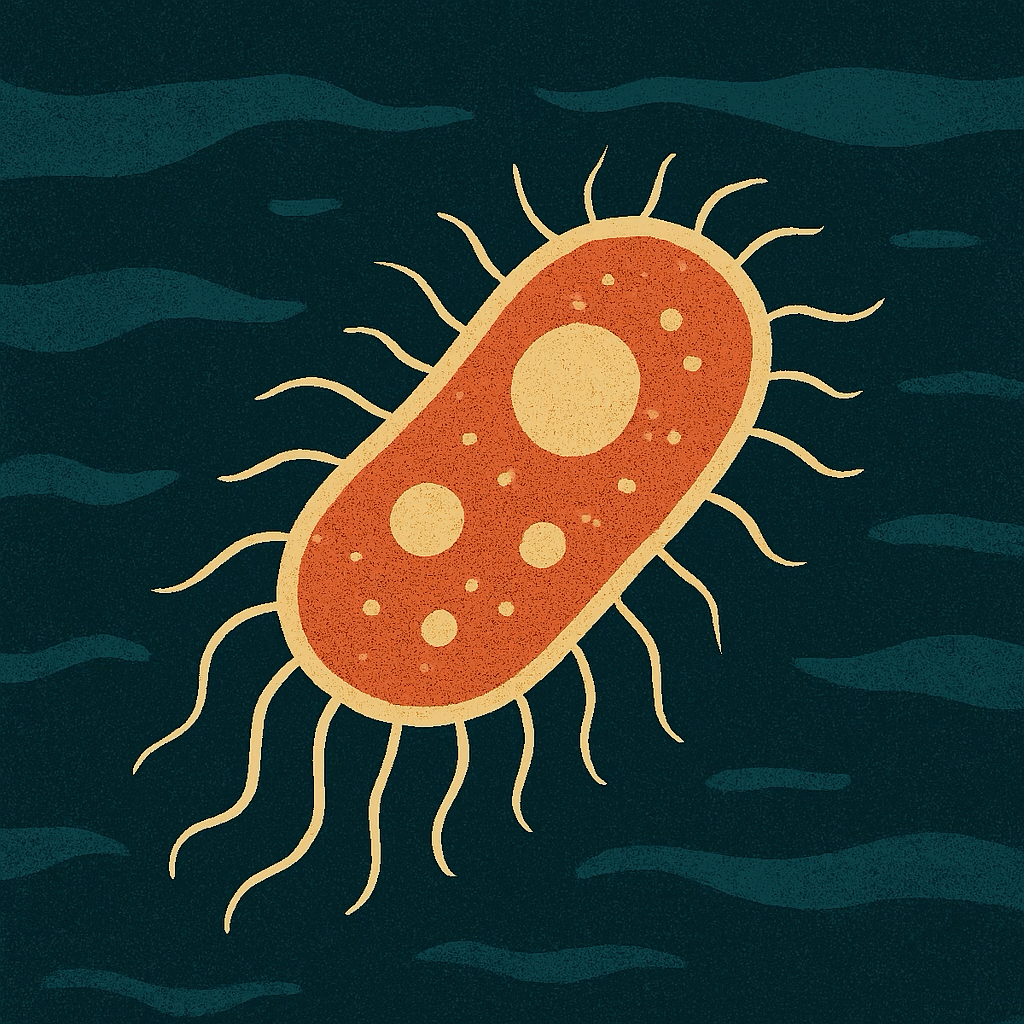
The blob floated mindlessly in the darkness. It had no eyes, or senses, save the ability to touch. To feel. It had no explicit conscious thoughts as such. But, driven by impulse, it knew what it wanted. It had that most primordial of all instincts. It wanted to live. And so, on and on it floated, without words, without thoughts, simply trying to stay alive.
Then, it encountered a hard surface. Harder than it was. Immovable. It was caught there for a while, stuck in a small crevice, but in this space it felt protected. Safe. While there, other blobs brushed against it and the blob could feel their presence. It was aware of their energy. It knew then, that it was not alone. A small fragment, a tiny morsel if you will, touched the outer surface of the blob. Instinctively, it knew what to do and it absorbed it through its cell walls. This action replenished and invigorated it.
Suddenly, something swept the blob out of the crevice and it was floating again, carried along by some invisible, yet irresistible force. Over time, it began encountering other things. Some larger than it, some smaller. Some entities it could consume, others were more dangerous, and tried to consume it. Life was dangerous, but living involved dealing with these precarious situations, adapting to change and sustaining its needs. With food came energy. With greater energy came greater potential. It was able to replicate itself into numerous divisions, and with each replication it grew larger, stronger and more complex.
Then, it felt the presence of another blob, similar, but not the same as itself. Excited by the encounter, it mingled with it, exchanging chemicals, matter and information. From this meeting, the blob had its first primitive conscious moment. It knew it had sewn the seeds of the next generation. Soon, the blob perished, but more blobs were born and so its legacy survived.
The new blobs were more aware than the previous iteration. They grew more complex, organising their cells into roles and functions. Some for respiration, some for temperature, some for digestion, some for defence, some for attack. Rather than floating mindlessly, the blobs now had greater purpose. They moved towards locations where they could remember food being in the past. They avoided places where predators would eat them, and they moved towards each other. They formed communities, they mingled, they exchanged information, and they procreated. Together they were stronger.
More generations of blobs came and went, and with each, they grew more and more sophisticated. They developed cells that could respond to light, and in time, eyes were formed. This enabled them to see themselves, to see each other, and to sense their environment. With this newfound awareness, their consciousness advanced, and with it, their intelligence.
The next generations of blobs developed a physical shape. They became tubes, not blobs. Food would enter at the front, waste products from the rear, so it could be pushed efficiently away. With this new shape came organic extrusions to help propel it forwards. Hard, bony systems supported its inner or exterior frame.
Everything they did was for the sole purpose of survival. Nothing else mattered. Often, finding food was difficult. There were times when it was plentiful, but usually it was a struggle. Life became a constant battle to navigate the environment and avoid predators. Eat or be eaten. It wasn’t just the blobs that were growing and evolving. Everything around them was too. To respond to this struggle, more and more sophisticated and elaborate mechanisms were developed. Armour-plated exteriors, spikes, teeth, claws, toxins and camouflage, to name a few. Survival became harder and harder.
Eons passed, and among all these struggles, these red in tooth and claw encounters, the memories of their early struggles and encounters faded. They lived in the moment in order to survive. Memories were prioritised for which ones would maintain their survival. Where food would be plentiful. Where good shelter was. Where temperatures were optimal. Where its community was. Gradually, the blobs (now tubes), grew stronger and more intelligent. They began to favour a new environment, one away from all the hustle and bustle of the water. On dry land. Besides, food was more plentiful on the shoreline.
Over time, they left the ocean and found a new home among the rocks and plateaus around the shores. They evolved from breathing the oxygen in water to breathing the oxygen of the air, and so their shape radically altered to adapt. Gradually, generation after generation, over millions of years, its fins became sturdier and stronger. Strong enough to hold them upright so they could move across the earth. Their other fins became sturdier too, and the bones within them became flexible enough to grip and grasp the branches of trees and rocks. With this newfound mobility, they traversed mountains, oceans and Great Plains to populate the planet.
They developed its means of communication from simple chemical exchanges, into grunts, whistles and calls, and then later into spoken words and phrases. Language became sophisticated and complex, and soon, methods of transcribing language into symbols evolved. From this, imagination was born. Now, the blobs could record their own history.
Only, they had no memory of their long journey out of the water, across the mountains, the ice floes and Great Plains to where they currently were. They couldn’t even remember living in the water, let alone being a humble blob.
Every organism needs to know where it originates from. It shapes its identity, preserves its heritage and helps it grow. And so to compensate, the blobs used their new ability to imagine and conceptualise. They weaved beliefs and superstitions into elaborate myths that served as metaphors for the symbolic truths they built their life around. These creation stories were meant to be part of a greater culture. They were supposed to be an integral aspect of being at one with the environment they lived in. Sadly, as time progressed, and they became more and more sophisticated, the true meanings of the stories were lost, and so each generation, and every culture, reinvented their origins, like long lost souls seeking answers to long lost questions.
Finally, through the miracle of genetic fingerprints, the blob was able to trace its entire journey, because every step had left footprints in every cell in its body. Incredibly, the saga unfolded and the whole story could be told at last. Sadly, so fantastical was their origin story, that few believed it. And the blob, the blob who had journeyed across the whole world, from the bottom of the ocean to the highest mountain, became nothing more than a forgotten footnote in the story of time.


 Paul Carney’s Blog
Leave a reply to Paul Carney Cancel reply