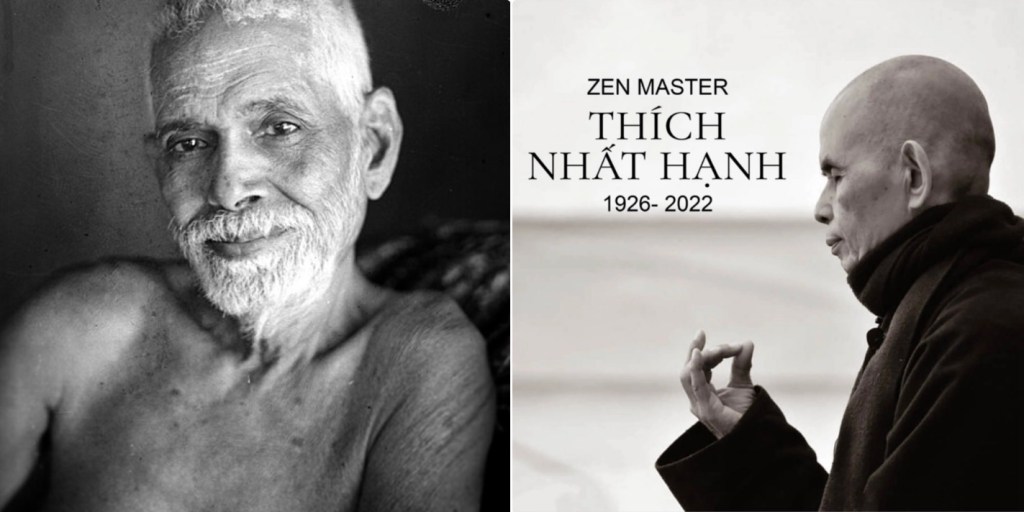
Two eastern mystics with profound insights into the nature of existence and how to lead happier lives are Sri Ramana Maharshi and Thich Nhat Hanh. Maharshi was a Hindu sage who lived around eighty years ago in India, while Hanh was a Zen Buddhist monk nominated for the Nobel Peace Prize. Here are summaries of their approaches to leading happier, more fulfilled lives.
Nhat Hanh Mindfulness
Breathing in, I know I am breathing in. Breathing out, I know I am breathing out.
Thich Nhat Hanh taught focussed, mindful breathing. Observing and noticing the breath, attaching pleasant thoughts to breathing, rejoicing in it. Not trying to control the breath, but just to observe it.
Similarly, with negative thoughts, embrace them as an inherent aspect of self. Just as gardeners recycle old plants, so we must transform our negative thought patterns into positive ones, by reframing them with compassion and love. We should accept these parts of ourself as though they were children in need of care.
Doing everything with care and deliberation, and being present in the moment for all things, brings liberation and energy to the self. Holding on to negative ideas makes us suffer. We need to let go of thoughts that remove our potential happiness.
Reflect on the question Who Am I?
Maharshi taught us to reflect deeply on the nature of self. He said:
Peel away all the outer layers of self to get to the core, inner self. This inner self is the pure you. It is pure awareness. The pure self has no worldly needs, or superfluous desires. It makes no demands on you or the world at large. The pure self is at peace, it is free of fears, anxieties and dark thoughts.
Thoughts are like the current of a river, sometimes flowing quickly, other times slow, sometimes deep, often shallow. No thoughts matter. None are important enough to hold onto. Visualise your pure self on the banks of the river, sitting calmly, watching your thoughts go by. Let them drift in and out of your mind without attention.
Meditate on a mantra, a sound, or God. This will help your mind become focussed. Meditating by controlling the breath will help, but this will only control your mind if your breath is calm.
You are not your senses that help you engage with everything you interact with in the world. You are not your organs or the body parts that help you function. You are not your breath or the beating of your heart.
Thoughts are the nature of the mind. Apart from thoughts there is no mind. Therefore, thoughts are the mind. The external world comes to us through thoughts. Thoughts are how we create the the world. Without thoughts there is no world. Therefore, controlling thoughts is the path to the pure self.
You are your pure self, you are pure awareness, devoid of thoughts, fears, anxieties, hopes and dreams. This inner self is calm, serene, and tranquil. It makes no demands and has no needs. The pure self is supreme, and in this state it finds true happiness, true contentment.
I make no judgement on either method. Each brings its own peace, each has its own truth. Both are great teachers, both were truly inspirational people whose lives humble me. I am working on my own inner peace through meditation and reflection. It is a journey I am on, to a destination I can never reach, but I focus on enjoying the journey itself.


 Paul Carney’s Blog
Leave a reply to Paul Carney Cancel reply