Do you trust your instincts?
Everybody talks about the good old days, the good old days, right? Well, let’s talk about the good old days. As bad as we think they are, These will become the good old days for our children. Gladys Knight and the Pips, the Way We Were
Do I trust my instincts? Well, my instincts tell me that society is getting worse, the world is heading for disaster, and that life was significantly better in the past than it is today. I was younger then, I was slimmer, healthier, happier, I took more risks, everything was new and exhilarating. By comparison to the present, life seemed so much more exciting back in the ‘good old days’. In many ways, I’ve come to believe my own narrative – the past really was better than the present. Today’s world is bad, awful, and depressing. People are cold and callous now, but when I was young, we weren’t like that. People had time for you. We looked out for one another, etc. etc.
A good way of testing this notion: that life was better in the past, is to study the historical records. We need to try to understand what history tells us about what was happening in our recent past. My era is the 60s, 70s, and 80s. This was when I was a child, a teenager, and a young man. When I’m reminiscing, these are the good old days my instincts believe are superior.
As a child, much of the horror of modern life was shielded from me. I wasn’t even aware of the Moors murderers Brady and Hindley, for example; it was only years later that I learned about the sickening crimes they perpetrated against young children. For me, the 60s consisted of going to the sweet shop, playing games, going to school, and watching our black-and-white TV. The darker side of life did not exist in my world, thank goodness.
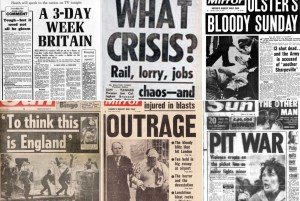
I remember the power cuts from the 70s and the national strikes, but not how and why they happened. I was too busy playing out, watching our new colour TV and eating food from our new fridge freezer. Domestically, quality of life was improving, even if politically, things were falling apart. And fall apart they did in 70s Britain. Here are two quotes from prominent people in that era:
“It is difficult to imagine a previous period when such an all-pervasive hopelessness was exhibited at all levels of British life” – Professor Stephen Haseler, 1975
“Our place in the world is shrinking: our economic comparisons grow worse, long-term political influence depends on economic strength – and that is running out. If I were a young man, I should emigrate.” Jim Callaghan, the British Prime Minister, in 1974.
It’s hardly reassuring is it? But, it gets worse. In 1971 the life expectancy for a man was 68. For a woman it was 72. Inflation was 30% at one point in the 1970s. Income tax was 41% for lower earners and 90% at one point for the highest earners. In the 1978 Winter of Discontent, the country ground to a halt because of strikes, and there was a nationally imposed three day working week in order to save electricity during an energy crisis. Binmen, nurses, car workers, coal miners, gravediggers, lorry drivers and train drivers were all on strike. TV channels were forced to stop broadcasting promptly at 10:30pm every night, people worked by candlelight and torchlight, and relied on blankets and duvets to keep warm. It makes me wonder how on earth we survived! Far from being a sweetie shop paradise, the 1970s look more and more like a complete breakdown in society.
It didn’t get much better in the 80s. Prime Minister Margaret Thatcher used every nefarious trick in the book to break the stranglehold the unions had over the country, but the miner’s strike was a bloody battle that lasted a full year. The north, where I’m from, was decimated by her victory, but the south prospered, and still does to this day. There was a war with the Falklands, for which I truly believed I would be called up at one point. Unemployment went through the roof, manufacturing declined, wages were cut, public spending was slashed, and there was a deep recession.
And yet, as much as most of us up north hated Thatcher and her Conservative government, things got better for people. Living standards went up, we became comparatively richer than our parents generation, and we even owned our own homes. To this day, I cannot agree with Thatchers economic policies that closed the shipyards, the steel industry, the mines and engineering. Nor can I ever agree with her decision to privatise our service industries, and the national rail networks, which are now so desperately lacking. But I can’t deny that the country needed her tough, no-nonsense hands at the helm. I shudder to think what state we would be in without her.
This is the paradox of getting older. We romanticise the past because we were children and we were therefore shielded from, and unaware of, most of the bad stuff. When we were young, we were more energetic, and everything was new to us. We were literally building our own worlds and discovering the existing ones. No wonder we look back on it with such fondness. As we age, our bodies are no longer what they were and we longer understand many of the idiosyncrasies of the younger generation. Things are changing too quickly for us to keep up. And yet, things are getting better. For most of us at least. Poverty in the UK got worse under the Conservative government from 2010, but has broadly remained level over the last twenty years. People are generally living longer, healthier, and more secure lives. It might seem as though the past was better, but I don’t think it was. In fact, I think the world is actually getting better, and the statistics prove it. It seems that, rather than being in the past, the good old days are actually in the here and now. It seems like we are being dragged kicking and screaming into a better world.


 Paul Carney’s Blog
Leave a reply to Paul Carney Cancel reply