What was the last thing you searched for online? Why were you looking for it?
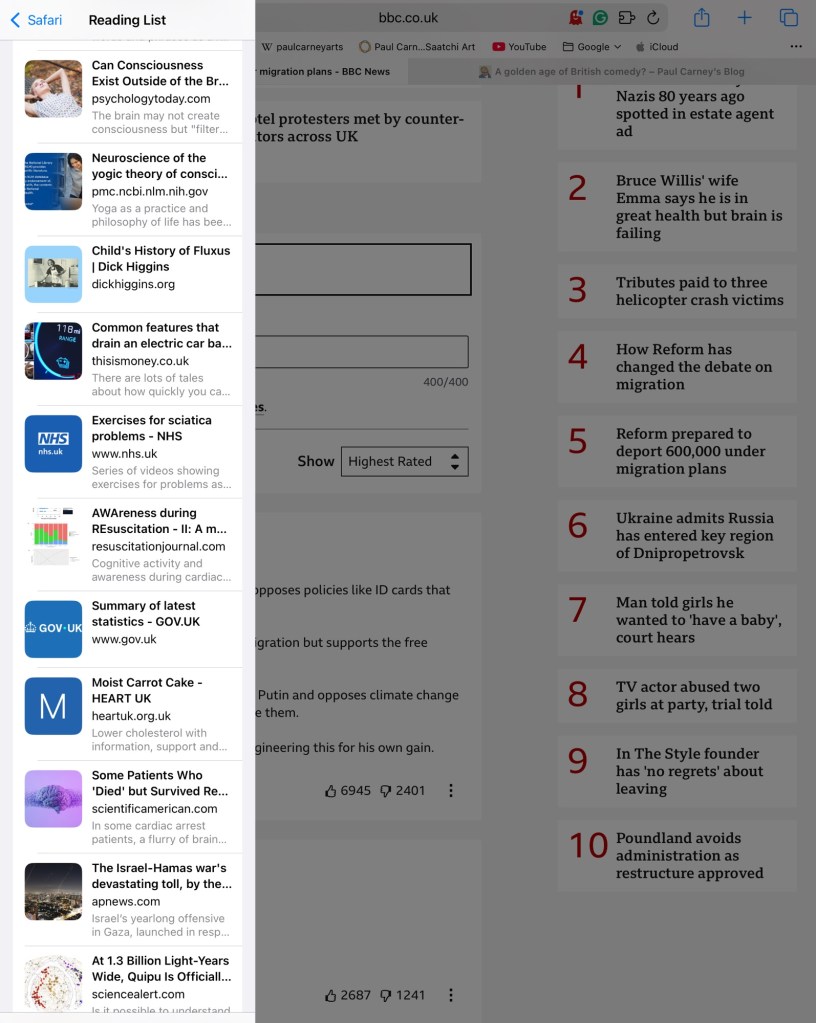
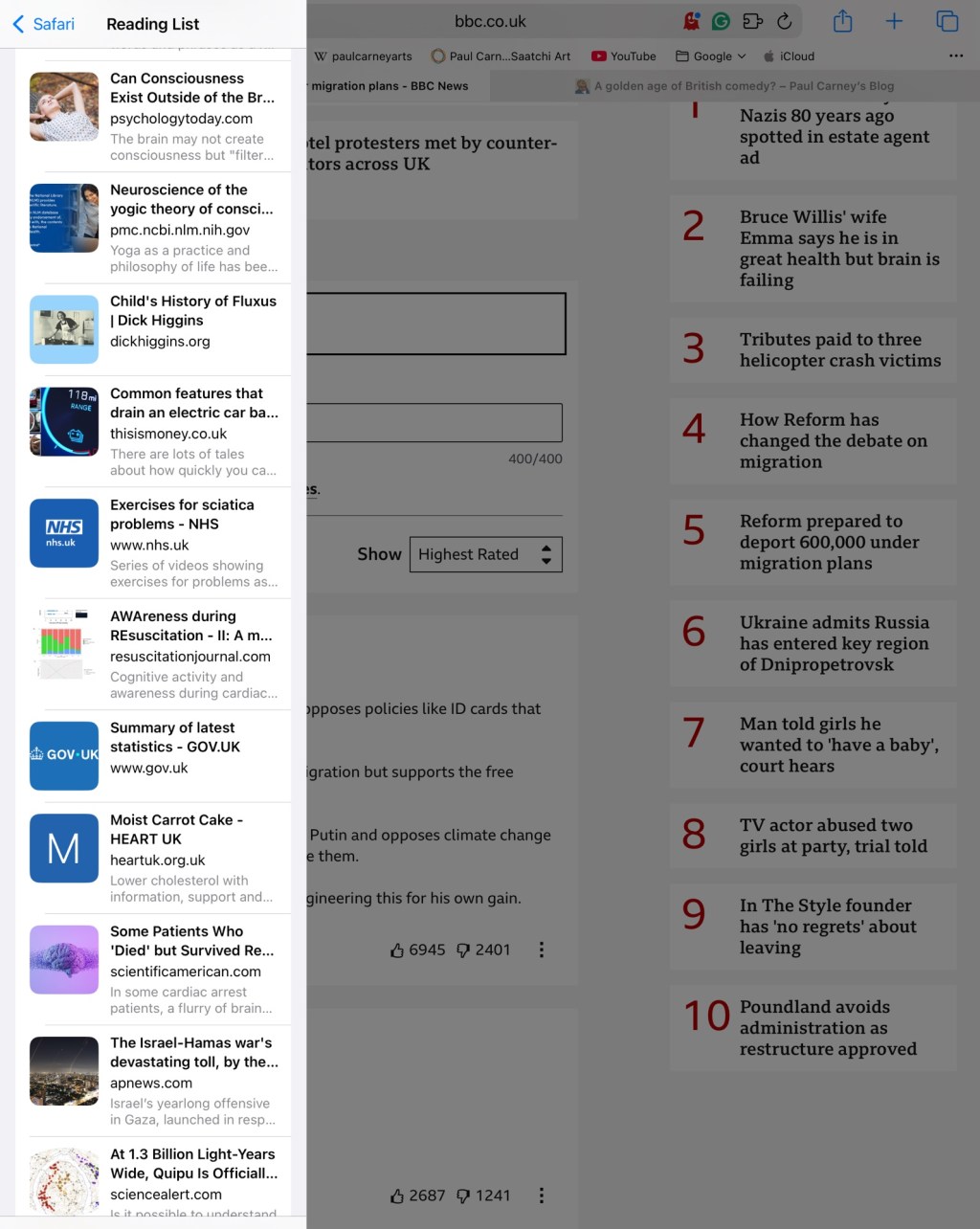
My recent internet searches

Can consciousness exist outside of the brain?

Yoga as a philosophy and practice of life

A child’s history of Fluxus (an art and design movement).

Common features that drain an ev car battery

Exercises for Sciatica 

Cognitive awareness during cardiac arrest

Carrot cake recipe

Israel – Hamas war 

Quipi- a 1.3 billion light year universal cosmic interstellar feature 

I think the list of my searches are fairly self-explanatory. Like everyone, I have a need for information. I have sciatica, an ev car, and a lifelong interest in spirituality, science, and the universe. Also, I love carrot cake! 

When I was younger, before the internet, we were ignorant of things. You needed encyclopaedias, reference books and medical journals, which most of us didn’t have. During this time, and from a very young age, I was a library culture vulture. I visited it every week, more if I could, just to know more about stuff I was curious about. I didn’t think my education was that good, so this was my attempt to fill that gap. Libraries are being eroded in the UK. They don’t have the funding for new books and people don’t visit them as often. I think it would be very sad if they closed because something very important will be lost if they go. Books, magazines and journals are different to the kind of knowledge you see on the internet. Text books are rigorously researched, checked and proof read before they go to print. They aren’t uncurated diatribe written by anyone with an opinion, and for that reason, they represent something we cannot lose – authenticity. Searching online is quick, it’s easy and convenient, but it isn’t as good as searching through curated content written by proven experts in a stimulating environment such as a library. 

Paul Carney Avatar

Published by

7 responses to “Library culture vulture”

  1. Rohini Avatar

    Can consciousness exist outside of the brain?
    An interesting and extremely important topic I’ve been reading up on lately.

    1. Paul Carney Avatar

      From my understanding, consciousness is an electromagnetic cloud. It is much weaker than the one produced by the heart, but it can be measured outside of our heads. I don’t think it is capable of living on detached from the neurons in the brain however. Like you, I find it fascinating 🧐

      1. Rohini Avatar

        Paul my last reblog on my page is for you.
        Would love for you to participate and I look forward to reading your thoughts

        1. Paul Carney Avatar

          Hi, I wasn’t sure which of the posts was the one you wanted me to read. I read some of your posts and one that seemed to be a link to another site. Anyhoo, I’ll reply here.
          As you say, there are many different perspectives on what consciousness is. Primarily, I think you have to decide on whether you take a materialistic stance: consciousness is the result of neural circuits in our brains, or the immaterial, philosophical stance which is that consciousness is something more than mere biology. I think you can get lost in the philosophy. It ties you up in knots. Surprisingly, neuroscience takes a much simpler, more direct approach.
          For example, neuroscientist Nick Chater, in his book The Mind is Flat, says there is no evidence of any subconscious activity in the brain. He says it doesn’t exist. What we know as subconscious are simply deeper memories. All our thoughts pass through a single narrow bottleneck one at a time. We cannot multi-task, we simply switch between trains of thought. Our brain operates by pulling on stored memories. Everything we think we know is reinvented every time we recall it, based on the limitations of that current situation.
          Non-materialists say that mere neural circuits cannot define the qualia of our experience: the redness of red, or the quality of a sunset, because they say this cannot be found in the material brain. Neuroscientists would disagree. They say they can now absolutely find the areas of the brain that cause these effects.
          For me, I am more inclined to the neuroscience than the philosophy, which overcomplicates everything and clouds the science with ‘hard problems’ and philosophical zombies. What I do think is interesting however, is that science’s reductionist mechanisms of explaining everything by drilling deeper and deeper into them, doesn’t work in reverse. Philip W Anderson pointed out years ago that you can’t reconstruct the universe with elementary stuff. Something happens at each level of being and that is called emergence. A violin is one instrument, a trombone another. Put enough instruments together and you have an orchestra, but the sound of the orchestra changes according to the quantity and types of instruments you have. Consciousness is like that. All these individual neural circuits work to create their own signals, but when combined they manifest a symphony of thoughts that seem like magic, but aren’t. It is the wonderful illusion of consciousness.

  2. David Pearce Music Reviewer Avatar

    I still use encyclopedias occasionally, especially for crosswords where I am pretty sure I know where to find the answer! I’m otherwise completely hooked on search engines. Your search history doesn’t look that much different from mine in terms of the subject matter. 🤔

    1. Paul Carney Avatar

      I don’t have an encyclopaedia as such, but I used to love them. My local library isn’t so good, but I still visit it occasionally. The city library is better, but they are more like multi-media centres these days!

Leave a reply to Paul Carney Cancel reply