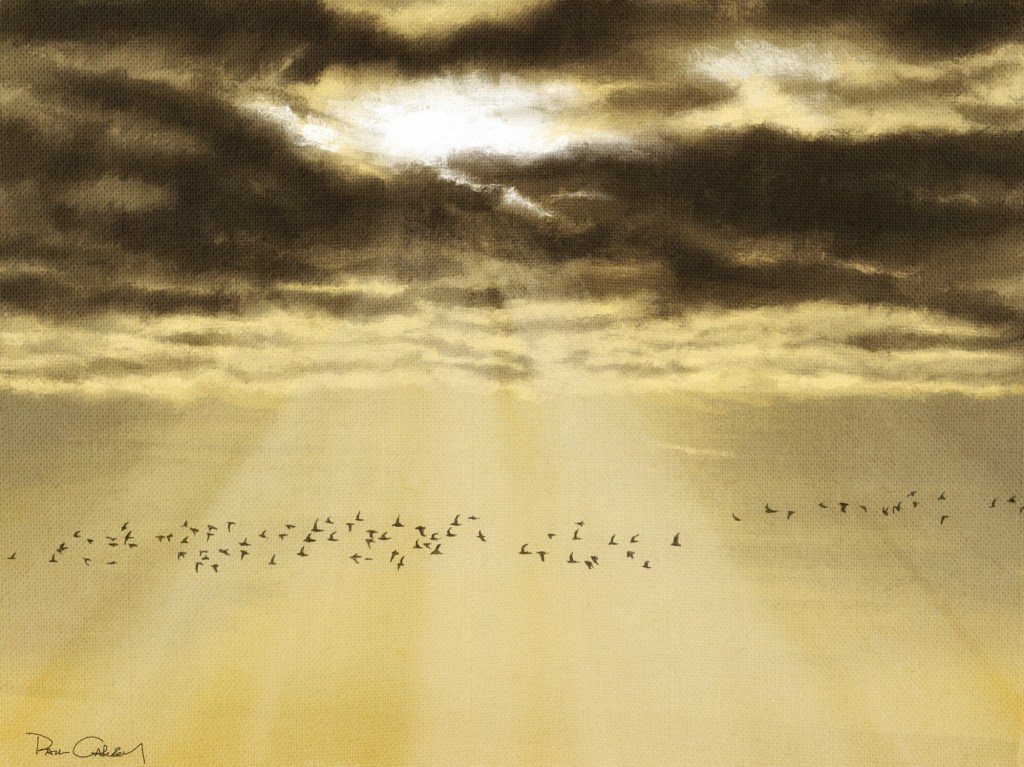
I’ve been reading an old book about Near Death Experiences called Life After Life by Dr Raymond Moody. It very much relates to a topic I wrote about a while ago Where Do We Go When We Die? in which I wrote about some new research done on the topic by Professor Sam Parnia, described in Scientific American.
There is enough material in both sources to convince me that NDEs are a real phenomena, experienced by numerous people upon near-death. Not all people live to tell the tale of course, and many who survive don’t have experiences of this kind. Nonetheless, they are too common, and too similar, to be dismissed. What’s more, there is enough evidence in Professor Parnia’s work alone, to persuade us that there definitely is brain activity, beyond what was previously thought possible, after death.

What is commonly described in NDEs, is a feeling of leaving the body, and being able to observe people and events going on in the surrounding room, usually from above. Then, people describe being in a dark tunnel of sorts, before encountering a bright overwhelming, benevolent light. Their whole life flashes before them, while the light gently and kindly coaxes them into a form of self-realisation of their life’s deeds and events.
There are only a limited number of conclusions you can draw from NDEs, I think. They are either a simple, biological curiosity, a by-product of a brain experiencing its ultimate demise, or they are evidence of something more profound – life after death.
Let’s take the first possibility. While there is an evolutionary advantage to death (shorter-lives mean faster adaptation through more frequent generational turnover), this particular trait would be unlikely to benefit the living. It’s difficult to see what evolutionary advantage can be gained from having the whole of your life flood through your brain before you die, and besides, not all patients reported this happened to them anyway. Scientific explanations for NDEs include: rushes of endorphins, released when the body is under extreme pain, which can cause hallucinations; abnormal temporal lobe activity that can produce strange sensations and perceptions; depersonalisation which is the feeling of being detached from your body; cerebral anoxia, lack of oxygen to the brain; or the dying brain hypothesis – hallucinations caused by activity in the brain as cells die. The problem with all of these theories is that no one theory accounts for the full range of experiences people have in these situations. And in any case, no scientific explanation can properly describe the profundity of experiencing this level of elation, serenity and other worldliness at the end of life. Why on earth would death produce such awe-inspiring experiences? After all, it serves no evolutionary purpose. Science might therefore explain the mechanisms of how it happens, but it cannot account for why it does. That said, NDEs don’t necessarily prove that there is a next stage after death. They aren’t concrete evidence of an afterlife. But, they do raise some tantalising questions:
Why do people see their whole lives flash before them? Here is one example from the book Life After Life by Dr Raymond Moody:
“All of my childhood thoughts, my whole entire life was there at the end of this tunnel, just flashing in front of me. It was not exactly in terms of pictures, more in the form of thought, I guess. I can’t exactly describe it to you, but it was just all there. It was just all there at once, I mean, not one thing at a time, blinking off and on, but it was everything, everything at one time.”
Professor Parnia puts forward a coherent, mechanistic explanation for why people experience their whole life flashing before them. He says:
“Normally, the brain has “‘braking systems’ in place that filter most elements of brain function out of our experience of consciousness.… In the dying brain, however, the braking system is removed. Parts that are normally dormant become active, and the dying person gains access to their entire consciousness—all your thoughts, all your memories, everything that’s been stored before.”
While this sounds perfectly plausible, I find it odd that these ‘braking systems’ only seem to malfunction upon the proximity of death. Why not at other times, such as through neurological conditions or diseases? I may be wrong, but I don’t know of any other ailment that triggers such visceral recollections like this. What is it about death that releases this ‘braking system’ and where is it in the brain?
The other question NDEs raise for me is: why do so many people experience an overwhelming, benevolent, all-powerful light? This seems odd. You might expect one or more of the religious subjects to describe such a phenomena, but for a significant proportion? Even the non-religious ones? That doesn’t sound like something you would typically expect. And, what is this force of light? Is it real? Is it God? I think people have to draw their own conclusions here, but it is certainly compelling. Again, from Dr Raymond Moody’s patients: “I floated right straight on through the screen, just as though it weren’t there, and up into this pure crystal clear light, an illuminating white light. It was beautiful and so bright, so radiant, but it didn’t hurt my eyes. It’s not any kind of light you can describe on earth. I didn’t actually see a person in this light, and yet it has a special identity, it definitely does. It is a light of perfect understanding and perfect love.”
Perhaps there are rational explanations for the apparent witnessing of a light, but why the additional, overarching, all-powerful persona? And, why is it so loving and benevolent?
Finally, why do so many people describe an overwhelmingly positive feeling of being greeted by people they have loved, but lost? Here is a typical experience, taken from Life After Life:
“The doctor gave me up, and told my relatives that I was dying. However, I was quite alert through the whole thing, and even as I heard him saying this, I felt myself coming to. As I did, I realized that all these people were there, almost in multitudes it seems, hovering around the ceiling of the room. They were all people I had known in my past life, but who had passed on before. I recognized my grandmother and a girl I had known when I was in school, and many other relatives and friends. It seems that I mainly saw their faces and felt their presence. They all seemed pleased. It was a very happy occasion, and I felt that they had come to protect or to guide me. It was almost as if I were coming home, and they were there to greet or to welcome me. All this time, I had the feeling of everything light and beautiful. It was a beautiful and glorious moment.”
The thing that strikes me here, is not so much that so many patients saw their loved ones. You could reasonable expect an unconscious mind to envisage their loved ones when in a dream-like state. No, what struck me is how profoundly beautiful and glorious so many people found this moment. I mean, most of them were in a pretty horrendous predicament. They were dying after all, and likely to be in all kinds of pain and discomfort. Precisely the opposite of euphoria and joy. Why then, would the typical state of affairs be for people to so blissfully happy at the end of their life?
I want the science here. I don’t want to fly off into the realms of woo-woo and the supernatural. I am a rational person who prefers evidence over the existential. But it becomes clear, when reading the testimonies of so many people who have experienced NDEs, that something profoundly beautiful, emotional and spiritual occurs at the end of life. To summarise, Dr Moody says:
Despite the light’s unusual manifestation, however, not one person has expressed any doubt whatsoever that it was a being, a being of light. Not only that, it is a personal being. It has a very definite personality. The love and the warmth which emanate from this being to the dying person are utterly beyond words, and he feels completely surrounded by it and taken up in it, completely at ease and accepted in the presence of this being. He senses an irresistible magnetic attraction to this light. He is ineluctably drawn to it.
Is this proof of life after death? Of course, this is a matter of personal choice. However, even if the science is correct, and this is simply a physical manifestation from a natural event, with no other cause or purpose than the processes of a dying person, who wouldn’t want that in their final moments? Who wouldn’t want to be greeted by such an overwhelmingly positive feeling of love and joy at their end? Believing there is an afterlife makes no difference to the cold fact of death before us. Belief has no impact on people’s ultimate demise, but if believing that there is an afterlife brings us comfort and reassurance in this life then that’s a good thing in my opinion. Besides, you don’t have to choose between the science and the real testaments of so many people, because they can both be right. Yes, the brain might be shutting down. Yes, it may hallucinate and imagine while in that state, but the fact that this is our default mode upon dying, the fact that we actually have profound, beautiful experiences like this in our final moments, is telling us something very important about the nature of life and what lies beyond it. If it is just an evolutionary accident, it is an almost unbelievably lucky one, some may even say Divine.
Life After Life by Dr Raymond Moody available from all good bookstores
Scientific American 23 Sep 2023 – Some Patients Who ‘Died’ but Survived Report Lucid ‘Near-Death Experiences,’ a New Study Shows
Where Do We Go When We Die? by Paul Carney
The Conversation Dec 4th 2018: Are near-death experiences hallucinations? Experts explain the science behind this puzzling phenomenon
Addendum
Statistics of NDE’s from Professor Sam Parnia’s research:
Of 567 Cardiac Arrest patients: 53(9.3%) survived, 28 of these (52.8%) completed interviews, and 11(39.3%) reported memories or perceptions suggestive of consciousness.
Four categories of experiences emerged:
1) emergence from coma during CPR (2/28(7.1%), or
2) in the post-resuscitation period 2/28(7.1%),
3) dream-like experiences 3/28(10.7%),
4) transcendent recalled experience of death (RED) 6/28(21.4%).
In the cross-sectional arm, 126 community Cardiac Arrest survivors’ experiences reinforced these categories and identified another: delusions (misattribution of medical events).
Nobody identified the visual image, 1/28(3.5%) identified the auditory stimulus.
By those statistics, 39% of Cardiac Arrest patients who survived and completed interviews, had some form of conscious perception of death. This means that approximately 220 patients out of the 567 are likely to have experienced some form of conscious experience while they were dying. I’d guess that figure was even higher, since extracting data of this kind is extremely difficult. This makes Near Death Experiences commonplace and, if survivors stories are anything to go by, it makes death a strangely euphoric, blissful experience. No wonder writers, poets, philosophers and theologians have written about death in such spiritually affirming ways throughout history. Why death should be like this is a matter for your own conscience.


 Paul Carney’s Blog
Leave a reply to A Spiritual Journey – Paul Carney’s Blog Cancel reply