One of the biggest questions philosophers and theologians ask about our universe is: if there is a Creator, how could He/She possibly create a universe with such evil and suffering in it?
“Is God willing to prevent evil, but not able? Then he is not omnipotent.
Is he able, but not willing? Then he is malevolent.
Is he both able and willing? Then whence cometh evil?
Is he neither able nor willing? Then why call him God?”
Epicurus
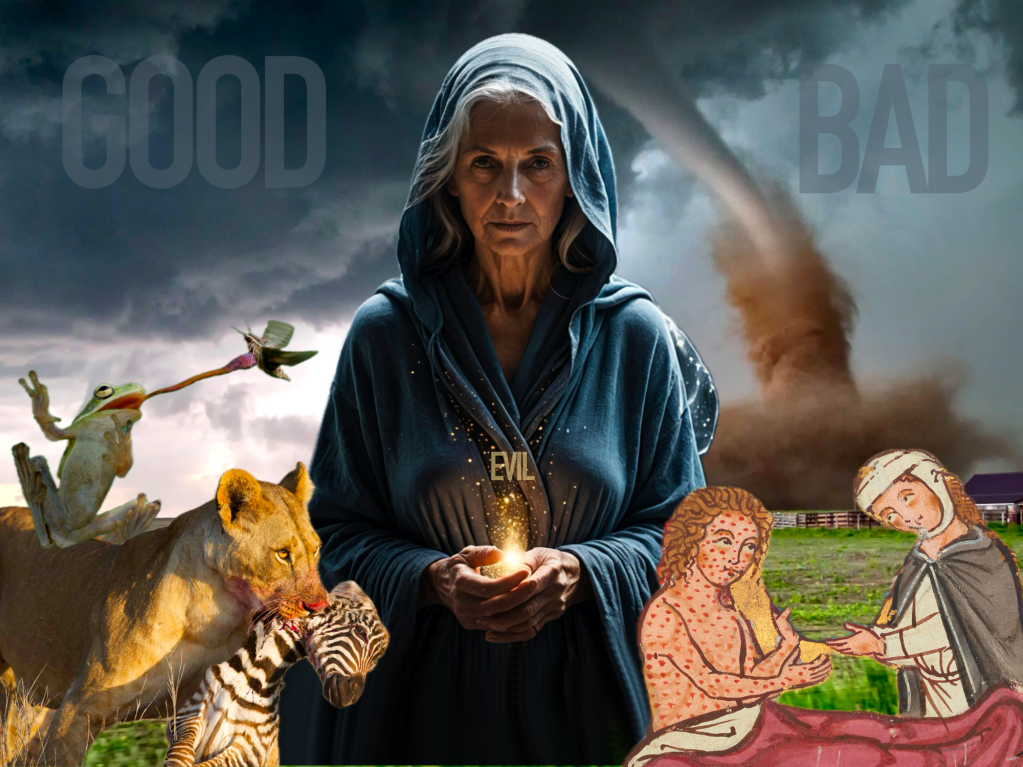
Atheist philosopher John Leslie Mackie formulated this argument into the ‘inconsistent triad’. This is known as the Logical problem of evil which claims that it is logically impossible for both God (as defined with omnipotence & omnibenevolence) and evil to both exist.
Premise 1: An omnipotent God has the power to eliminate evil.
Premise 2: An omnibenevolent God has the motivation to eliminate evil.
Premise 3: Nothing can exist if there is a being with the power and motivation to eliminate it.
Conclusion: Evil, omnipotence and omnibenevolence thus form an inconsistent triad such that God (as classically defined) and evil cannot possibly co-exist.
This is a theoretical (priori) argument, which does not reference real experience (posteriori knowledge). It makes the claim that evil and an omnipotent God cannot simultaneously exist. But, it does not state what evil is, or what God is for that matter. Defeating the logical problem therefore, requires establishing what is meant by evil, and if it exists, conceiving of some reason God could have for allowing it.
The short read answer: What is evil?
- There is no such thing as evil. Evil is an outmoded concept that tells us little about the motivation for extremely bad behaviour or terrible natural disasters. What constitutes evil, is incredibly difficult to define, and much of what we think of as human evil is down to poor upbringing and environmental conditions, rather than an innate badness which is the fault of God.
- No one is born evil. There is little evidence for a genetic cause for evil, but there is a well recognised condition known as antisocial personality disorder in human beings, or ASPD, which creates many of the symptoms we think of as evil. ‘Evil’ is largely down to environmental factors and poor upbringing. Poor nurture causes more evil than nature alone.
- Human morality is a construct. Human beings attempt to behave in ways that are above the harshness of the natural world, which isn’t always easy. Behaviours that are successful in nature, are often counterintuitive to life in a civilised society.
- The very notions of goodness and badness are relatives, rather than absolutes. What’s bad for the prey is good for the predator. The natural order can seem tough to us city dwelling folks, but maybe that’s because we don’t understand nature anymore.
- Death, disease and pain are important essential aspects of being a living, breathing, sensitive organism. They have evolved under genetic conditions, over millennia, to help organisms respond to complex environmental situations.
- Some aspects of nature can appear quite cruel to us, but they are in fact, natural instincts creatures have developed to help them survive and pass on their genes. What we think of as evil in nature is actually essential behaviours needed for life in the wild.
- Natural disasters are the product of geological systems and an aspect of living on an active, volatile, living organism. Humans have the intellect and foresight to prepare for them, and to mitigate against them.
- We cannot blame God for bad things that are caused by, or strongly influenced by human beings.
The long read answer: What is evil?
Over the ages, writers have spent a long time considering what evil is and how it manifests itself. In Milton’s Paradise Lost, the jealous Satan vies with his conspirators to overthrow God in battle, and when that doesn’t work, he spends eternity trying to usurp His plans. Iago from Shakespeare’s Othello, is a vile, envious, pernicious man who destroys the life of every character in the play. Grendel from Beowulf, slaughters the innocent townspeople and devours thirty of them at once. Tolkien’s Sauron from Lord of the Rings, wants the ring of power and the whole world of Middle-earth brought under his control.
In reality, Adolf Hitler and his Nazi party members would come to most people’s minds of the embodiment of evil. Joseph Stalin has also been widely condemned for overseeing mass repressions, ethnic cleaning, hundreds of thousands of executions, and famines which killed millions. Genghis Khan, Pol Pot, Osama Bin Laden and Kim Jong-il, also must rank as people who have committed atrocious acts against innocent people for their own gain. Whenever evil dictators like this arise, it is left to other peacefully minded human communities to resist and overthrow them. Humans must fight against human-made evils.
Some acts may be clearly and evidently evil to us, but how do we know where goodness ends and evil begins?
The philosophical concept of evil: as outlined by the Stanford Encyclopaedia of Philosophy. The concept of evil has been divided into two areas: natural evils and moral evils:
- Natural evils are bad states of affairs which do not result from the intentions or negligence of moral agents. Hurricanes and toothaches are examples of natural evils.
- Moral evils do result from the intentions or negligence of moral agents. Murder and lying are examples of moral evils.
Natural Evils
Natural evils are bad states of affairs which do not result from the intentions or negligence of moral agents.
The statement says that natural evils do not result from moral agents. Therefore, if God is responsible for natural disasters he cannot have morals, or God is not responsible for natural evils. However, the statement might be wrong, and natural disasters might be the result of moral agents, if a suitable moral framework can be found that justified natural disasters. Let’s look at the examples cited in the quotes.
Hurricanes
Hurricanes are not supernatural events. There is no evidence that a divine force, such as God, intentionally creates or manipulates them with the intention of deliberately hurting anyone. But, are such events evil?
Most large weather events can now be fairly accurately predicted when certain atmospheric conditions occur.
Hurricanes, and storms in general, are a crucial part of earth’s climate system. They play a significant role in redistributing heat and moisture, replenishing groundwater supplies, maintaining ecosystems such as moving nutrients, creating new habitats and shaping landscapes. This does not sound malevolent to me. Far from it. If God created hurricanes and storms then it is clear there is a valid purpose for them.
Humanity has claimed most of the natural world as its own, with little concern for nature. Does the fact that human beings build houses in the known path of hurricanes and on floodplains, add to people’s notion that hurricanes and storms are evil? I think it does. People are of course, devastated when their homes are destroyed or loved ones die in a hurricane. It’s only natural for them to blame someone, but it sounds unfair to me to blame God for wilfully destroying your property when you know very well that storms are a naturally occurring event in your area, and that they are an essential part of earth’s ecosystem.
Knowing and understanding the purpose of natural events is crucial to defining why they happen. Taking adequate steps to avoid personal damage from natural events, is also fundamental. If you want to go chasing a twister in your car fine, but don’t blame anyone else for your misfortunes if you get injured or die.
Toothaches
Toothaches are (apparently), a natural evil. Toothaches can occur randomly, but most often occur when people eat a poor diet, consisting of too much sugar. Medieval people had much less tooth decay than we do today, because they had little sugar in their diet. So, people’s voluntary actions contribute significantly to toothache.
When applied to the wider issue of pain in general, the purpose of pain is to warn our body of specific threats, to protect us from further harm, to signal dangerous situations, and to prompt us to receive treatment. If pain did not exist, we would be unable to take care of ourselves. Pain therefore, is a necessary condition of being an organism that can sense, feel and respond, to its environment.
Our upbringing and social conditioning influence how we express and feel pain. Some cultures encourage the expression of pain, and others suppress it. Some cultures over time show an almost superhuman tolerance of pain. This means that the perception of pain can be, at least partly, controlled by the mind.
It’s true however, that some people have conditions that make them more susceptible to pain. This may be because of a genetic disorder, age or an environmental factor. Genes replicate, they mutate. This process is why life on earth exists. It is an incredibly complex process that can sometimes go wrong. However, genetic disorders are often due to preventable conditions such as chemical exposure, diet, some medications, poor lifestyle choices, tobacco, drugs or alcohol.
Pain is extremely unpleasant, it can be debilitating, and sometimes is not the fault of the individual, but rather, of poor genetic reproduction, but even this is an essential mechanism of life in general. Often however, pain is preventable.
Are natural evils everywhere? Is life on earth hard-wired for evil?
My immediate thought in response to this thought experiment was yes, evil is a fundamental part of the natural world. After all, bad things happen all the time in nature. And, isn’t there an unwritten law of the jungle, a survival of the fittest, ‘nature is cruel’ mindset, when thinking about life on earth?
All living organisms are doing everything and anything they can to survive. They all need the same basic stuff: food, water and shelter, and they all need to reproduce. The cliche says; ‘it’s tough out there,’ and life does whatever it can to survive.
Insects burrow into the flesh of hapless creatures to feast and lay their eggs, apex predators rip the throats out of their innocent victims then gorge on them, before other creatures feed on the remains. It’s no different at the microscopic scale of life. The bacteria and protein wars precede all life on earth. Some bacteria poison their opponents, others pierce them, some lure them to their demise, others devour them whole. It’s no different to a human war. Creatures steal, and trick, and maim, and wound, and kill, and devour, and feast upon their prey. All life is in competition with each other. Nature has concocted some pretty gruesome ways of killing. Everything is at risk, everything is game. No one is immune. If a predator doesn’t get you, a parasite will. At first glance, it seems like this is concrete evidence that natural evils are manifest everywhere.
What’s bad for the prey is good for the predator
But, surely we have to take perspective into account here. Yes, it’s bad for flies that frogs eat them, but it’s good for the frog. It may be argued that the bad event still happened, because the fly experienced it, but the frog would disagree, and surely claim that the same event was a good one, because it has a right to sustain itself. A bacteria infects us and brings disease, which we think of as bad. But the bacteria has a vital life spark too, and is only trying to live and reproduce, in the same way we are. This means that the same event can be good or bad, depending on your perspective.
Is it evil to take a life and eat it for food? If that is our definition of evil, then humans are evil every time they eat a pork sausage. Vegans may think they are off the hook, but no, plants are a form of life too. Is eating a lettuce a natural evil? A lettuce would say yes. If it could.
The whole notion of what constitutes goodness and badness is one of perspective and morality, and as such is extremely debatable. I don’t think nature thinks in terms of morals, rights and wrong, because morality is a human construction. There is simply the issue of survival, and needing to do whatever it takes to stay alive. Goodness or badness then, is in the mind of the observer.
Indiscriminate acts of evil
What about killing indiscriminately then, for no other reason than you have a greater power over your opponent and want to do it?
Cats come to mind. They kill mice and birds even if they aren’t hungry. Dolphins also seem to kill, maim and injure porpoises for fun. Hyenas, leopards, foxes, badgers, leopards and lions, all seem to kill for no perceivable reason we can find. But, maybe that’s key here. Just because we can’t see a reason does not mean there isn’t one.
They may be learning how to hunt, practising vital skills they’ll need to get them through lean times. Or, they may be removing invaders from their territory, marking it out, eliminating creatures that may out-compete them for limited resources. It could be, as is the case in domestic cats, that it is a hard-wired behaviour. Maybe evil is a part of nature after all.
But, back to intention again. We can’t say for certain that cats intend to be cruel – if not, they aren’t immoral, only amoral.
Cats will instinctively chase anything that moves quickly, or in a certain manner. They don’t seem to be aware of any difference between chasing a plastic toy and chasing a real mouse. They don’t seem to get any pleasure from, or enjoy, killing mice. As soon as the mouse stops moving, it’s game over. In some senses, it is an amoral, automatic reflex, rather than an intention to kill. But, from the mouses perspective it is most definitely bad. I find it difficult to quantify indiscriminate violence as being anything other than evil, but maybe that’s the human in me, or maybe it’s an evolutionary left over.
Speaking of being human then, what are moral evils, and how do they affect the issue of whether God has created an evil universe?
Moral evils
Moral evils do result from the intentions or negligence of moral agents. Murder and lying are examples of moral evils.
What do some of the most prominent thinkers in history think moral evil is?
- According to the Neoplatonists, evil does not exist as a substance or property but instead as a lack of substance, form, and goodness. If evil is a lack of goodness, then God creates no evil. All of God’s creation is good, evil is a lack of goodness.
- In 3rd Century BC Persia, the prophet Mani said the universe is the product of an ongoing battle between two coequal and coeternal first principles: God and the Prince of Darkness.
- According to philosopher Immanuel Kant, anyone who does not choose to perform morally right actions has an evil will.
- Nietzsche argued that the concept of evil arose from the negative emotions of envy, hatred, and resentment. He argued that the powerless and weak created the concept of evil to take revenge against their oppressors.
- Hannah Arendt uses the term evil to denote a new form of wrongdoing which cannot be captured by other moral concepts. For Arendt, radical evil makes human beings into living corpses who lack any spontaneity or freedom. “According to Arendt, (one of the organisers of the Jewish Holocaust), Adolf Eichmann’s motives and character were banal rather than monstrous. She described him as a “terrifyingly normal” human being who simply did not think very deeply about what he was doing.” Stanford
Evil isn’t on trend
Trying to find the necessary and sufficient conditions for moral evil is almost impossible. Is it that the person themself is evil, or the performance of certain actions that makes them evil? And, what are the essential component features of an evil action? Some claim that evil acts have extra qualities over and above normal wrong doings. Others claim it is the pleasure that some seem to take in doing evil acts. And then again, others say it is the intention to cause intolerable suffering that makes a person evil. Maybe it is all of these things. There is no doubt that some people have committed atrocious and cruel acts, while gaining perverse pleasure from carrying them out.
However, since it is people and societies that define morals, and morals can fluctuate according to who defines them, morality itself, is a highly problematic framework. For example, people in Western cultures would think it morally repugnant to kill and eat a dog, yet it is common practice in China, North Korea or Vietnam. Killing babies is morally repugnant to me, yet infanticide has been a widespread practice throughout human history to dispose of unwanted children. My point is that, what we think of as immoral changes from time to time, and from place to place.
Anyway, most contemporary philosophers and psychologists would avoid using the term ‘evil’, because it is an antiquated notion that invokes the supernatural and lacks explanatory power. Furthermore, it can be harmful or dangerous when used in moral, political, and legal contexts. In addition, social psychologists now try to explain how social conditions can lead ordinary people to perform ‘evil’ actions. The most common description of an evil person would be someone we would describe as a ‘psychopath’, but this is an outmoded concept. As I said earlier, the term psychologists would use is ASPD or antisocial personality disorder. People with ASPD have little empathy and a habit of rationalising their actions. But they do know the difference between right and wrong. The causes of ASPD are thought to be mostly environmental, rather than genetic. Evil, it seems, is more nurture than nature. Let’s look at morality then.
Morality
Morals are the prevailing standards of behavior that people and societies sanction as right and acceptable. People or entities that are indifferent to right and wrong are considered amoral, while those who do evil acts are considered immoral.
Morality is a human social construct designed to help us live in harmony and maintain the social order. Societies differ from culture to culture, but there are some social norms of every human culture that are prevalent. These ensure compliance, conformity and obedience. Recent research from the University of Chicago has found seven social norms that exist in almost every culture: helping family, helping your group, reciprocating, being brave, deferring to superiors (respect), dividing disputed resources (fairness), and respecting prior possession (property rights).
The most obvious negative things, or evils, that human societies try to overcome are: killing and murder, stealing, cheating, and breaching someone’s privacy or property. However, there are thousands and thousands of laws in almost every culture, that all aim to protect both the individual and the state, to ensure the wider community is stable and peaceful.
Human morality is very different from that found in nature. Human society attempts to transcend the natural behaviours found in nature, to create a fairer, more just, and more humane civilisation. We aim for a more egalitarian society, where everyone is equal. In human society, if a person is aggressive, or violent towards others, if they injure them or steal their resources, they would be punished and sent to jail. However, this is perfectly normal behaviour in the wild. It establishes who is the dominant individual in the group (male or female). What we would consider to be cruel, ensures survival and means that the strongest genes are passed on in the wild.
Human society attempts to transcend the natural behaviours found in nature, to create a fairer, more just, and more humane civilisation.
Civilisation has evolved above the call of the wild
Civilised societies are only a few thousand years old, and yet we usually have most of our needs at hand without having to gather them ourselves. Humans aren’t competing for resources, we don’t (usually), fight each other to find a partner, and so our goal isn’t to rear the strongest, most aggressive offspring that can survive the brutality of the natural world. We have evolved socially to be above those more primitive instincts, despite what some social media bloggers would like us to believe. If we hadn’t evolved to be able to live peacefully in large communities, we all wouldn’t be here.
It is difficult for us to navigate the moral maze between what our natural, basic instincts are, and what our developed, cultural, social norms are. Those born without much wealth must resist any attempt to take it from those who have it, despite it being a natural instinct to gather essential resources. They are told they are ‘bad’ if they do, but in the natural world this is an everyday common occurrence. Empires have been built on invading weaker countries and taking all of their resources from them. When your country does it, it isn’t seen as morally bad, it’s only when another country does it to you, or if you are a lone person doing the taking that morality steps in.
Killing has been a staple, daily occurrence throughout history in all human societies. When humans kill on a personal level, this disrupts the social order and so the perpetrator must be punished. When the whole society does it, i.e. in the name of war, it’s ok. All kinds of reasons are given: freedom from oppressors, liberty, overcoming evil, God, unification, rights to land ownership and many more. In reality, these reasons usually come down to taking the other persons land and gaining their power and wealth.
Genghis Khan said:
“The greatest happiness is to shatter your enemy, to crush him before you, to see his cities pulverized to ashes, to see his loved ones shrouded in tears, and to gather his wives and daughters into your control.”
Criminal gangs operate in much the same way as the kings and queens of history. Brutality prevails. Yes, this is the natural way, but the whole point of a civilised, developed society is that it attempts to transcend this brutal order. It tries to make us better than that. It makes us evolve into better versions of ourselves, so that we can live in humongous groups called cities and countries. Without this order, we would descend into a real-life version of the Walking Dead TV series in no time. This isn’t easy. It’s easier for those who can understand the thin mask that is draped over the face of nature. It’s easier for those who are born into the kind of wealth that means they don’t have to live in the dog-eat-dog reality of having nothing. It’s easy for those who aren’t physically capable of taking whatever they want off anyone they choose.
What about death and disease? Aren’t they evil?
Death is never easy to take, whether you’re a blackbird that has had her eggs stolen by a magpie, or a mother who has lost her son, yet it does have wider evolutionary benefits. Death is the biggest driver of evolutionary change, more so than genes, and even the most gruesome acts of parasitic behaviour have a function. Organisms that die have evolutionary advantages over unaging counterparts. If every organism lived forever, then the earth’s limited resources would quickly be used up and all life would come to an end. Yes, the cycle of life is tough, but it keeps the precarious supply and demand nature of life at optimal levels.
Disease can be the result of an incident or accident, or by the ingestion of toxic substances, environmental, genetic diseases, germ-based or by natural causes. The only one of these that I think could be attributed to an evil God are genetically inherited diseases, but the fact that genes have errors when they replicate is as much a benefit as it is harmful. We are only reading this because of gene mutation. Gene mutation has enabled us to be so advanced that we can invent cures for most diseases and we have the ability to greatly ease suffering. We could also ensure safe living conditions so that people are at less risk of disease, we could provide excellent health care, free to all, and provide the best treatments. Human actions can lessen the risk of disease considerably.
Ok, what about murderers and serial killers, surely they are evil?
The majority of the most prolific and dangerous serial killers may be genetically disposed to behave this way, but why people murder isn’t fully understood. Usually, they grew up in an environment that cultivated a disregard for the lives of others, and most have antisocial personality disorder, as I outlined earlier. There are many behavioural traits that characterise ASPD, some of which are: a disregard for the feelings of others, exploitation of people for their own pleasure, a lack of remorse about harming others, lack of fear, aggressive and violent behaviour.
ASPD is usually found in combination with narcissism and inflated ego. Other factors are more speculative. Studies have shown that a greater percentage of male serial killers have extremely high levels of testosterone in their bodies compared to the average male. Abnormal levels of dopamine— which is responsible for pleasure and motivation, may also be a contributing factor.
Serial killers then, are a product of poor nurture and nature. But, while some people are born with factors that lead to them to commit violent acts, it’s clear that the predominant causes are social and environmental. Humans then, overwhelmingly, create serial killers, not God. We come back again to a key message: human beings are the cause of most of the ‘evils’ they experience, and those that are the result of natural causes, are the unfortunate by-products of a volatile ecosystem that drives all life on earth. God doesn’t create Adolf Hitler, Stalin, Jeffrey Dahmer, or Dennis Nilsen – human beings do. Even if genetic, natural factors play a role, environmental factors outweigh them, and so we do have the capacity to nurture our children in such a way that they never manifest that awful potential they have had the misfortune to inherit.
Bullying
Bullying is an evolutionary adaptation designed to help the strongest group members thrive and pass on the most favourable genes. It might also be an evolutionary strategy to target and eliminate weaker genetic contributors. Psychologist Anthony Volk says: ‘bullying has been found in every modern country in which it has been studied. It is found throughout historical cultures and even exists among hunter-gatherer groups that have strong reputations for fostering peace and forgiveness. Most strikingly, bullying also appears in nature, carried out by most animal species and even many plant species. Human genetic studies suggest that bullying perpetration is associated with heritable genetic factors whose details we don’t yet know.’
Although bullying is an evolutionary adaptation, it is also strongly linked to environmental factors. Lack of resources, pressures on habitat, group dynamics and genetic factors all play a key role. It may also be a learned behaviour among certain social groups, beginning in childhood. When children bully each other, they are displaying typical animalistic behaviours found in the wild. What is important then, is that bullying is tackled early and dealt with appropriately using the right interventions. Just because we may be predisposed to bullying behaviour, does not mean we should accept it and do nothing.
If I was God, why not make a world where organisms didn’t need to kill and eat each other? Why do creatures have to be predators? Why make survival of the fittest the default mode for nature?
What kind of world would it be if everything was built for the sake of humanity, so that every human could have perfect lives and live in an earthly paradise? What would that even look like? Whose version of paradise would you use? Every human you ask would have a different viewpoint – a different looking paradise. The versions of paradise would look radically different across time, place and culture. And, who’s to say paradise should be exclusively for human beings anyway? Don’t plants and animals get a say? And anyway, maybe this is paradise.
In this fictional paradise, would creatures have to be born, grow, develop and die in the usual way? If so, this would imply childbirth. Would females have to go through the pains of childbirth in this paradise? I assume not, and that babies will magically appear. I also assume death wouldn’t involve the gradual deterioration, pain and sickness of earthly deaths. But all this is sounding very unparadise-like to me. Childbirth is a wondrous process. Admittedly it’s a bit more painful that it needs to be, but I still think it’s pretty incredible as it is. In addition, the very fact that old age is painful and slow is what makes being young so amazing. Imagine if everything lived forever? There would be no life cycle, no growing up, no death and no clarity that death brings. Pain and death clarify life and give it meaning. I’m speaking as someone who is old and who is in a lot of pain. It sucks, but it certainly brings life into focus.
Speaking of pain, would it exist in paradise? Probably not. So, how would you know if you’d hurt yourself? Without pain we cannot feel joy or ecstasy. Would diseases exist? How about bacteria and archaea? Humans are carriers of billions of microorganisms, so they are essential. If they didn’t exist, how would complex organisms like us survive without them? It seems to me that pain and suffering aren’t very nice, but they are essential in enabling us to experience all the good things in life in all its glory. I might be missing the point here, just because I can’t imagine it, doesn’t mean it wouldn’t be a big improvement on reality as I currently experience it.
So, why does God make life predatory? Why doesn’t He make life placid, so it could feed off the earth’s latent heat energy for example, or by photosynthesis as plants do? Well, I used to have an aquarium, and some of my algae eating sucker fish used to literally stick to the surface of the glass all day doing hardly anything. Imagine a world where every living organism was just laid in the sun all day, basking, doing nothing. The struggle for life produces its very strength and vitality. Many of the wonders of human, animal and plant behaviour are due to the constant need to sustain ourselves, interact and procreate. If all that was removed and life existed in a passive, bland, non-struggle, would it really be as enthralling? Perhaps that is easy for me to say since I’m living a relatively safe life. I wouldn’t say that if I lived in a hell-hole, was starving and being hunted by predators.
Whatever my own perspective, we see the need for reactionary forces to create life, everywhere in the universe. The violent and volatile energy from stars, the collisions of matter, and dynamic gravitational forces, create the precarious equilibriums needed to sustain life. Every time I look at possible alternative, perfect universes without such forces, I encounter problems. Creating a perfect world would mean it isn’t perfect, or it is too different to be perfect. Like eating sugar-free candy. Nice, but not the same. Even if I could create a perfect world from my perspective, it wouldn’t be perfect for the person stood next to me. And, this perfect world would not house the perfect conditions for life to thrive as it does now.
Rather than trying to invent alternative worlds that fit our human moralistic narrative, we should instead, try to make sense of the world we are in. It’s a wonderful, if sometimes harsh, place. Did God make it? I’m not sure, but if He did, He’s a lot smarter than we are. Blaming God is an easy option-out for humanity’s own failings, but an understandable focus for a good rant at the often harsh struggle of being alive. However, if it were easy, life wouldn’t be beautiful.
To answer Mackie then: I don’t believe evil exists. It is an outmoded concept that fails to encapsulate the complex motivations and causes of actions, and which anyway, are often preventable or are naturally beneficial, however violent they may seem.
I also don’t believe in an omnibenevolent God, because benevolence is an entirely human construct derived from human moral principles. Being good generally favours one entity over another, and it can cause detriment to the other party. Every action for something, is an action against something else. Besides, I have no reason to assume human beings are any more important than any other organism, so why should God favour us over them?
This suggests an amoral God, but I don’t think this is correct, because God is outside of any moral framework we can conceive. We cannot put God into a construct that humans have invented purely to help us live together peacefully in large communities. This begs the question, what is God? But that is a question for another blog post.


 Paul Carney’s Blog
Leave a reply to An Elegant and Persuasive Power – Paul Carney’s Blog Cancel reply