What is it that makes our conscious experience? Scientists and philosophers battle it out to try to define it, but in the end, we just have to sit back and enjoy it.
Philosopher David Chalmers argued that, while neuroscientists can explain the workings of the brain: the emotional centres, vision mapping etc. they can’t explain how and why you feel those things, or what your personal experience of them is. Chalmers argued that, you can know everything about water by breaking it down to its molecular composition, or a clock by its mechanism, but you can’t know everything about a person by revealing the contents of the neurons in their brain. This is known as the hard problem of consciousness and it has baffled thinkers since thinkers first thunk.
Now, there are four leading theories about consciousness that I won’t go into, but you can read them here.
My own unphilosophical perspective on the ‘hard problem of Paul’ is: am I simply a load of electrical signals swirling around a lump of squishy tissue in my head, or is there more to me than that? What is my sense of self? Where does it comes from and how it is unique or different from anyone else’s sense of self?
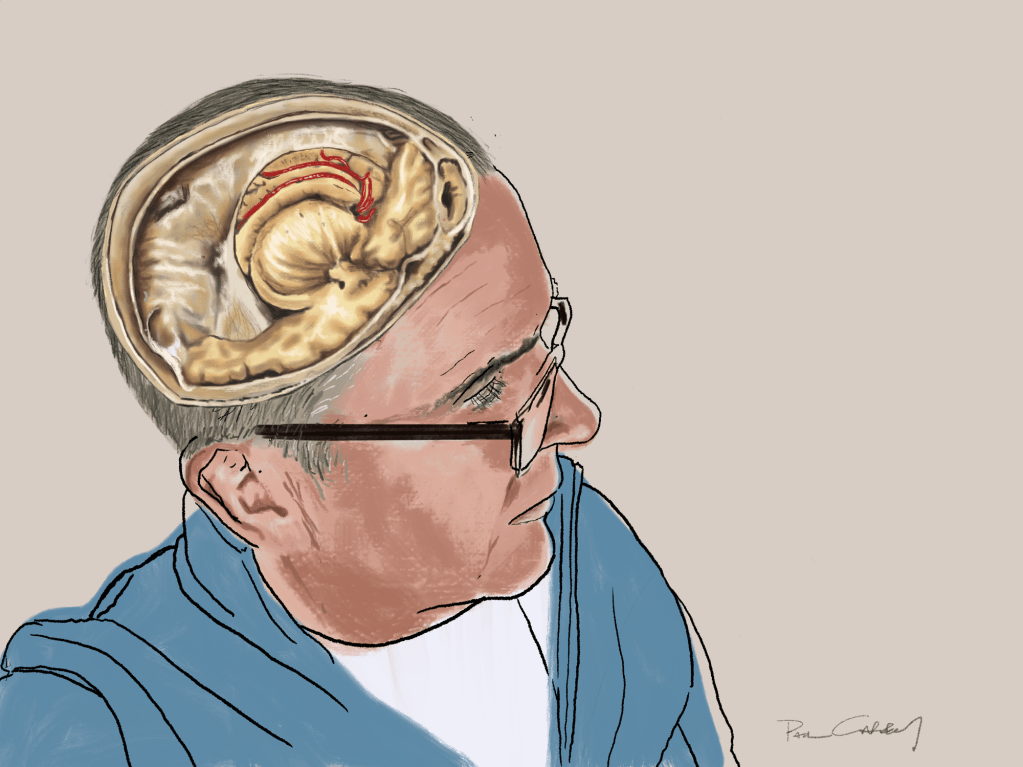
My first thought is that my feelings about things are strongly linked to my memories and past experiences; the schemas I’ve built up over time and my personal emotional condition. What it’s like for me to ‘feel’ things is a collection of my behavioral and emotional responses, created by my limbic system in response to new stimuli, which is strongly linked to my memories. Does this explain every subjective experience? How about the feelings I get from sunsets, the smell of fresh bread, a familiar loving face, a work of art or a piece of music?
I think it does yes. I build models in my mind of things that brought me joy in the past, were previously successful, are linked to comfortable, reassuring emotional states, that made me laugh or brought me joy. When I see a beautiful sunset, I’m reminded of the intense light, the serenity and the beautiful colours I’ve associated with sunsets on multiple previous occasions.
Have I therefore, explained what it’s like to be me? Well, maybe not completely. After all, I’d like to think there was something ‘extra’ about me, over and above what everyone else’s experience of them being them is. I want to believe there’s something different about me – something unique. And there is. I was born with genetic predispositions to certain ailments (ADHD, depression, anxiety), and I also have other predispositions towards art and music which I’ve always had, and my parents had. These, and other genetic traits, have dealt me a unique hand, a set of circumstances only I have. In addition, I was raised in home within a whole subculture of family rules, religion, beliefs, and values which shapes how I see the world. My parents, grandparents, and siblings influenced me, so have the friends I’ve made, the school and church I attended, my teachers, uncles, bosses I’ve had, partners I’ve had, people I’ve loved, books I’ve read, places I’ve been to, events that have happened to me.
There have been so many physical and cultural experiences unique to me, that collectively, no one else could have had, that create my unique sense of self. All of these live in my memory. Some of that memory is easily recalled, some of it buried, only existing in a kind of murky sub-memory; a place that feeds my instincts, but all of it contributes to schemas that make me tend to like artistic, creative people and experiences, make me like natural spaces and the sound of music, or gravitate towards intelligent, kind, gentle people.
Our conscious sense of self then, is a rich tapestry of memories made from every life experience we have ever had, every person we have ever loved, every sunset we have marvelled at, every piece of birdsong we’ve ever been moved by, and every tear we’ve ever shed.
Finally, there is just something so indescribable about consciousness and it’s a common phenomena. I can read the science behind how a record player works; a needle vibrates over the groove of a piece of plastic cut into the shape of sound waves, which is then converted into electrical signals and amplified, but it does not come close to explaining the joy of listening to music – and anyway, I still can’t get my head around it, even when it’s explained. That a brain can make the record player in the first place, then create the music, and also appreciate the beauty of the music it has made, is stupendous.
Some things are just sublime and we have to sit back and marvel at them, without trying to inject anything other-worldly, mysterious, or ineffable to their workings. I think consciousness is one of those things.


 Paul Carney’s Blog
It would be great to hear your thoughts about this