Play is a profound way to learn and is inherent to our species. We can formulate play activities, engineer them in ways that facilitate particular experiences. In other words, we can teach it. #creativitycanbetaught
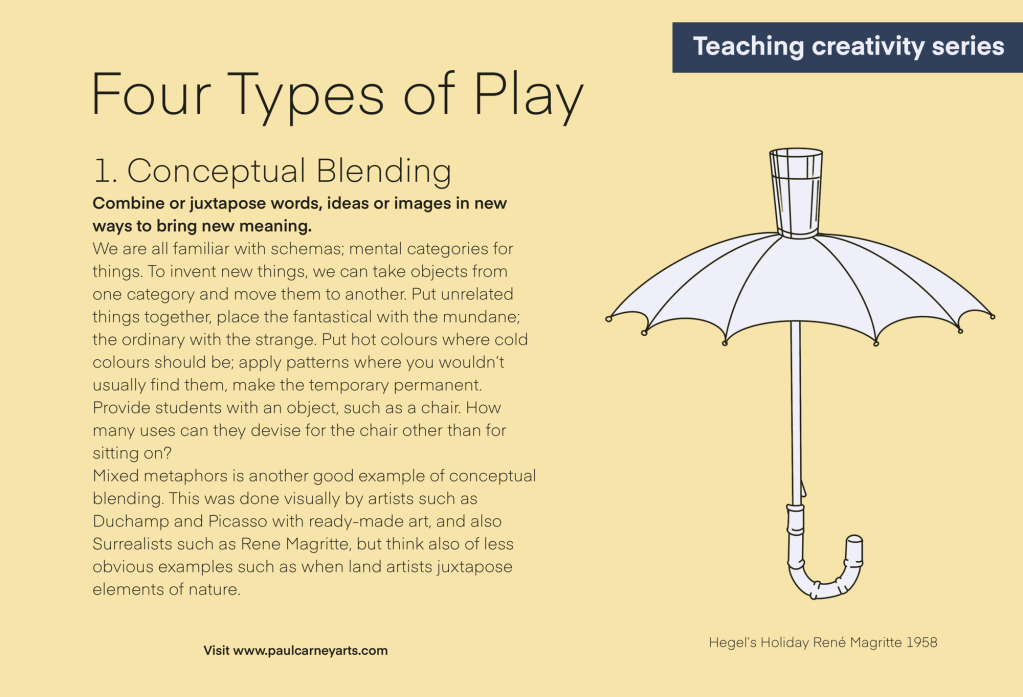
1. Conceptual Blending
Combine or juxtapose words, ideas or images in new ways to bring new meaning.
We are all familiar with schemas; mental categories for things. To invent new things, we can take objects from one category and move them to another. Put unrelated things together, place the fantastical with the mundane; the ordinary with the strange. Put hot colours where cold colours should be; apply patterns where you wouldn’t usually find them, make the temporary permanent.
Provide students with an object, such as a chair. How many uses can they devise for the chair other than for sitting on?
Mixed metaphors is another good example of conceptual blending. This was done visually by artists such as Duchamp and Picasso with ready-made art, and also Surrealists such as Rene Magritte, but think also of less obvious examples such as when land artists juxtapose elements of nature.
2. Reduce & Rebuild
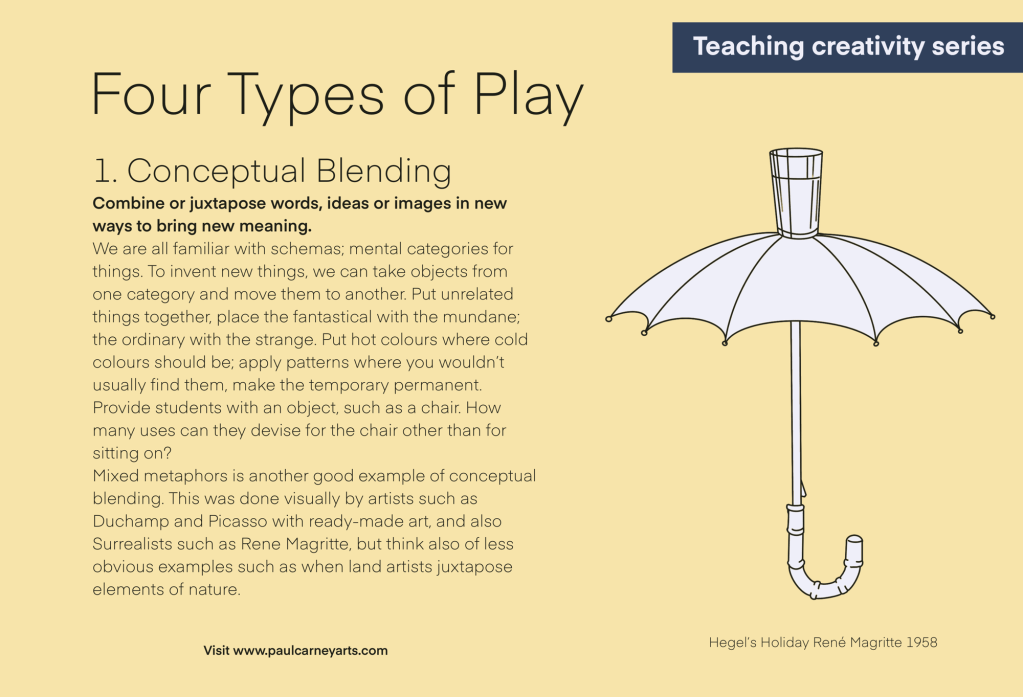
Something is reduced to its base elements then rebuilt in new ways.
A painter might observe the ripples of waves on water then transform them into a pattern. A sculptor might deconstruct the form of a seed pod, then utilise aspects of it into an abstract sculpture. Play by reduction: flattening, outlining with lines & borders, simplifying colours, removing complexity. Or play by rebuilding: decorating, embellishing, adding texture, detail, text, overlays. This is abstraction of course, it’s what Victor Pasmore taught on his Basic Course; we reduce complex forms to their constituent parts, then play around with them to invent new things. The Dadaists deconstructed reason and logic and remade it with irony, wit and absurdity.
3. World Play
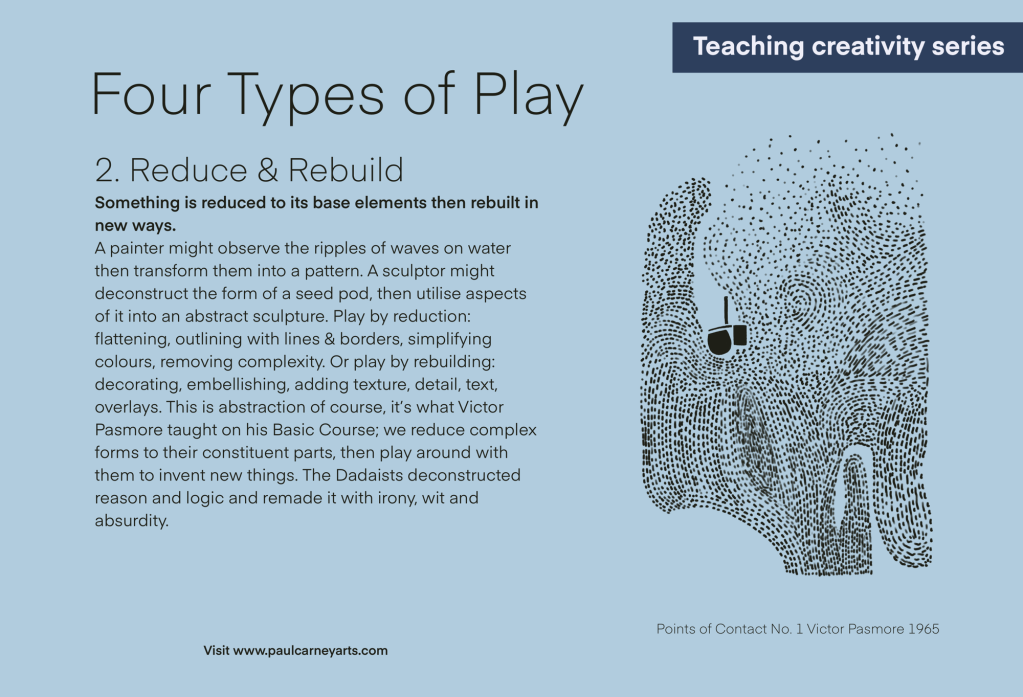
Inventing and depicting imaginary worlds.
The Bronte sisters had their Glass Town, Carl Jung was ruler of a medieval fortress, Nietzsche and his sister created a land for China figures, lead soldiers and a king squirrel. HG Wells was a pioneer of table top gaming with his game Little Wars. Alexander Calder built a hand made model circus.
Young people have worlds constructed for them in computer games such as Fortnite, or they make their own in Minecraft. But creating your own new worlds is pure escapism. You might work in groups and ask students to devise a new city, country or island; developing subsequent layers of complexity over time. World Play may be creating a whole world scenario, or it may be expanding a piece of art beyond its borders. For example, consider the environment it will be situated in and the audience it is intended for. How will it evolve over time and with usage? Perhaps you might create a series of works that relate to each other or make a specialist place from which they can be viewed.
4. Mimesis
Learn by watching and doing in real time.
According to Plato, all artistic creation is a form of imitation. We see this in art with schools of art; where artists share common ideals and work with a unifying theme. Sometimes this is an artistic style, such as Impressionism or the arts and crafts movement, sometimes it’s a common theme or subject matter such as landscape or still life. The key here is not to copy, but to find common ground and represent it in new ways.
We learn new skills via mimesis of course, but you can play with this process and compound the differences instead of accentuating the exactitude. For example, the Chinese Whispers art game, is where students study an image, which is then taken away and then drawn from memory. This is repeated multiple times around a group with the students working only from the previous drawing. The images are then compared afterwards.
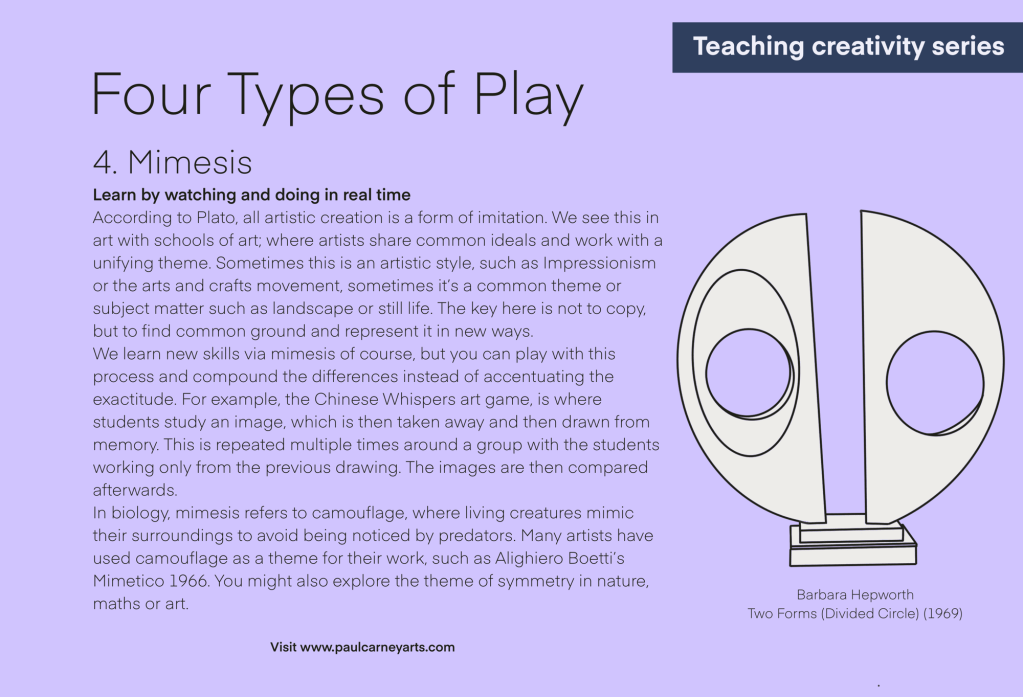
In biology, mimesis refers to camouflage, where living creatures mimic their surroundings to avoid being noticed by predators. Many artists have used camouflage as a theme for their work, such as Alighiero Boetti’s Mimetico 1966. You might also explore the theme of symmetry in nature, maths or art.

 Paul Carney’s Blog
It would be great to hear your thoughts about this