By Paul Carney
This blog post contains extracts from an essay by Anna Kindler – Art in early Childhood
“One man may sketch something with his pen on half a sheet of paper in one day, or may cut it into a tiny piece of wood with his little iron, and it turns out to be better and more artistic than another’s work at which its author labours with the utmost diligence for a whole year”. Albrecht Durer who died in 1519
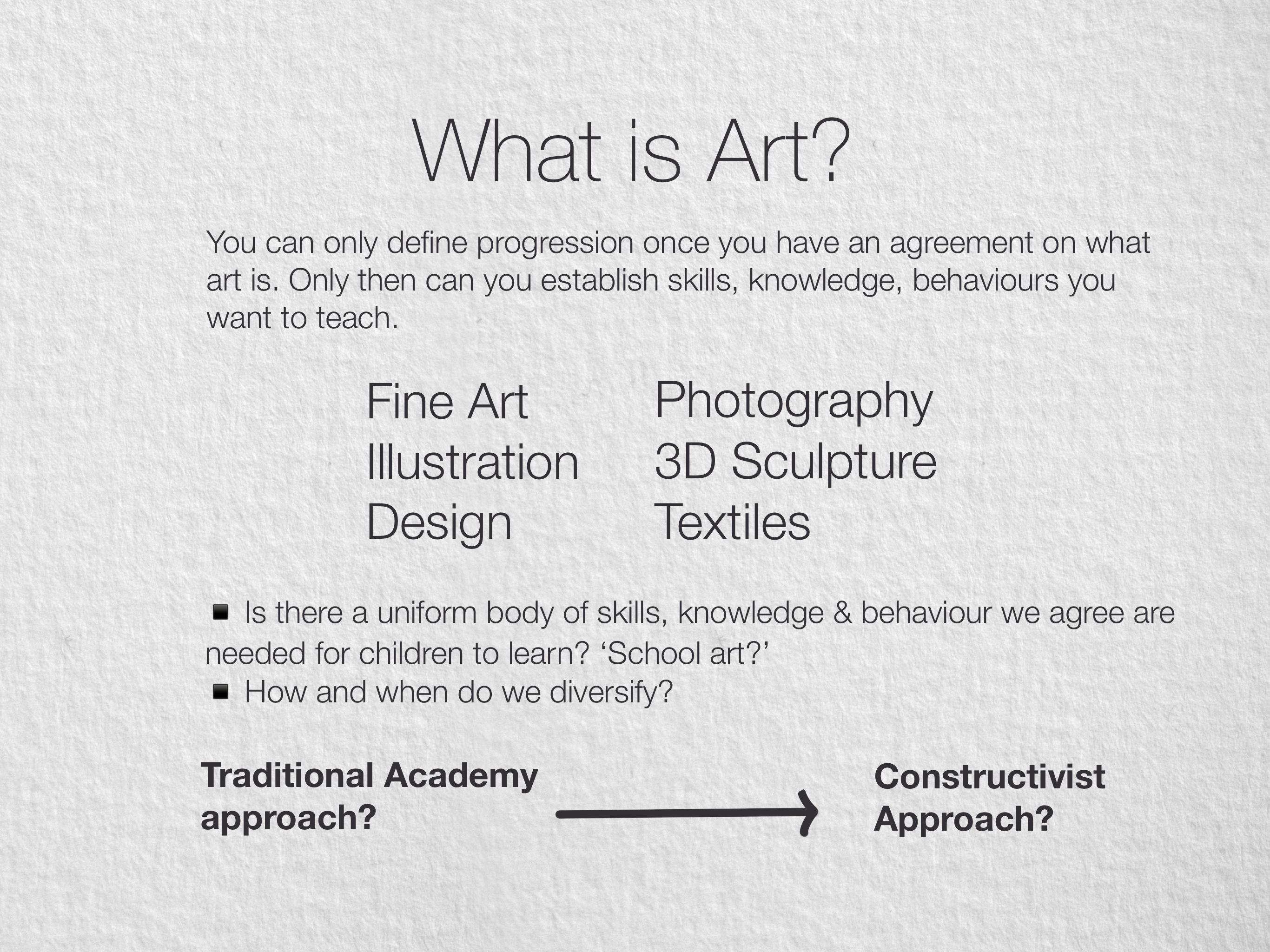
Professor Anna M. Kindler’s work in the 1990’s and 2000’s on artistic development in children has been extremely influential to me. I won’t try to summarise all her extensive research, but she states that you cannot define progression in art until you answer the question ‘what is art?’ This is not an easy question to answer but she outlines several education-based definitions of art:
Art can be anything definition Visual art might be described as any form of human pictorial activity, but this makes the definition of artistic development both impossible and unnecessary.
Art is creative expression (my addition) Again, this is very difficult to evaluate or quantify since it is highly subjective. What can be said however, is that expression as a form of exploration, risk taking, personal style and playfulness is a vital component in creativity and making art. We might not be able to clearly define what it looks like, but we can see evidence of these behaviours being undertaken.
Art is pictorial representation The key problem with pictorial representation is that the world of art has long abandoned visual realism as a likely endpoint in the development of artistry. It also focuses on two-dimensional representation and, essentially, a graphic vocabulary, paying little attention to any other attributes – such as quality of thought, for example, that arguably is not inconsequential in artistic creativity. These limitations make pictorial development theory not very useful for the purposes of helping us capture the complex nature of artistic development.
Art that functions within domain boundaries Artistic development can be related to the attributes and features which characterize artistic production of recognized artists and the expectations of the conventions of the artistic domain. Art critics, art historians, museum and gallery curators subscribe to this view. My additional text: Issues around these conventions centre on recent searching questions we have made around a lack of diversity and inclusivity in our cultural heritage. Has our very definition of artistic development been skewed by capitalism and elitist, biased notions of excellence? Many art movements certainly thought so.
School Art? (My heading) Art as a form of visual activity that conforms to some broad criteria of quality – with the notion of artistic development being the ability to create (art) that demonstrate progress along selected dimensions.
Whatever the definition, it is important to understand the long history of research into child development in art. Progression in art has been a subject of psychologists and artists for at least a hundred years or more. For the first half of the 20th century, psychologists focussed on how the cognitive growth and development of the human mind can be explained through drawing.
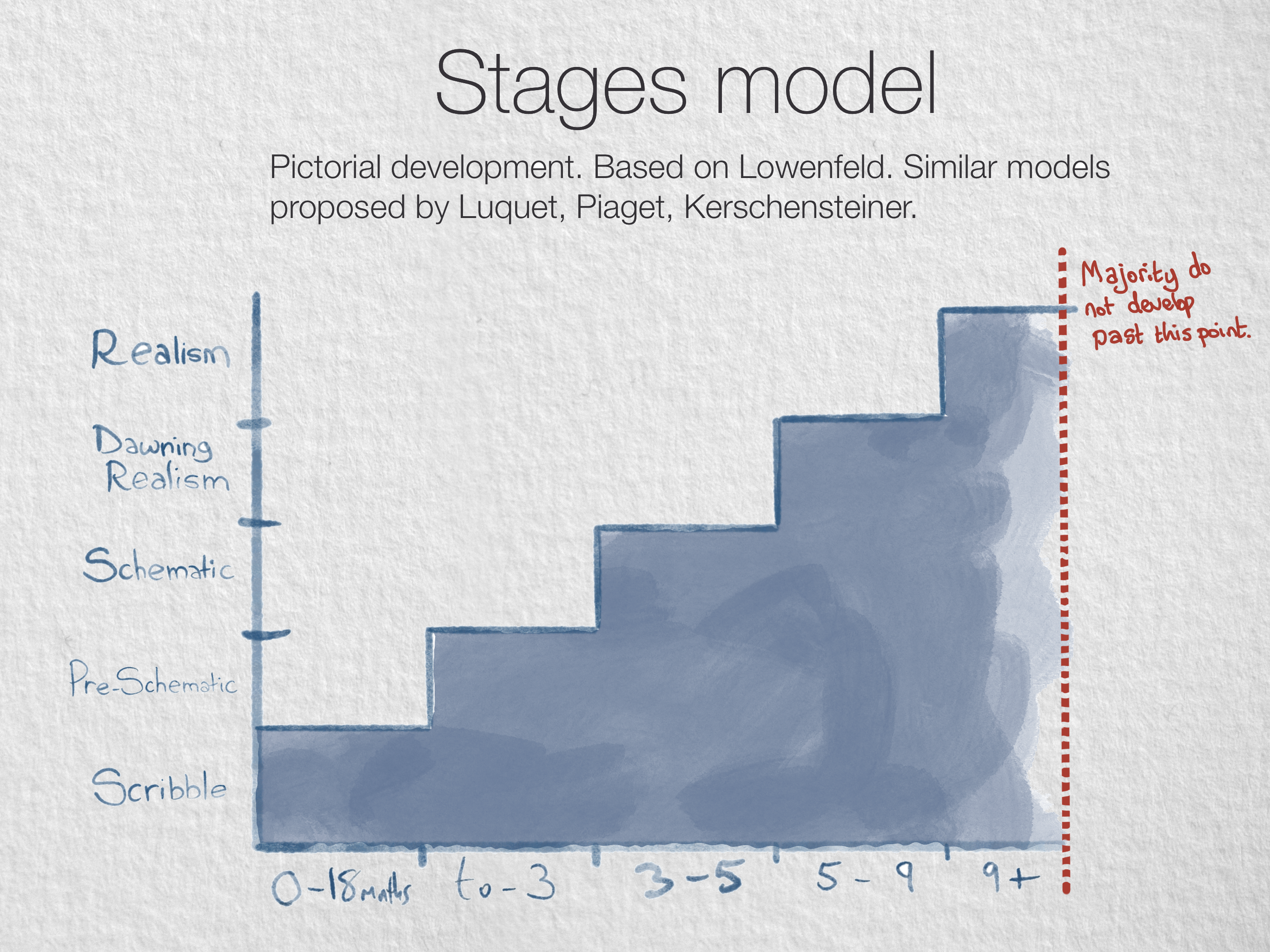
Pictorial development – the Stages model In the first half of the 20th Century, children’s drawings were studied for their illumination of the development of the minds of children, from a ‘primitive’ state to intellectual enlightenment. Many studies were undertaken by psychologists and thinkers such as John Dewey, Kerschensteiner, Luquet, Lowenfeld and Piaget.
Victor Lowenfeld’s 5 stages of artistic development perhaps summarise this thinking best:
- 1. Scribble Stage- (1-3 years old) At this age there is no connection made between the marks and representation during most of the scribble stage. This stage is mostly about the enjoyment of purely making marks.
- 2. Preschematic Stage-(3-4 years old) Children begin to make connections between the shapes that they draw and the world around them.
- 3. The Schematic Stage-(5-6 years old) Drawings are means of communication and narratives, but there is a lack of knowledge about perspective, scale, proportion etc.
- 4. The Dawning Realism-(7-9 years old) Children become more critical of their work. They are more conscious of achieving precision, order and structure in their drawings and compare themselves to their peers.
- 5. The Pseudo-Naturalistic Stage-(10-13 years old) Children at this stage of artistic development are very critical of themselves as there is an expectation to attain high levels of pictorial execution.
Aesthetic development In the later parts of the 20th Century, the development of children’s drawings were viewed through different lenses by child psychologists and artists such as Vygotsky, Bourdieu, Arnhem, Anna Kindler and John Willats. In this period, constructivism dominated educational thinking and approaches to cognitive development attempted to be more inclusive and all encompassing, looking at the wider scope of artistic development, rather than just pictorial development. I’ve read most of of these approaches but find them of limited use as working models for school-based art progression. I therefore have incorporated only those I found of most relevance.
U-curve model In the 90’s, Howard Gardner, Jessica Davis & Ellen Winner took a more aesthetic approach to artistic development. They used a set of criteria to determine the quality of artistic production of self-portraits that were assessed by expert judges based on Goodman’s aesthetic protocol. (Goodman, 1968). This protocol very clearly reflected an aesthetic value system corresponding to the modernist artistic heritage and related pictorial development to symbolic systems.
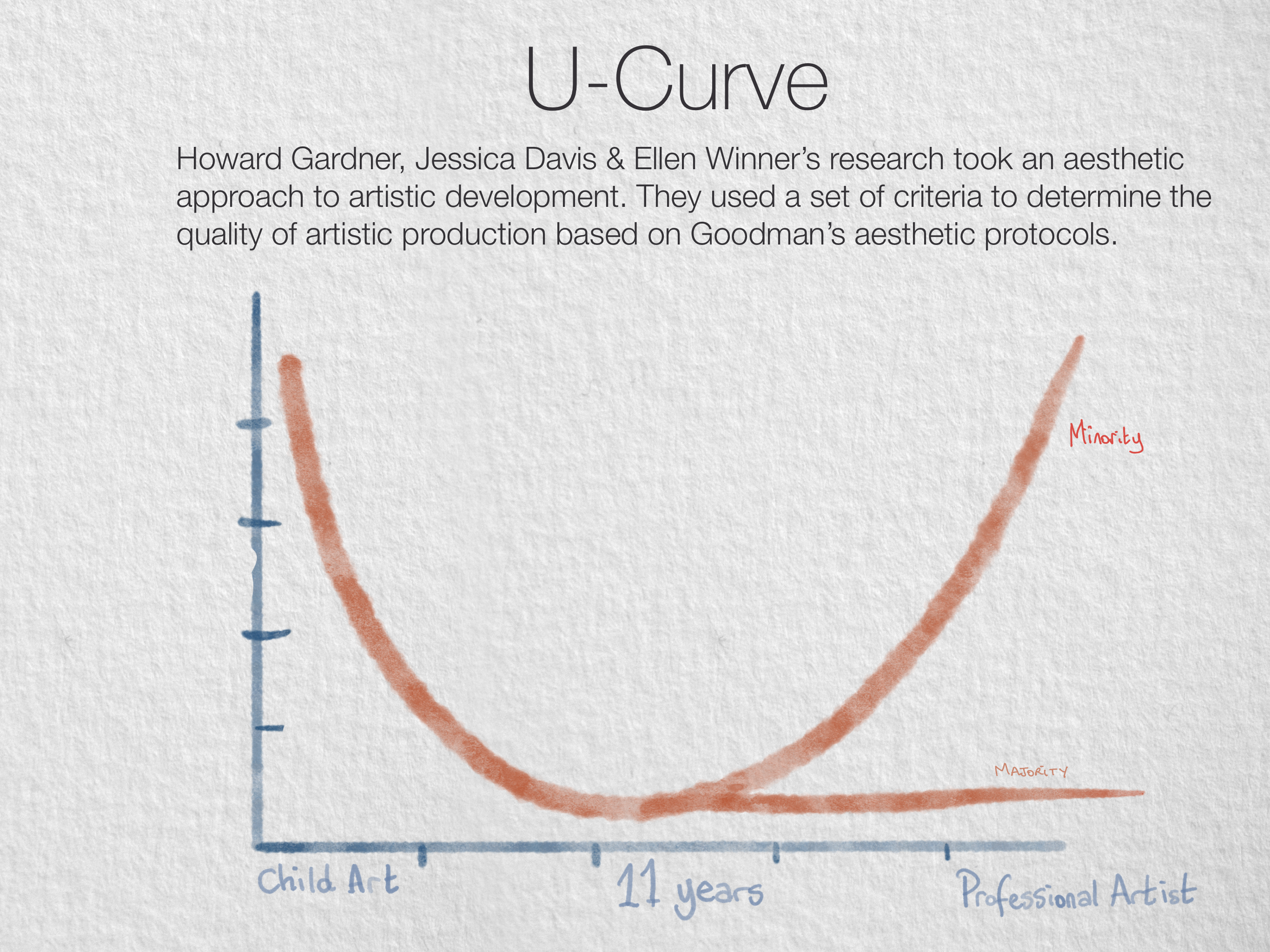
Davis then did a series of controlled experiments on the drawings of hundreds of people from kindergarten, to primary, secondary, students and adults, including professional artists.
What she discovered was that aesthetic aspects of art progressed in a U-curve, where children aged around 5 years had high levels of aesthetic attainment, similar to those of professional artists. They also found that attainment dipped considerably until the age of eleven, where it plateaued for most, but accelerated for a talented minority who gained greater artistic capacity. The U-curve model argues that artistic development does not proceed in a linear fashion and it does not necessarily involve improvement over time.
The U-curve model was heavily criticised, other researchers found it difficult to replicate when the artistic input included non-western sources. It was also pointed out that the framework for judging ‘artistic merit’ was very selective and modernist in approach. In my opinion, none of these criticisms detract from the findings of the robust research undertaken by Davis. In much the same way as we can argue that Lowenfeld’s step model represents only one strand of artistic progression, so the U-Curve model only represents the aesthetic element of art progression
When taken together, they form a pattern of artistic progression that I have experienced in 25 years of teaching art and that was substantiated by Ofsted’s Making a Mark report of 2011 by Ian Middleton, that outlined a decline in many aspects of artistic development from Year 1 to Year 9.
Conclusions and implications of the research The Lowenfeld steps progression model of pictorial development is a recognised, established and well researched model of how drawing develops in western children. It tells us that children go through a fairly well established series of stages of pictorial development, before hitting a realism plateau around the age of nine or ten, and that most adults do not proceed beyond this phase.
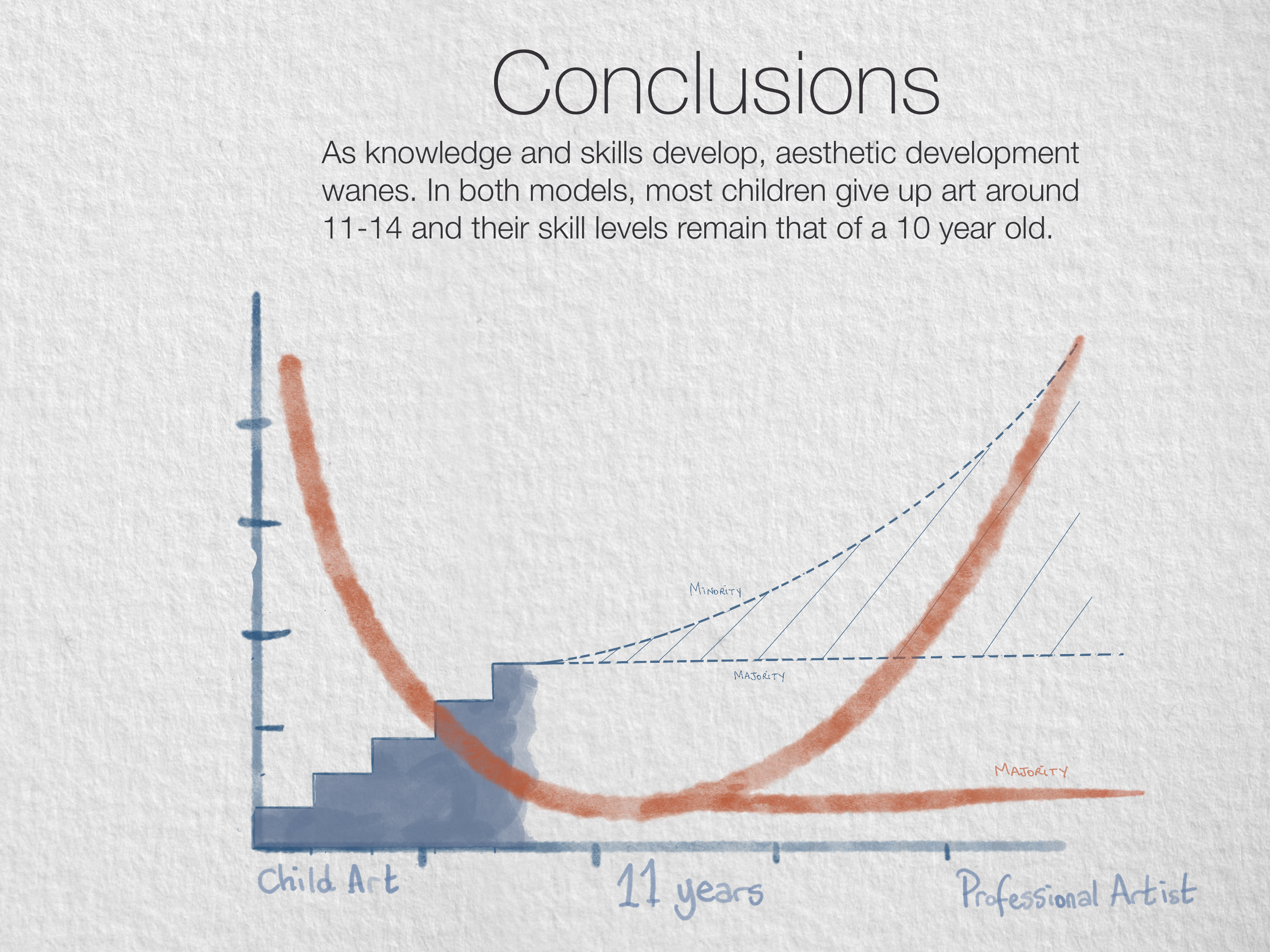
Gardner, Winner and Davis’ U-Curve models posits that aesthetic, artistic development wanes from around the age of five to age eleven, then rises again for some, but not for most. From this we can conclude that as children age, the cultural value we place on pictorial accuracy hinders artistic, aesthetic, creativity. This is not a product of school education, since most young children do not receive art instruction from specialists, but rather a society wide cultural norm.
As Goodman’s Aesthetic Protocol states and Rudolf Arnhem outlines in his 1973 book ‘Art and Visual Perception, a Psychology of the creative eye’, children acquire a pictorial symbolic schema from cultural references they are exposed to from birth. In short, children learn, from us, that lines must form pictures and that these pictures have order, precision and meaning attached to them. We could teach children that drawing objects or emotions in more symbolic, abstract ways is the norm, as other cultures such as Aboriginal cultures do. Our culture has developed systems of Cartesian perspective and illusions for modelling form on a two-dimensional surface, all of which are highly complex and difficult to learn.
Kindler’s systems model In the 1990’s and 2000’s, Professor Anna Kindler proposed an alternative theory of artistic development based on a systems approach that recognizes the dynamic interplay between the three key variables: the individual, the educational field and the domain, in conceptualizing artistic growth.
Kindler was critical of past approaches to artistic development that were based in psychology. She made rigorous studies of a wide range of contemporary Chinese artists who worked in traditional, sculptural and contemporary forms to identify the nature of their artistic development and identify, from their own experience, features and attributes that made their artistic success possible. She identified three dimensions of artistic development:
- Visual imagination/sensitivity – the ability to carefully and imaginatively attend to the natural and human made environment is foundational to creative performance in visual arts, no matter what form it may take.
- Understanding of the pictorial medium/technical proficiency – not in any specific artistic style (realism, expressionism, etc.) but rather development in any pictorial repertoire.
- Cognitive discernment/artistic thinking – the ability to discern between the trivial and the extraordinary, to understand deeper meanings behind art.
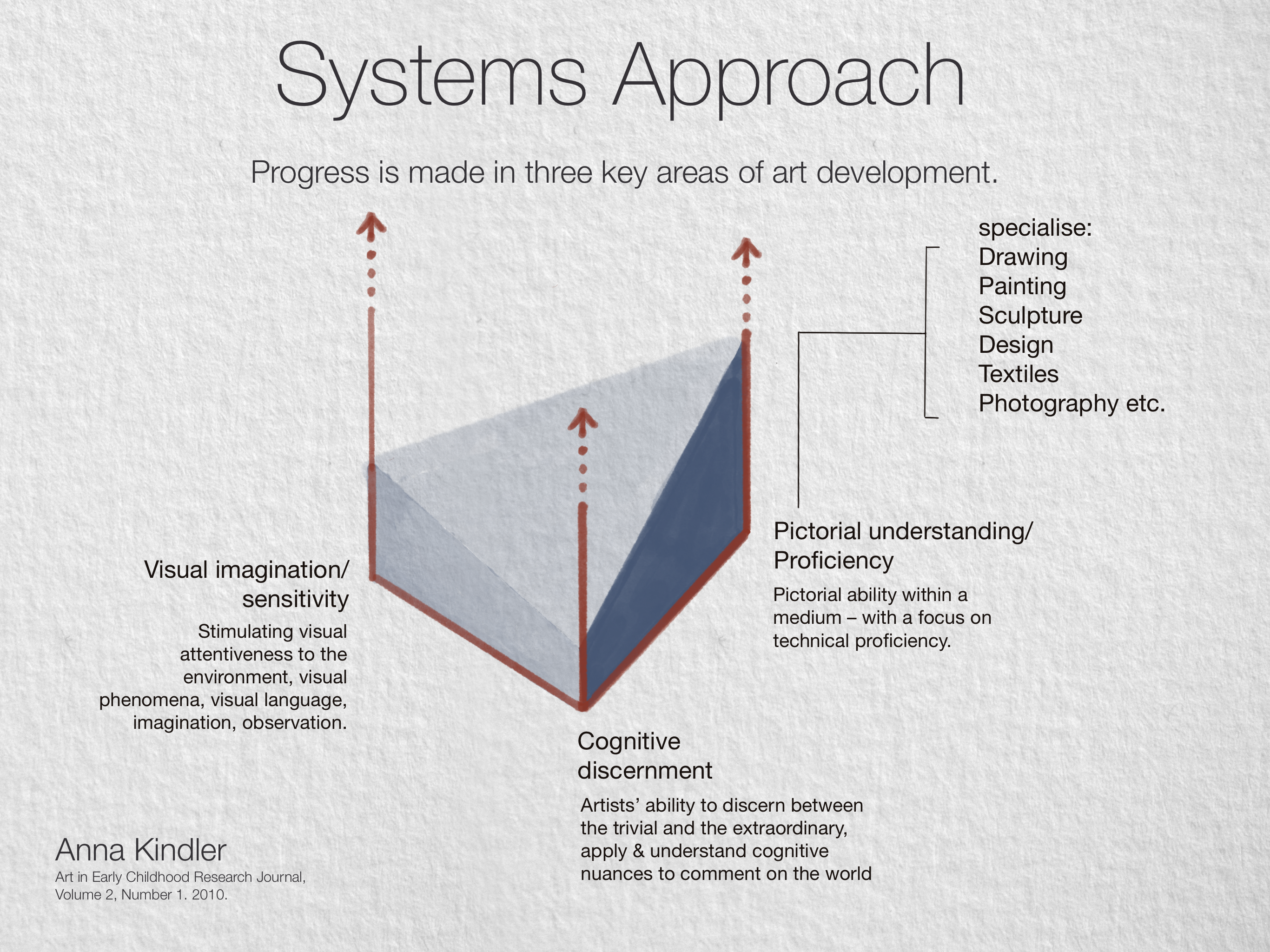
Kindler said it is vital to ascertain what exactly the children are learning, and establish how the art activities and the teacher’s role contribute to the achievement of worthwhile educational outcomes.
Kindler: There is not a single endpoint for graphic development, nor is “expression” the sole possible communicative intent behind drawing; rather, neophyte graphic artists can pursue a multiplicity of goals and intention.
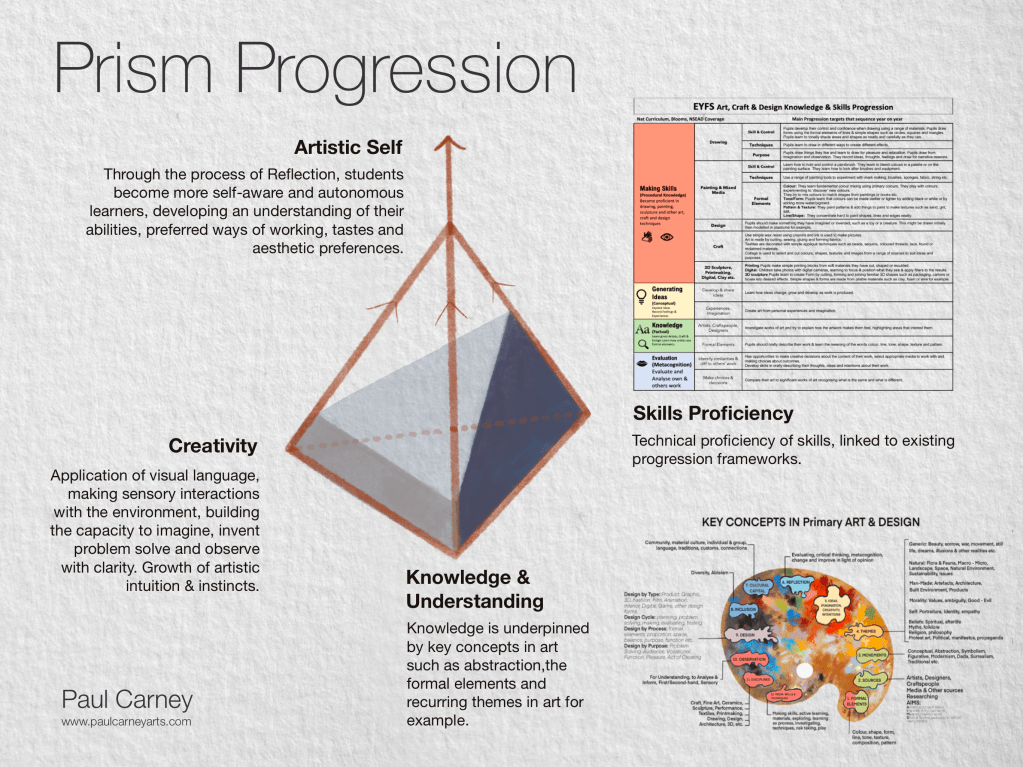
A Prism Progression model
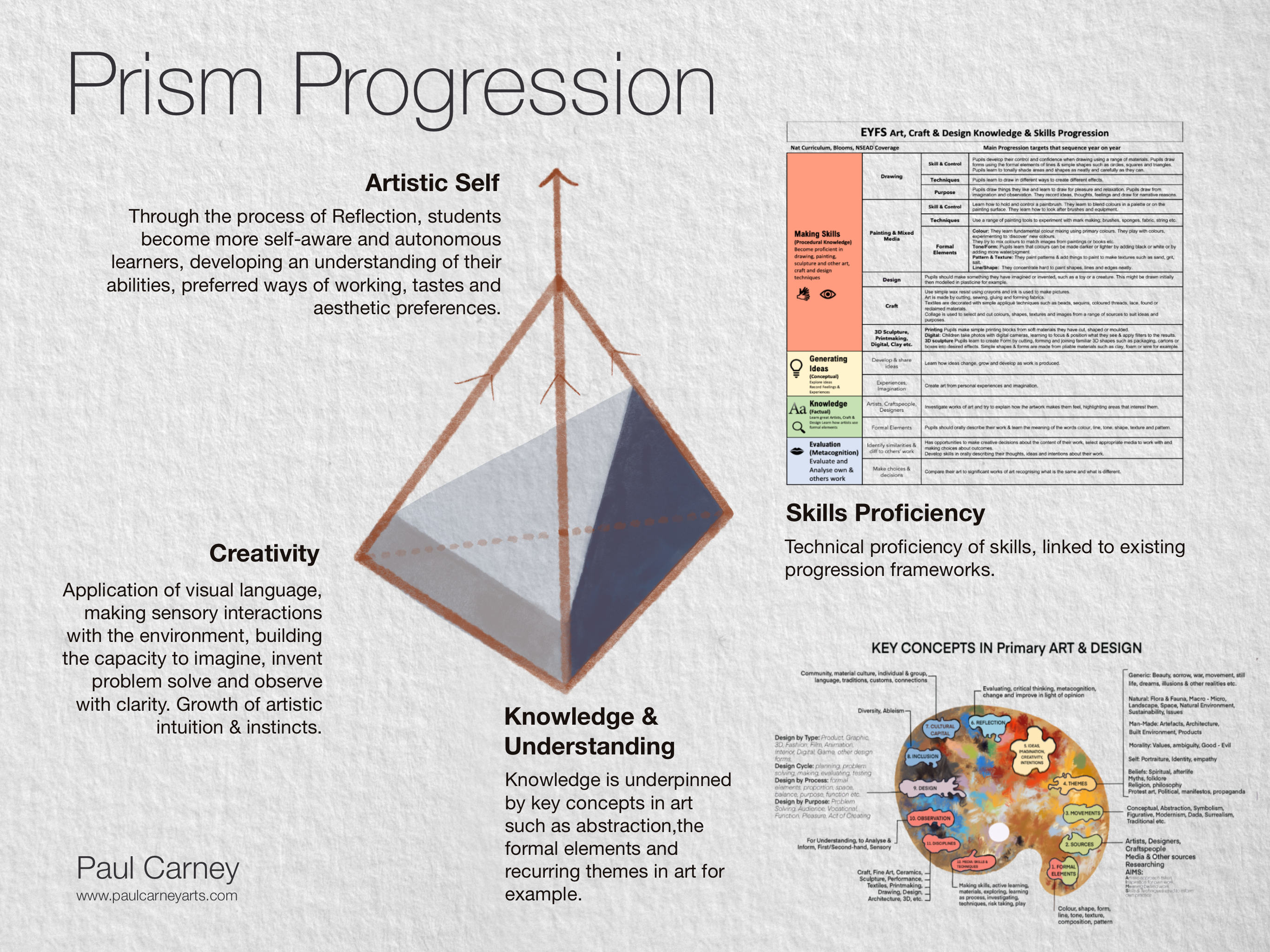
Artistic Self In my Prism model a fourth area for art progression would involve a focus for the development of the artistic self. Being self-aware, children would be able to articulate their likes and dislikes, tastes & preferences, in addition to exercising control and autonomy in the creative directions they wish to take, under guidance from the teacher. The three attainment areas of skills proficiency, conceptual knowledge & understanding and expression would combine in greater or lesser amounts depending on the educational intentions. It is perfectly plausible to envisage instances where any of these could be taught in isolation, but I think a balance of these in curriculum planning would ensure that art progression provides a breadth of experience.
Skills Proficiency We can relate Kindler’s systems model to current educational practice, where knowledge and skills based progression form the technical proficiency dimension. Most schools have a model of skills development in place and this would be slotted into this position in my model.
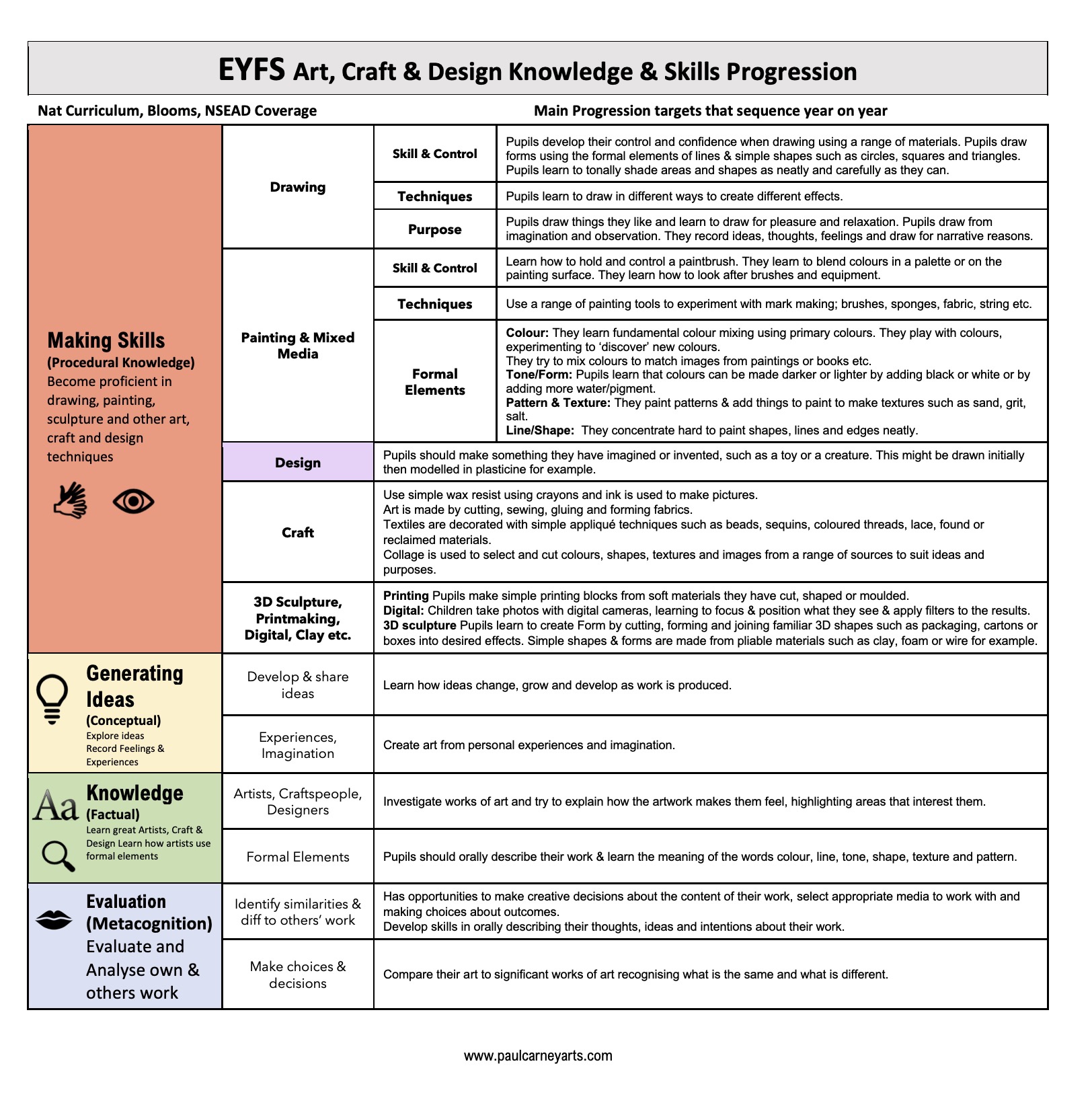
Note however, that Kindler strongly emphasises student autonomy in the development of media. She does not advocate development in any specific pictorial repertoire (such as optical realism, expressionism, etc.) but rather to a level of mastery of any pictorial repertoire – both traditional and non-traditional modes of representation. Her findings pointed to the significance of the artists’ profound understanding of the full potential of the medium, his or her “control” in its use, and the impact that it has on unleashing one’s creative ideas.
Creativity Encompassing both Kindler’s visual acuity and sensitivity dimension and Rudolf Arnhem’s Gestalt-centric ‘Art & Visual Perception’, creativity should address imagining, making meaning, expression, visual observation and perception and the ability to think and communicate in visual terms. It should cover the creative application of visual language in practice, making sensory interactions with the environment, building the capacity to imagine, invent, problem solve and observe with clarity. It should also comprise the growth of artistic intuition & instincts. Essentially therefore, this attainment area attempts to address the need for open-ended, creative art activities, rather than prescriptive, closed outcomes that all look identical. To this end, I think imagination is of profound importance. Imagination has, in recent times, been placed under the umbrella term ‘generating ideas’ which provide a focus and purpose, but I think also narrows the role of our imagination to being a device for coming up with ideas for (usually teacher-led) projects. Imagination is a much broader, more useful description of what we should aim for in art education in my opinion, especially if we encompass Kindler’s visual imagination and sensitivity descriptions. This is adapted from Wikipedia:
- Imagination is the ability to produce and simulate novel objects, sensations, and ideas in the mind without any immediate input of the senses.
- Imagination is the forming of experiences in one’s mind, which can be re-creations of past experiences such as vivid memories with imagined changes, or they can be completely invented and possibly fantastic scenes.
- Imagination helps make knowledge applicable in solving problems and is fundamental to integrating experience and the learning process.
- Imagination involves thinking about possibilities.
- Involuntary imagination involves day-dreaming or dreaming.
- Imagination can also be expressed through narratives, fantasy or play.
Knowledge & Understanding – Key Concepts What Kindler calls Cognitive discernment/artistic thinking, is something I think relates strongly to prior attainment targets of old that we called knowledge and understanding, but are now more fashionably called Key Concepts. Key Concepts are the underlying meanings and principles behind culturally significant art. I’ve done some work on this, because they aren’t actually formulated anywhere as far as I can see. However, there are some key concepts I think that would be beyond dispute, such as formal elements or abstraction. I would welcome discussion on this issue.
My key concepts are; formal elements in both theory and practice, choice of media, design, making & craft, knowledge of artists’ intentions and art movements, creativity, inclusion, reflection, diversity, observation and themes in art. For a more detailed description of Key Concepts, visit www.paulcarneyarts.com
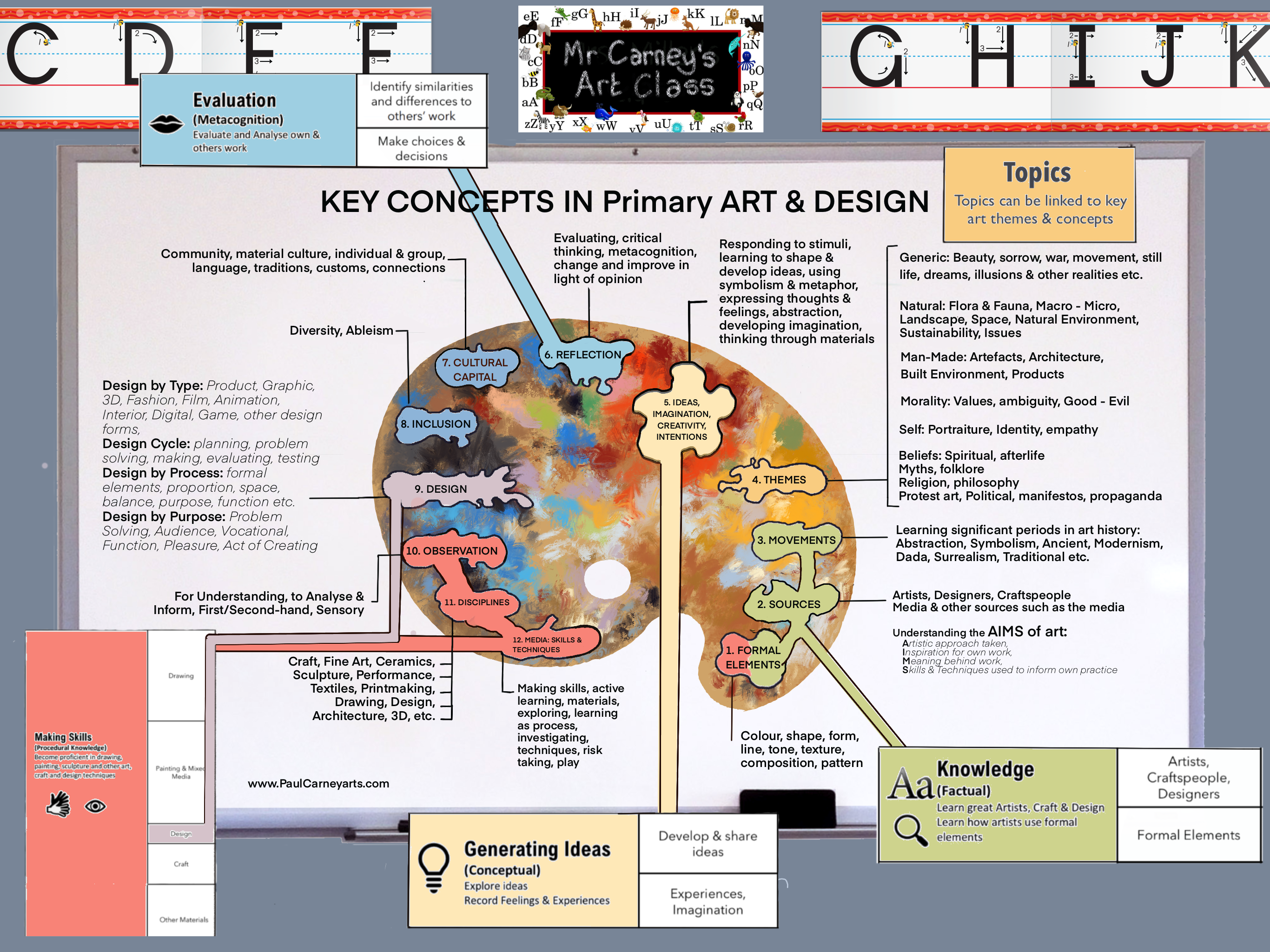
Summary; I advocate the Prism Progression framework as a growth model, where children constantly evolve these three attainment areas from EYFS onwards. Complexity can be staggered over time, but I don’t really envisage a rigid step model as has been developed for skills progression because I think areas such as imagination don’t follow these patterns. Gardner’s U-Curve has taught us this. Exposure to, and opportunities provided for application in a range of circumstances should suffice, but I think this needs more work.
Reflection should form a strong element at the creative outcome stage. In the past we have used the term evaluation to describe artist reflection, but I think this has limitations. Evaluation is the process of judging or calculating the quality, importance, amount, or value of something. Reflection involves describing, analysing and evaluating our thoughts, assumptions, beliefs, theory base and actions. In this way, reflection is a broader term more useful for educational development.
Every project you do should incorporate knowledge and skills delivered through unique, creative opportunities for your pupils to develop their own artistic abilities.
Example project planning For example, a primary teacher might be teaching the children about the Egyptians and want to deliver an art unit as part of this topic. All they would need to is to do a bit of backwards planning – think of the learning outcomes first. They might want the children to understand that the key concept that the Ancient Egyptians did not have a word for art for example, that every piece of decoration they made was part of a spiritual belief. They might select certain skills they feel are appropriate such as painting or 3D making for their technical proficiency. Then they might devise a project with an open outcome that involves the children utilising their imagination to produce a creative outcome, such as producing a piece of sculpture in an Egyptian style, based on their own beliefs. They then review and reflect on their own and others’ outcomes and make judgements about their own progress and the learning they have made.
References
Art in early Childhood, an essay by Anna Kindler http://www.artinearlychildhood.org/artec/images/article/ARTEC_2010_Research_Journal_1_Article_1.pdf
Child development in art by Anna Kindler https://www.amazon.co.uk/gp/product/0937652776/ref=x_gr_w_bb_sout?ie=UTF8&tag=x_gr_w_bb_sout_uk-21&linkCode=as2&camp=1634&creative=6738
Creative and mental growth Viktor Lowenfeld https://www.amazon.co.uk/Creative-Mental-Growth-Viktor-Lowenfeld/dp/0023721103
From the U-Curve to Dragons: Culture and Understanding of Artistic Development Anna M. Kindler https://www.jstor.org/stable/20716006

 Paul Carney’s Blog
It would be great to hear your thoughts about this