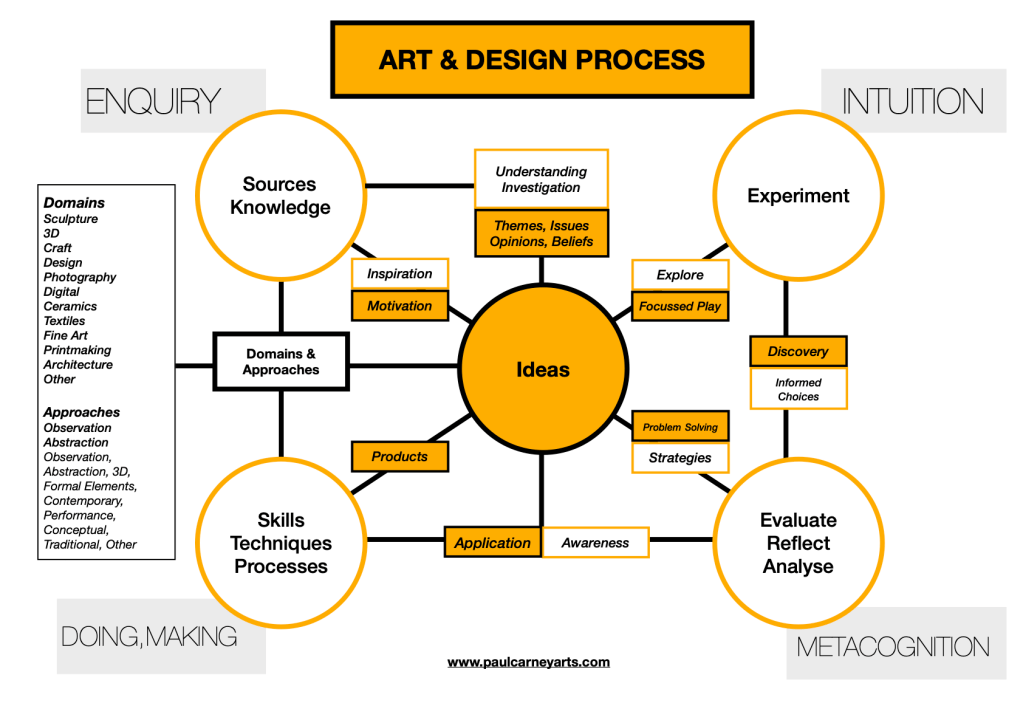
Making art is a complex, diverse process that can take many forms and be shaped by a wide range of factors. I’ve attempted to outline the main ones in a series of graphic organisers that could help teachers plan activities and support students in their studies.
This graphic organiser places Ideas at the centre of a five point shape that includes Sources of Knowledge, Skills & Techniques, Experimenting and Evaluating. No one area is more important than another. It may be that you are only focussing on one or more areas at any one time, but in a full project such as an Externally Set Assignment for examination, you’d want to cover all areas.
Domains & Approaches precede all five learning areas. These should help identify which area you are working in and I’ve listed some common ones:
Domains: Sculpture 3D, Craft, Design (Graphic, Fashion, Interior/Product), Fine Art, Photography, Digital, Ceramics, Textiles, Printmaking, Architecture.
Approaches: Observation, Abstraction, 3D, Formal Elements, Contemporary, Performance, Conceptual, Traditional, Other
Connecting each learning area are a series of prompts to highlight key pathways:
Sources/Knowledge is connected to Ideas by Approaches, Inspiration and Understanding/Investigation. These three areas should help focus the use of sources into meaningful ways. Connecting Ideas to Sources in the other direction is Themes/issues/opinions and beliefs as well as Motivation. By connecting them in this way we can see that artists and sources can inspire and motivate us, as well as that looking for deeper meanings behind work can provide us with the common themes and issues that shape both art and our society.
Skills & Techniques also link to domains and approaches because they are influenced heavily by the domain we are working in. Skills link to Ideas via products, which are less final outcomes that could lead on to more conceptual pieces. Skills also lead to Evaluation through increased Awareness which comes from greater application of skill.
Ideas in art can come from focussed play and by exploring the potential of media. Ideas also link to Evaluation through briefs and problem solving activities that demand we consider, analyse and reflect on the problems in hand. These problems require us to apply metacognitive strategies to answer them.
The final area of the process organiser is the link between Experimentation and Evaluation. The act of experimentation leads us to discoveries that should then inform our future choices for our art.
We can however follow the graphic organiser in numerous ways and I’ve outlined some of these below.
Knowledge led method
In this model you begin by investigating the source of inspiration which may be a work of art, or a news article, a photograph, film or piece of text. You would have an idea of the medium you want to work in and a style of approach you want to take.
From there you should evaluate and analyse your research to consider directions you want to take the work in. Ideally, you should develop your ideas into more sophisticated forms, before taking your work into trials, explorations, modifying your outcomes and trying to develop your skill and technique, before attempting a final outcome.
Knowledge led method
Ideas led method
In this model you begin with an idea, which may be a response to a question or starting given to you by a teacher, an examination question, or a brief from a client. You’d want to develop this idea in rough form before investigating sources that could influence and shape your thinking. After this you should reflect on what you’ve done so far, forming thoughts and opinions on the direction you want to take. You may even alter the medium you want to work in, and you’d do this through experimentation to find which works best. This would operate in a cyclical process with development of your skill and technique before you execute your final intentions.
Ideas led method
Skills led method
With a skills led approach you would usually begin through observation of sources, but sometimes it may be by modifying previous work. You’d be practising and developing skills through practical activities such as printmaking, photography, ceramics or drawing for example. You would then look to sources of artist practice to inform your own work and to learn from them. This should then inspire new ways of thinking about your original work and could lead into further, more experimental work. This could be part of a cyclical process where you are moving through each of the individual areas as and when you need to.
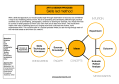
Skills led method
Experimental led method
Sometimes in art and design we begin by curious investigations that are shaped by our existing knowledge and motivations. These lead to ideas for future pathways, but it is still important to look to other artists’ work in order to validate our intentions. It may be that this has been done before. If so, how? Can what has gone before help us modify our responses and shape our ideas? This would take us into developing the skills, techniques or processes behind our idea, in order to ensure the final execution of our work is as good as it could be.
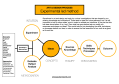
Experimental led method

 Paul Carney’s Blog
It would be great to hear your thoughts about this