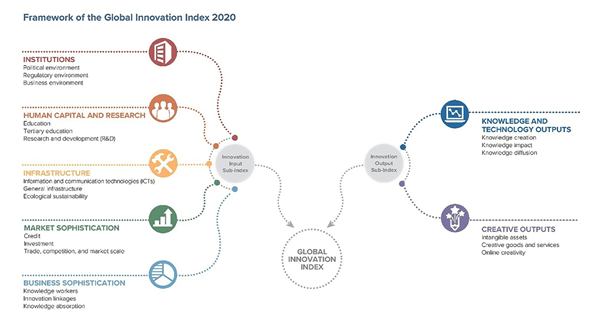
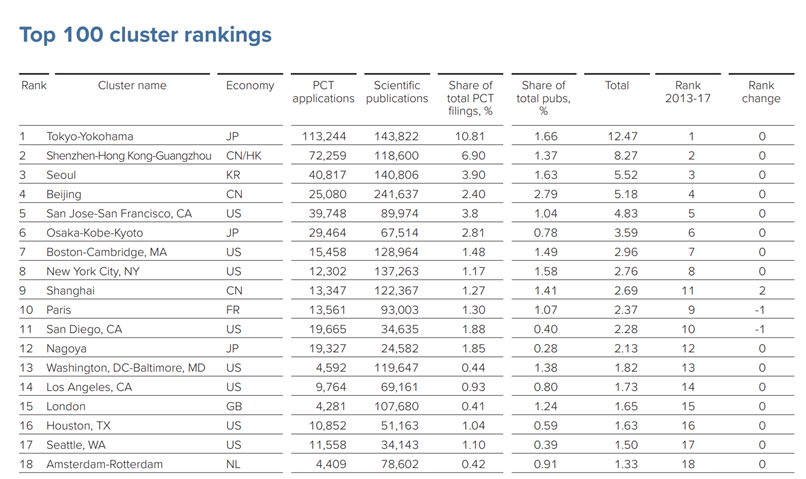
The UK has been ranked as the 6th most innovative nation in the world by the Global Innovation Initiative in 2020. There is a lot we can be proud of. But if we are to improve our global position then our production of new patents needs to improve. Our leading University, in London, produced an impressive 107,680 science and technology research publications in 2020, yet it only produced 4,281 patents for original inventions. That is less than one twentieth of the research total. The leading city, Tokyo produced 143,822 research papers (only 36,000 papers more than London) yet they also registered an impressive 113,244 patents.
There may be many valid reasons for this, and no blame is attached to London, but we need to examine why this might be and take action to improve our level of innovation. This means our schools, colleges and universities must teach students how to innovate, create and invent from the knowledge they gain.
We must alter our path from being largely producers of knowledge to both producing and applying knowledge for original purposes.
What is the Global Innovation Index?
Innovation is a central driver of economic growth and development, and the Global Innovation Index provides insightful data on innovation to assist economies in evaluating their innovation performance and making informed innovation policy considerations.
The Global Innovation Index report of 2020 makes for interesting reading. This year the GII model includes 131 countries/economies, which represent 93.5% of the world’s population and 97.4% of the world’s GDP in purchasing power.
Where does the UK stand in the GII?
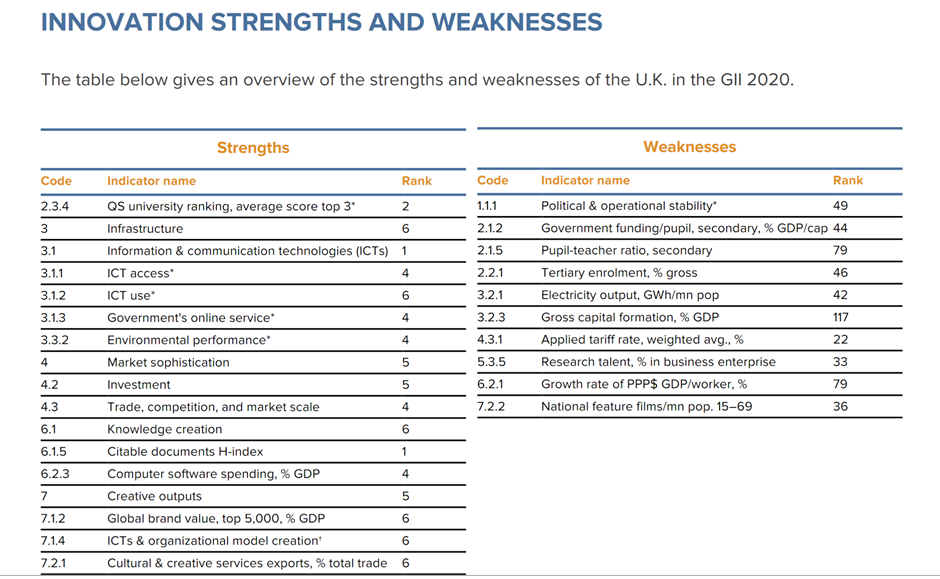
In relation to other high-income group economies and Europe the U.K. performs above average in all seven GII pillars.
So, we have much to be proud of in the UK. We are among the world’s leading global innovators. In 2020, the UK has improved in industrial design, it has strong global brands, some of the best universities in the world and is a world leader in scientific publications. We have four of the world’s top 100 science and technology clusters, are 6th in the world on the Global Innovation Index, and the U.K. produces more innovation outputs relative to its level of innovation investments.
The UK has improved in the GII areas related to infrastructure and creativity, thanks to a combination of performance improvements and changes to the GII model.
• The U.K.’s ranking has improved notably in the indicator Industrial designs.
• The UK scores highly on global brand value, with 314 of the top 5,000 brands worldwide.
• The country ranks 2nd globally according to the indicator Quality of universities, being home to the universities of Oxford and Cambridge, which are among the top 10 universities in the world according to various rankings.
• The U.K.is also the world leader in the quality of its scientific publications.
• In addition, the U.K. hosts four of the world’s top 100 science and technology clusters: London (15th), Cambridge (57th), Oxford (71st) and Manchester (93rd). Cambridge and Oxford are also the most science and technology-intensive clusters in the world.
• The U.K. produces more innovation outputs relative to its level of innovation investments.
How might we improve our position?
Clearly, we have some of the best brains in the world and have good reason to be proud of our position. But we are far from the top, so how can we catch up to countries such as the USA, China, Korea, Israel, Germany, Sweden and Switzerland?
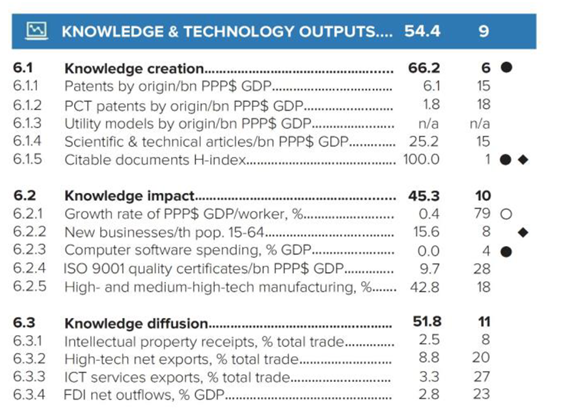
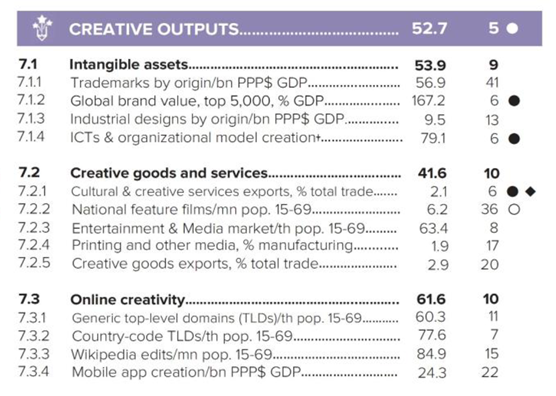
Delving deeper into our performance in the GII’s two main output performers, we can see that our Creativity sector is heavily reliant on global brands, ICT, entertainment and media and creative services, but could improve in trademarks, feature films, mobile apps and creative goods exports.
Our knowledge creation is good, thanks to our excellent scientific research, but there are areas of knowledge impact and diffusion that can be improved. And our rate of registering new patents is a fraction if our knowledge production.
The Patent Problem
One significant area of improvement is that of patents, especially those in the science and technology sector.
A patent is an exclusive right granted for an invention, which is a product or a process that provides, in general, a new way of doing something, or offers a new technical solution to a problem.
Across the whole GII index we only rank 15th and 18th in the world, yet we lead the world in scientific publications and academic research. However, Houston Texas only publishes half the scientific research papers London does, yet doubles its number of patent applications. Global innovation leaders Tokyo, Hong Kong and Shenzen, China publish around three-quarters of the number of patents compared to scientific publications. Shenzen-Hong Kong only produce 11,000 thousand more scientific publications than London’s 107,000k yet they produce nearly twenty times as many patents. Surely, if we are to become global leaders, we need to increase our patenting output?
How do we increase our patenting capacity?
To increase this area of our expertise we would need further investment as I have outlined, and this will be difficult, given the shrinking of investment forecast due to Covid19.
Clearly, we need to do more with the resources we have. Currently, our education system is heavily centred on further increasing our knowledge base at the expense of innovative thinking. It is believed, and actively promoted, by policy makers, that creativity cannot be taught and it will automatically result from increasing our knowledge base. The evidence shows otherwise.
Improving Education
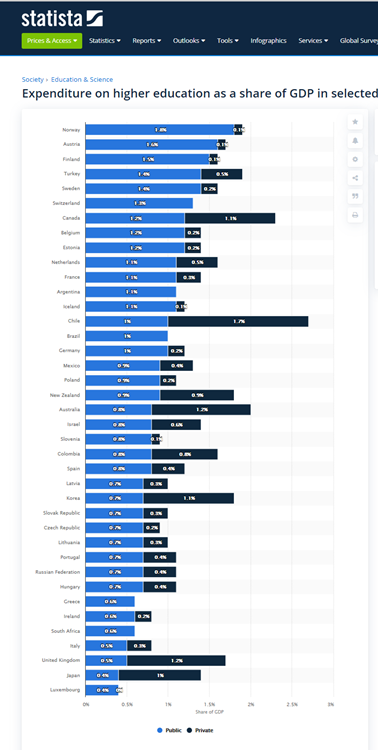
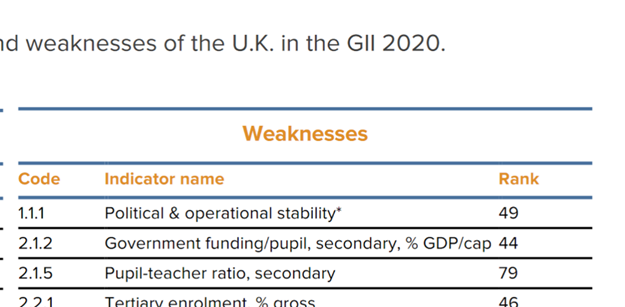
Education is one significant area for improvement. Despite our highly rated Universities at Oxford, Cambridge, London and Manchester, Higher Education Spend in UK per % of GDP is some of the lowest in the developed world. We also rank 44th in the world for government investment in primary and secondary school education as a % of GDP and 79th in the world for pupil-teacher ratio. This unbalanced educational performance is surely cause for concern and more investment is needed to create a level playing field.
Research and development funding
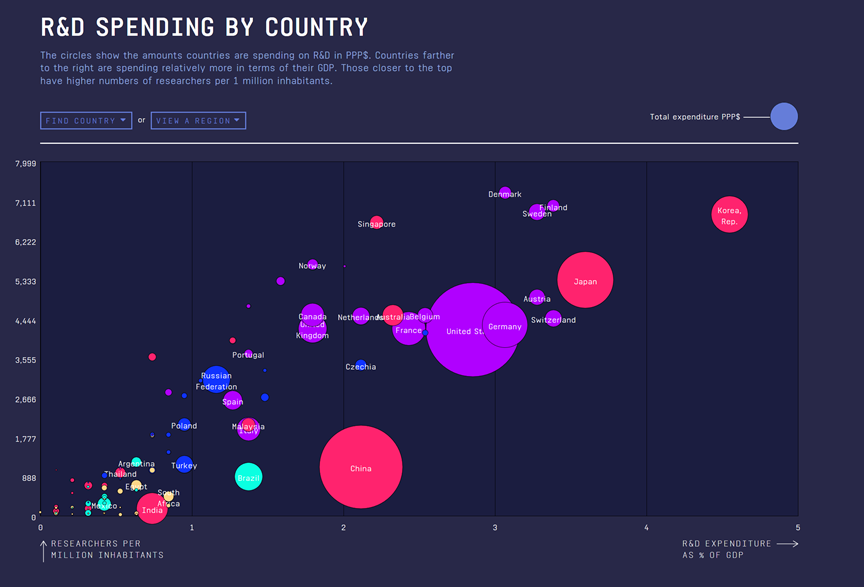
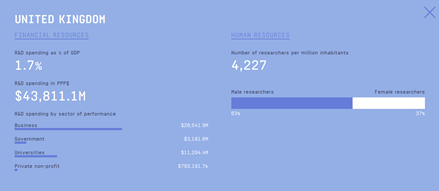
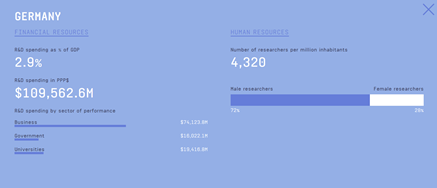
Research and development funding in the UK is quite good, but less than half that of Germany and less than France too. Although these three countries have almost identical numbers of researchers per % of population, Germany’s funding (at 109,500M) is more than double the UK’s (at 43,800M). Germany’s government provides 16,000M of that sum, whereas the UK government provides only 3,100M. Business investment in R&D in Germany is nearly three times that of the UK also.
Summary
We are global leaders in knowledge-based publications, but we are not producing anything like the number of patents we should be.
Creativity experts such as Professor Bill Lucas, who is the Director of the Centre for Real-World Learning (CRL) has written extensively about how creative thinking might be better facilitated in our education system. He is a world-renowned expert in this field and advises PISA on creativity measuring. Surely, the conversations must be had at the highest levels and action must be taken, in order that we might move up the GII rankings and become, not only a global leader in knowledge production, but also in producing innovative inventions?
Even if you do not believe creativity can be taught, you must acknowledge that other nations register more innovative new patents than we do with similar (or less) knowledge and expertise. What are they doing that we aren’t? And how do we catch up? What aren’t we doing that we need to?
Paul Carney
NSEAD registered Art & Design Education Consultant
http://www.paulcarneyarts.com
Author of Drawing for Science, Invention & Discovery
NSEAD Council member
Twitter – @PaulCarneyArts
Sources
https://www.globalinnovationindex.org/about-gii#keyfindings
http://uis.unesco.org/apps/visualisations/research-and-development-spending/
https://www.statista.com/statistics/707557/higher-education-spending-share-gdp/
https://en.m.wikipedia.org/wiki/Category:Inventions_by_country

 Paul Carney’s Blog
It would be great to hear your thoughts about this