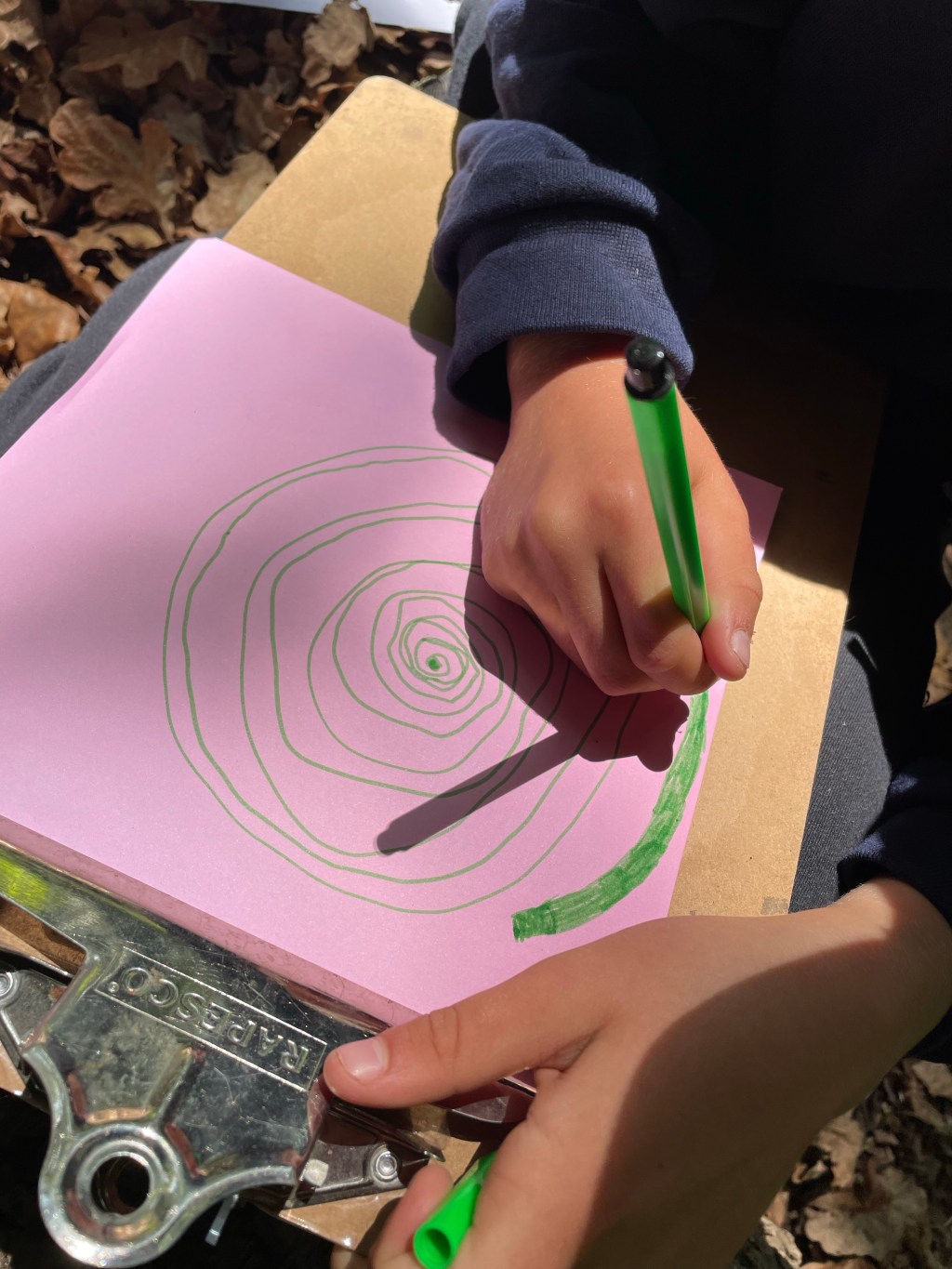
Ok I accept this may be a fairly contentious blog post and that not everyone will agree with me, but here’s my two penneth worth.

Outcome driven art
Most of the art in schools I see is outcome driven. In Primary schools it is the corridor display that determines the kind of Art that is taught. It used to be that ALL students would see their work displayed but these days it is more common to see only the best work shown. Art projects at this phase are topic driven and so usually the art is also taught in a very limited range by a non-specialist art teacher. By and large art is judged by how good it looks on a wall with very limited understanding of the learning processes behind it or even how much of it is actually the pupils own work. There are some wonderful exceptions in Primary of course and so this post isn’t addressed to them.

Exam driven art
In Secondary and Further Education art is predominantly taught by expert art teachers and as you’d expect the quality of outcome improves. Yet larger forces are at work that are even more powerful than the primary display. I’m talking about exam art of course and exam expectations pervade almost everything students are taught from year 7 onwards regardless of the fact that a large percentage of students will never study art to exam level or indeed never have another art lesson in their lives. 
So the GCSE and A level exam criteria mould and shape the art teachers thinking, their ideas of progression and ability. The projects they design explicitly attempt to make students more able to succeed at exam and in this way, quality of outcomes, presentation and organisation  dominate our success criteria. Four assessment objectives and an assessment rubric make up what for most of us is our professional working lives, yet are they any good? I’d say they are partly successful but also damaging in equal measure.  

Despite the best efforts of the exam boards they still reward realistic technical mastery and good presentation and punish failure. A sound accomplished still life drawing is still worth more marks than a promising idea that didn’t come off. The assessment rubric encourages teaching to specific goals and checkpoints in order to measure success rather than a holistic learning experience. 

Recipe Art

And so recipe art becomes the norm, teachers teach projects they know will reap the best results and outcomes because the exam system determines that they daren’t fail. Is this good Art? I’d say not. I’d rather a pupil draw a picture of his favourite car and be proud of it than make a lame copy of a Picasso painting (or even paint his car in a Picasso style). 
What it all comes down to is planning. Where planning dictates and controls the outcome you can artificially improve the quality of what the pupils produce but you are impeding their ability to imagine, invent, create and more importantly, you are quashing their motivation. 

Good Planning

With good planning you can have it all; confident intelligent young artists who know their strengths and work to them. (The side effect of this is that you also get some pupils who confidently assert that they don’t like art, but I’ve always found photography my get out clause here because everyone takes photos these days.)  

Art teachers, charged with teaching contextual studies will often design projects around an artist, where pupils learn about the artist then adopt some of their techniques into their own work. This has only limited merit in my opinion. Apart from the fact that it excludes those pupils who don’t like this artist it also eliminates the potential for the student to select their own artist and so help them develop their own style and technique. Whenever I see Cubist, Impressionist, Warhol, Liechtenstein projects (and I’ve taught them myself) I see limitations being set by the teacher. Even when the artist selected is a cool, trendy contemporary artist I can guarantee that only a minority of the class are genuinely inspired by them. Pupils are learning art through mimicry, learning to copy and to imitate the ideals and expectations of the teachers. As I’ve wrote many times before, look for the deeper meaning behind the art movement and make that your learning objective, not an artists style. 

Skills first, creativity second?
So do we (as is often taught) become more able to express our own creativity by being taught skills and techniques first THEN developing unique thinking processes? I would say no. Visit a nursery reception class and talk to the children about their work and they’ll usually have bold imaginative ideas attached to a barely recognisable image. Most people have ideas floating around their heads about all manner of things that can’t or won’t express. So ideas, imagination and thinking come first not skills. The moment you begin choosing the skills the pupil are to learn you are restricting the potential of what could be learned and replacing it with mimicry. Pupils who can replicate what you have demonstrated will have done well, those that can’t (in their mind) have failed.
In an ideal situation pupils should be developing skills appropriate and relevant to their own intentions. They should understand that they don’t have to master realistic drawing and painting skills to make art. They should know that neat, colourful presentation is not as important as the idea itself and they should know where and how to look for artist sources that truly inspire them not you. Above all they should acquire a repertoire of ways to express the ideas that permeate their minds. 
“In what different ways can I say that?”
“How can I adapt and develop my idea in unique and original ways?”
“Who has thought of similar things before and how can I learn from them?” 

Good art teaching should plan for possibilities and open, diverse responses not duplication or replication. Pupils should be able to work in ways that suit them and build skills in areas of their own interest. This sounds daunting for the teacher but it doesn’t have to be. I used techniques of classroom management where all my pupils (from primary to secondary) produced art from sculpture, to textiles, to photography and printmaking all in the same room with minimal disruption. In fact, they became more independent and less needy.  
Paul Carney Avatar

Published by

3 responses to “Are you teaching art all wrong?”

  1. mikl longstaff Avatar

    Visual Arts – Early Childhood Centre – Prep to Year 6

    Mr Mikl Longstaff, M.Ed (Visual Arts) B.Ed (Visual Arts)
    Junior School Art Teacher, Carey Baptist Grammar School

    Art education provides opportunities for students to develop higher order thinking and problem solving skills. It enables them to enhance imagery and spatial learning, individual, cultural, global and aesthetic awareness. Students gain an understanding of verbal and non-verbal communication and multiple viewpoints or responses. All these aspects can be used to reach their creative potential.

    Encouraging students to actively, as decision-making individuals, participate in all aspects of these creative processes can enhance their overall appreciation and enjoyment of the subject within a classroom setting. It can also allow them to discuss art in an enhanced and meaningful way – to each other, to teachers, to parents, to artists and the general public.

    Art education should be about relationships, where art sits in the scheme of things, not just about the art object that is somehow separated from life experience. These relationships include: a relationship between the visual arts and other arts areas; a relationship between the visual arts and other intellectual disciplines; a relationship between oneself and others in a pluralist society, and a relationship between contemporary culture and history.

    Art is viewed as a subject with aesthetic content that cannot be taught or learnt appropriately if the cultural context of the art practice is excluded. This implies that understandings of the relationships between art and culture – that culture shapes art and that art shapes culture – should be integral to an arts curriculum. Art appreciation or aesthetic education can involve the detailed descriptions of images, speculative and informed analysis, interpretation, and evaluation.

    Aesthetic awareness in schools is essential so students will have skills in both areas: the skills to produce and the skills to appreciate. To know only art skills, processes and techniques, in the use of materials, would deprive the student of an extra body of knowledge necessary for a deeper and more profound approach to art production. Their own studio art areas will also benefit from increased aesthetic knowledge put to use within the creation of more cohesive, substantial and varied artworks.

    All children can learn in the Visual Arts. How quickly they learn depends upon the ability of the child, and the effectiveness of the teacher. It is the teacher’s responsibility to be informed in the domain knowledge and subject content they are teaching. An effective teacher is also aware of different learning styles, and respects the diversity of their students. The teachers guides the student through experiences that enable the student to think, reach their own conclusions, and apply what they have learned into other contexts. It is the student’s responsibility to take an active part in their learning.

    The following details a specific visual art program, its aims, catering for individual differences, frames for teacher self-evaluation, and a generalised rubric for assessment.

    The Visual Arts program will:
    – be a relevant, sequential and cumulative learning program that fosters a purposeful progression in learning, and meets the specific needs of the schools students;
    – encourage creativity and experimentation with a variety of media, materials, techniques and processes;
    – develop intellectual and expressive potential through art experiences;
    – equip students to use and understand the language and skills necessary to explore and develop their own ideas and critically appreciate the work of others;
    – develop students’ visual literacy through describing, analysing, interpreting and evaluating their own and others’ art works within particular social and cultural contexts from historical and contemporary perspectives.

    My personal aims for an art program also include:
    – introducing art as a visual language;
    – developing personal aesthetic awareness and visual literacy;
    – generation of personal and relevant ideas through a variety of mediums and approaches;
    – problem-solving skills;
    – higher order thinking skills involving analysis, evaluation, and synthesis;
    – encouragement of students to learn through experimentation;
    – development of creative potential;
    – development of self-expression and cultural identity;
    – the fostering of an understanding of other cultural heritages;
    – the promotion of co-operation and collaboration;
    – and the development of literary, vocational and leisure skills.

    Central to achieving these aims is an art classroom that accepts and celebrates individual differences, by providing a cooperative, supportive, well-organised environment where expectations and options are clear. Such a classroom environment is structured to encourage children to take responsibility and make decisions in their learning where appropriate. It is a classroom that is a ‘safe’ place where they can experiment, try new ideas, and where mistakes or ‘when it does not work’ are part of learning within a creative context. Each child brings a wealth of experience, knowledge and understanding to the art classroom. Teachers may draw on these so that new knowledge and experiences can be added to these prior understandings.

    It is important to vary routines and timelines to meet the individual needs of children so that they can work at their appropriate level, and structure programs so teachers can intervene in children’s learning in order to help them to meet specific needs. Essential to success is the monitoring and assessment of individual children’s progress, so that specific teaching strategies can be employed to meet each child’s individual needs, depending on the purpose of the activity. Additionally, in the art curriculum there is a balance of: skills, process and teaching of technique, experimentation, teacher-directed and child-initiated learning activities, and individual, small groups and whole class teaching.

    Continual evaluation of the program is essential, as is making changes to meet individual student needs. The following questions are useful here: Are students enjoying their art lessons? Are they getting a sense of satisfaction from what they are doing? Do they see the relevance of what they are learning? Do they understand that they use art and creative processes in other areas of their lives? Do they understand that art involves a wide range of inter-related concepts and processes? Will they persevere at a task until it is finished? Are they able to work at a project over a number of lessons? Are they able to work individually with a partner and in small groups? Are they able to initiate investigations and select appropriate materials, techniques and processes? Are they able to collect, record, display, interpret and explain data clearly? Are they using arts language appropriately? Are they able to explain the processes they have undertaken, the results they have found, and the conclusions they have made?

    1. paulcarneyarts Avatar

      Eloquently and beautifully put Mike. More art teachers should aspire to this model instead of judging themselves by their exam results. Thank you for taking time to write this.

  2. Jo Avatar
    Jo

    Hi Paul-absolutely agree, in fact I’ve been thinking along the same lines for many years now. More pressure on the arts in schools will only make things worse, and combine that with less availability of advice and support, and you’ve got a very depressing picture. I was running a training for ITT trainees just before Christmas and several said that they had ‘done no art at all with their groups since september’ (Primary). I focussed pretty much all the session on getting them excited about working with art materials, mark-making experimenting etc…I was encouraging them to value process, and to avoid prescribed ‘model’ final outcomes-they totally got the potential, and felt empowered to take the ideas back into school with them. It was lovely to see, but a teeny drop in the ocean! After nearly 30 years in art ed in one way or another, I’m more depressed about the future than ever!

Leave a reply to mikl longstaff Cancel reply