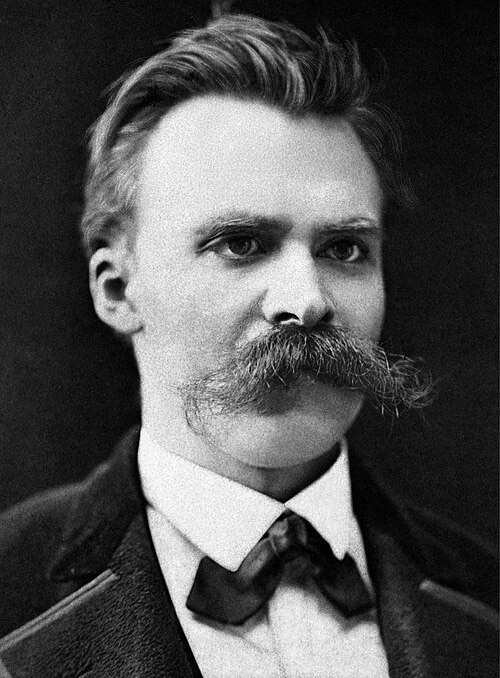
Friedrich Wilhelm Nietzsche was a philosopher who advocated the rich, elite and powerful and was against the mechanisms of the church who he saw as shackling people with guilt and shame. His ideas and beliefs have been manipulated and absorbed into Conservative and Republican Party policies: namely that the elite and powerful are above common people; they should not be judged by the same moral compass as the herd (his word); charity and benevolence allow the weak to thrive instead of standing up for themselves; that the State should play a minimal role in peoples’ lives and they should be free to act.
He recoiled in horror at how the public received him, and how much his words had been manipulated by others. (This was before his sister adapted his writings into her own right-wing agendas, and before the Nazi party did worse). He was very much a supporter of law-abiding values, and was anti-anarchy.
He thought, (as many of the 19th century elite did), that you can judge the quality of people by their genealogy or background. Noble birth or lineage therefore was the epitome and common birth was seen as the ‘herd’. Nietzsche’s philosophies include:
- A disgust for the mindless social behavior of ‘common people’.
- Strong anti-Christian/anti-church views. The God is dead argument.
- A belief that the elite classes should not be subject to the same rules as common people.
- He thought that charity and kindness weakened humanity and was a subversion of the natural, survival-of-the-fittest order.
- He thought there should be a new type of human: an ‘overman’, or Übermensch.
- The idea that there is no single truth and only perspectivism exists: (the belief that truth is always bound to individual perspectives).
- Free will is an illusion stemming from subconscious thoughts and desires, though he did advocate freedom for people, and he hated bureaucracy, laws and restrictions.
Master-Slave morality
Nietzsche argues that there are two fundamental types of morality:
In master morality, “good” is the aristocratic classes and is associated with nobility and power.
“Bad” refers to the common, the herd or the low and the qualities and values associated with them.
Cultures and organisations (such as churches), that promote charity and benevolence to the ‘weak’ are subverting the ‘natural order’ where the strong should flourish. This makes the strong slaves to the weak, and makes them seem immoral.
This argument has been used by political groups to suggest that slavery is not evil, to advocate racial supremacy, and that Jews, gypsies, disabled people and homosexuals ‘bring down society’.
Biography
Nietzsche the son of a minister of the Lutheran church. This implies that his attacks of the church were personal. His father and brother died when he was a boy, and he was the sole male in a privileged family. He attended private school, and did well in theology and the classics. He became the youngest professor in his field at the age of 24 though he had not even completed his doctorate. He was forced to give up the post ten years later due to ill health. He served as a medical orderly in the Franco-Prussian war. His family were forced to look after him until his death. He lost his mind at the age of 44 due to a form of syphilis which he got from a brothel.
Church
His attacks on the church were based on the idea that it had lost the moral high ground and that something else needed to be put in its place. He thought that people needed to stand on their own two feet and find their own moral compass. He said that we base our lives on values and premises that, when we really drill down into them, have little basis in fact.
He tried to pull down the church for having lost its moral values, but had little to replace it with. He did not try to devise a system by which people could lead better lives because he mistrusted systems entirely.
He said that we base our lives on subconscious desires and needs, rather than decisions based on free will. He thought that life was deterministic.
There are four main traditions which Nietzsche attacked:
- Christian morality
- Secular morality
- The ‘herd values’ as he called them
- Ancient Greece
It’s important to say that Nietzsche thought there were special rules for special people. The elite were excluded from the moral criticisms he outlined below.
Anti-Christian
All the positive values of Christianity were ruled out. He thought that benevolence and charity were simply means by which weak people thrived. He advocated a survival of the fittest mentality, an evolutionary world by which weak people would either pull themselves up or perish.
Secular
He thought that systems of secular morality were abstractions from individual free will; that they were generalities; appeals to the common man. He thought that all laws were matters for the Herd and not for the elite.
Herd
Nietzsche was a philosopher for the great and the noble – the Heroic people, who should not be hamstrung by petty rules and regulations.
Ancient Greece
Nietzsche was a classics teacher, and he was an expert in the Pre-Socratic age which was a time of mythology, strength, beauty and heroes. Post-Socratic Greek is an age of logic and reason, which he hated. He was very much in favour of heroes and ’supermen’.
God is dead
Nietzsche thought we made our own values, that they weren’t given by God. “God is dead” means that the idea of God can no longer provide values. Nietzsche refers to this crucial paradigm shift as a reevaluation of values.
He didn’t understand evolution or any of the complex sciences, although he tried in his doctrine of eternal return (the idea that everything happens again and again).
Superman
The Übermensch, Superman or more accurately ‘Beyond-human’) represents a shift from otherworldly Christian values and manifests the grounded human ideal. It comes from his 1883 book, Thus Spoke Zarathustra. (Zarathushtra, or Zoroaster, was an Iranian religious reformer who lived around 600 BCE.) The superman was intended to illustrate that human beings needed to transcend God.
Other thoughts
Nietzsche (and Freud), placed a lot of emphasis on the unconscious, which contemporary neuroscience has debunked. No evidence for unconscious thought has ever been found in studies of the brain.
He advocated freedom for people and that they should not be hindered by rules and regulations.
He thought that people should have access to the kinds of knowledge they could bear – because he thought some knowledge could destroy us. He believed that cultures acquired knowledge pertaining to that culture. He did not believe that knowledge should be pursued relentlessly as it is now, because he did not believe in post-Socratic forms of thinking.
Feminism
He opposed the idea of levelling the sexes, (what we today would call equality), because he argued, the sexes should be kept distinct and unique from each other. He said that attempts to masculinise woman, and to feminise men, would jeopardise the future of society. He argued that this was not to undermine women, but rather to preserve the distinction between the sexes. In reality however, these arguments were, and still are, used to subjugate women. Equality should not imply that men and women are the same, only that they be treated equally.
Sister
After Nietzsche’s death, his sister, Elisabeth Förster-Nietzsche, became the curator and editor of his manuscripts. She edited his unpublished writings to fit her German ultranationalist ideology, often contradicting or obfuscating Nietzsche’s stated opinions, which were explicitly opposed to antisemitism and nationalism.
And finally; he loved artists. Artists were pretty high up on Nietzsche’s agenda


 Paul Carney’s Blog
It would be great to hear your thoughts about this