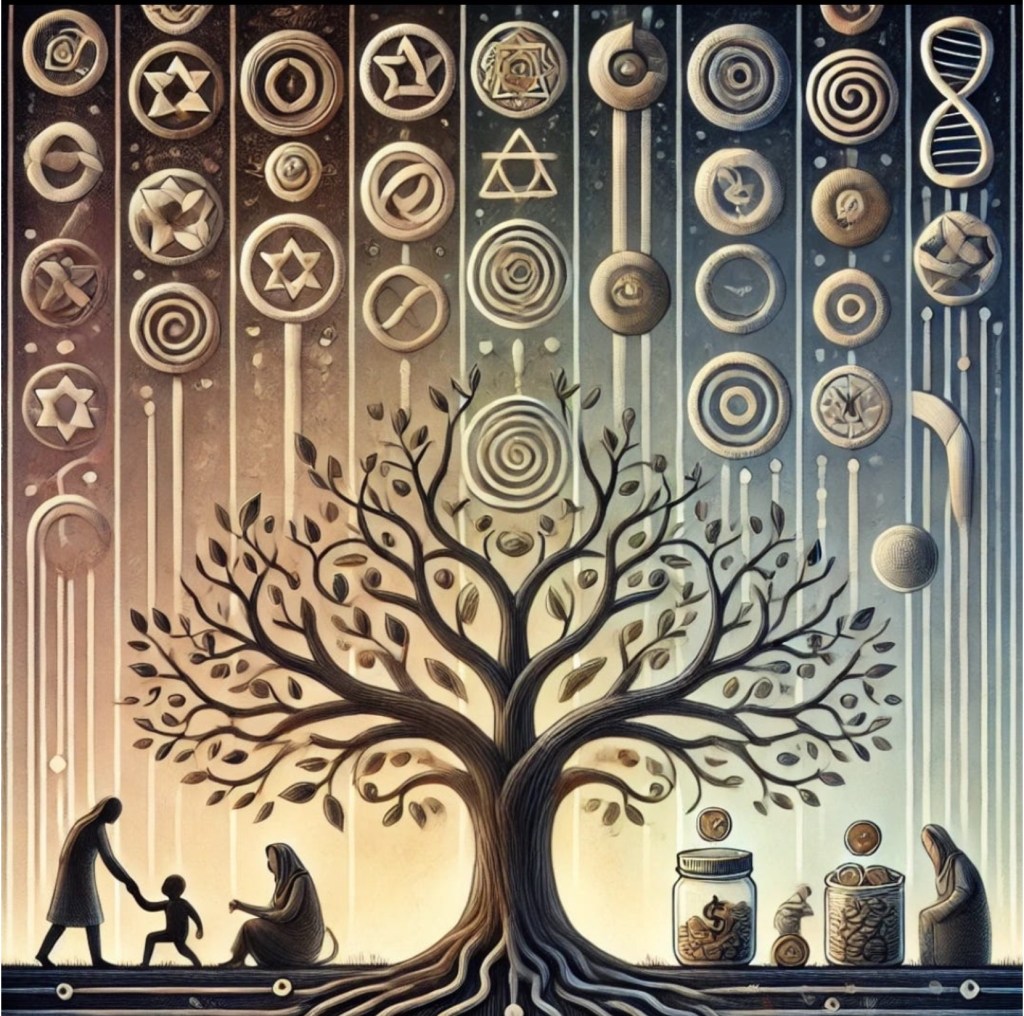
Pattern
- a repeated decorative design.
- an arrangement or design regularly found in comparable objects.
- a regular and intelligible form or sequence discernible in the way in which something happens or is done.
Is religion just the brain seeing patterns in things?
Human beings have a tendency to attach supernatural meanings to everyday phenomena. Seeing faces in clouds (pareidolia), believing there is a pattern in random events (like in gambling), or confirmation bias, where you seek evidence to support your opinion and ignore contrary information; all of these are examples of apophenia: the tendency to perceive meaningful connections in unrelated things. This is what brains do; they identify patterns to try to make sense of the world, then form implications from those patterns. Human imagination is such that we are able to form the most creative inferences from what we see.
Superstition can be dangerous
Some people, for example, are convinced that a dragonfly entering your garden is an angel, the movement of a photograph is communication from a deceased loved one, or that dreams are in fact prophecies. Often these have great benefit; they bring comfort and a sense of order to a sometimes cruel world. In some cases, however, they lead to harmful conspiracy theories and dangerous behaviour, such as the anti-vaccine movement which has led to increased rates of infection and death from diseases such as measles and COVID-19 in many countries, including the US, Italy, Germany, Romania, and the UK. Random patterns turn into myths, groundless superstitions, and even, very occasionally, violence. It is a very human trait, and one that sadly, I doubt will ever disappear.
As a species, we have moved on from our shady past
To give our species credit, of course, most of us have moved on. We once burned people at the stake in the belief that they were witches and believed that diseases were punishments from God. However, despite the Age of Reason and Enlightenment and attempts to ground us in beliefs based on evidence and fact, mistrust and suspicion of any official narrative is constant.
Religion is just a collection of myths and stories
Maybe this is part of our human defence mechanism, or perhaps it is more prevalent in some rather than others. In any case, we can say with confidence that human beings tell stories, we elaborate and expand on things that happen around us and mythologise them. Critics would say that this is all religion is: a collection of myths, stories and falsehoods espoused by deluded, misguided individuals. As such, they say, God is meaningless, unintelligible, contradictory, incomprehensible, or incoherent.
God is everywhere, in everything
And yet, religion seems to have been with us since the dawn of humanity in one form or another. We appear to have idolised animals in the beginning, so dependent on them were we for our own welfare. We imagined anthropomorphic lions, and revered the female form in ‘Venus’ figurines, perhaps as fertility symbols. In Palaeolithic people’s, Gods weren’t above them, in a higher realm, they were present in a life force, or spirit, all around them: in plants, rocks, animals and trees. It was felt in the power of storms, lightning and the astral heavens above them. It was given different names in different cultures: mana in the South Sea Islands, numina in Ancient Greece and Rome, or the jinn in Arabia.
Our spiritual connection to our world
These days, we scoff at the idea of believing a solar eclipse was an angry warning from the gods, but these people were highly sensitive to, and dependent on, the natural world. Solar eclipses can lead to significant environmental changes, including sudden temperature drops, altered animal behaviour, and disruptions in plant growth and atmospheric conditions. When you are so acutely in tune with nature as they were, it is easy to make the link that the environmental spirits are a bit upset at you.
We still feel this serene connection to nature today, standing near a mighty waterfall, watching a sunset, or walking through a leafy woodland. This ‘spiritual’ connection is physical as well as emotional. Trees and rocks contain strong electromagnetic phenomena and we can sense their electrical energy through the positive uplift in our moods that they bring. For many people, this is the closest thing to a religious feeling they experience in their life.
Beliefs diversified across time and place
As we progressed into the first civilisations, beliefs and ideologies advanced and developed hand-in-hand with technology, becoming more diverse and eclectic, and being relative to the geography, environment, and social structure of the people. Finding the religious patterns in such a myriad of belief systems is very difficult, but they are there:
Rituals
All belief systems have rituals, for example. Rituals may seem like pointless, repetitive actions, but they have both symbolic meaning and contain great benefits. Studies show that the anxiety-reducing effect of rituals, they induce happiness, help us cope with grief, and improve social bonding. Rituals connect us to our ancestors and mark important life cycles. In Confucianism, rituals permeate every aspect of living, eating, and even breathing.
Prayer
Rituals also extended to prayer, which can be traced back to prehistoric offerings and incantations tied to agricultural cycles and seasons. Today, prayer serves as a way of connecting to the divine, to provide comfort and solace, and to connect communities.
Sacrifice
Sacrifice has also been practised since prehistoric times, in the form of animal and sometimes human sacrifice, although it has evolved into an expression of religious devotion through self-sacrifice and fasting; a way of showing devotion, restoring order, cleansing, and providing social cohesion.
A tree of faith
Although there are countless doctrines, rituals, and practices contained in the world’s religions, you can find other patterns; not sporadic, casual patterns, but patterns with greater consistency, order, and structure; things that unify all religions; places where all faiths overlap:
- The law of reciprocity,
- Being truthful,
- Generosity,
- Peacefulness,
- Love,
- Doing no harm to others,
- Reaping what you sow,
- Being slow to anger,
- Forgiveness,
- and my favourite: all things are of one essence.
There are others, of course, but together they form a ‘tree of faith’; values upon which all religions unite. In this way, faith becomes a trustworthy pattern with significant form and clarity. It shows that, far from being a dangerous form of psychosis, religion has real purpose and meaning. Of course, these qualities don’t need to be religious in nature. Secular societies offer similar things without religion, and perhaps this indicates these patterns are human traits rather than being divine.
The highest level
However, there is another dimension to religion that is missing from non-belief: the other-worldly, higher dimension to existence that is God. Truly religious people place a deep trust in this higher authority and are humbled by it. They commit to living peaceful lives that reflect those unifying teachings and values. The values form a commitment; a pact with God whereby they pledge that they will live their lives trying to enact them in all that they do. This is very different to simply saying I think I more or less, kind of, practice them.
We should not judge God by the actions of humanity
Besides, the fact that people through time and place have abused and used peaceful, spiritual beliefs for their own nefarious ends says a lot about people and less about God. Anyone who kills in the name of God is not acting in true accordance with their holy scripture. The high values of religious teachings are things for the faithful to aspire to; they aren’t automatically bestowed the moment you walk through a church door. Besides, we have (apparent) free will, so it is our own personal choices that define us and make our species what it is, not God.
Look beyond the miracles
It is easy to get swayed or waylaid by the tenets of faith: the deity, the resurrection, the salvation, or even the miracles; all of the stuff that makes some people adore and others withdraw, in our ‘show me the evidence’ culture. But at the heart of it all are beliefs, principles and practices that transcend those ‘shop window’ habitudes and go right back to the very inception of Homo sapiens.
True faith is commitment
True faith, then, isn’t about clutching at random events and searching for meaning from them. It isn’t about claiming Jesus has appeared in a slice of toast, or a fairy visited my garden. It isn’t a one-off, random pattern. Faith has a deep, profound nature and order to it that has survived the test of time. It encompasses inherent human virtues but elevates them to help us to become better people, wrapped within a framework of commitment and devotion to a higher authority. Religion, then, comes from a long-held conviction that there is something profound to our existence, something behind the smoke and mirrors of our everyday reality. The labels might differ, the symbols might change, but the fundamental shapes are constant. Faith is a complex, rich, and profound pattern with great meaning, but it is so very hard to find.
Paul Carney is an agnostic Deist who attends a Unitarian church.
Agnosticism is a position of uncertainty regarding the existence of deities, while deism is a belief in a creator who set the universe in motion but does not intervene in its affairs. An agnostic deist maintains the claim that metaphysical categories such as God cannot be known to exist, however they still believe that they exist.
Image credit: Bindu Sammridhi on Medium


 Paul Carney’s Blog

It would be great to hear your thoughts about this