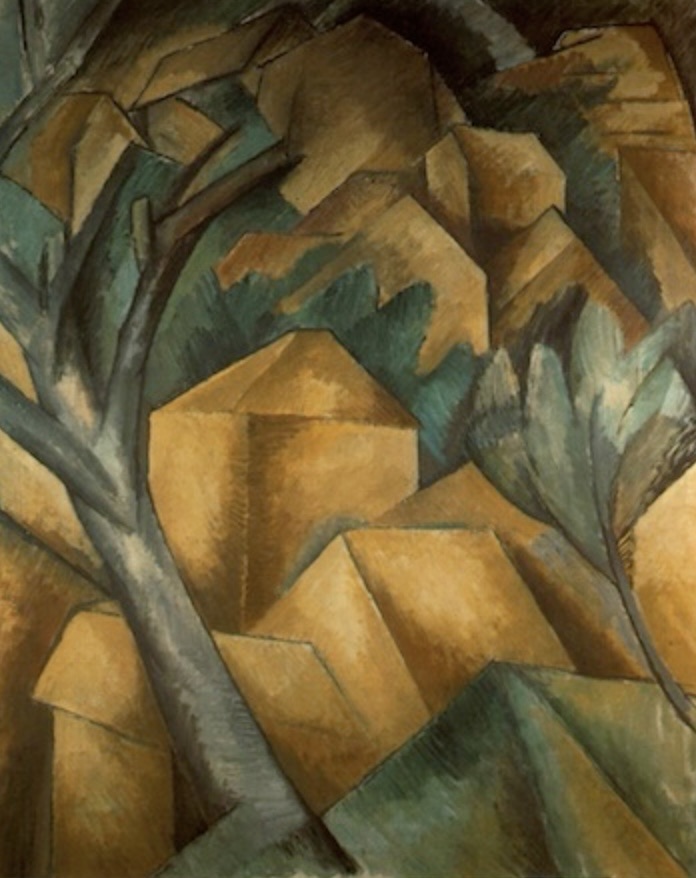
Cubism was borne out of artists’ desire to subvert traditional perspective and interpret objects in new ways. Essentially, it was a new way of seeing. But when all was said and done, was there any point in it?
A new way of seeing
The origins of Cubism are complicated, but the writings of the Symbolist Free Verse poets of the late 19th century, and the paintings of Paul Cézanne played a pivotal role. Traditional perspective had been developing since antiquity, but then Paul Cézanne’s death and his subsequent 1907 retrospective exhibition got artists excited. He had broken all the rules and painted his objects with flattened surfaces, simultaneously showing the subject from multiple angles.
Georges Braque
Cézanne’s work wasn’t quite Cubism, but it inspired one artist in particular – Georges Braque. He went away and began taking Cézanne’s ideas one step further, by painting landscapes using cubes. He entered his painting The Houses at l’Estaque to the Salon d’Automne in 1908. Considered the first Cubist landscape, it was refused by the Salon, with Henri Matisse remarking: “Braque has just sent in a painting made of little cubes.” And so, Cubism was born out of a fellow artist’s disdain. Braque was heartbroken, but his friend Pablo Picasso consoled him, and quickly saw the potential in what he was doing. The two men swapped ideas and began working feverishly in adjacent studios, developing a new way of representing reality.
Three dimensions on a flat surface
This new way of seeing abandoned the traditional notion of seeing a painting as a window into the world, and replaced it with a method of depicting solid, three-dimensional objects on flat surfaces. Any attempt to recreate the illusion of solid forms was rejected. Instead, subjects were fragmented, broken up, and reassembled in an abstract form—instead of depicting objects from a single perspective, the artist depicts the subject from multiple perspectives to represent the subject in a greater context. They also adopted a monochromatic and neutral colour palette to emphasise the subject matter further.
Picasso in, Braque out
By 1911, Picasso was heralded as the inventor of Cubism, and Braque was largely written out of history, but in actual fact Cubism had evolved across Europe by multiple artists including Juan Gris and Fernand Leger. The first organised group exhibition by Cubists in 1911 was held in a room called ‘Salle 41’; but no works by Picasso or Braque were included.
Understanding it all
It is impossible for us now to understand the true impact of Cubism on the arts and culture. Like all innovations, it became a sycophantic distortion of its true intentions, and I think in any case, few people ‘got’ its real meaning. In any case, I don’t think it really achieved its aims. Braque said Cubism was a more accurate way of describing reality; that it was a way of ‘getting closer to the object.’ He said that fragmentation helps establish space and movement in space. I’m not sure it does all that. To me, it’s hard to read the object with so much fragmentation going on, and any movement is lost. The Futurists did a much better job of that I think. I do love Cubist works, but I like them regardless of the convoluted intellectualism behind them. Rather than ushering in a new way of seeing, Cubism has become just another chapter in the wonderfully eclectic directory of art styles and movements through history. It’s no less an art form for that, but a new way of seeing? Not really no.


 Paul Carney’s Blog
It would be great to hear your thoughts about this