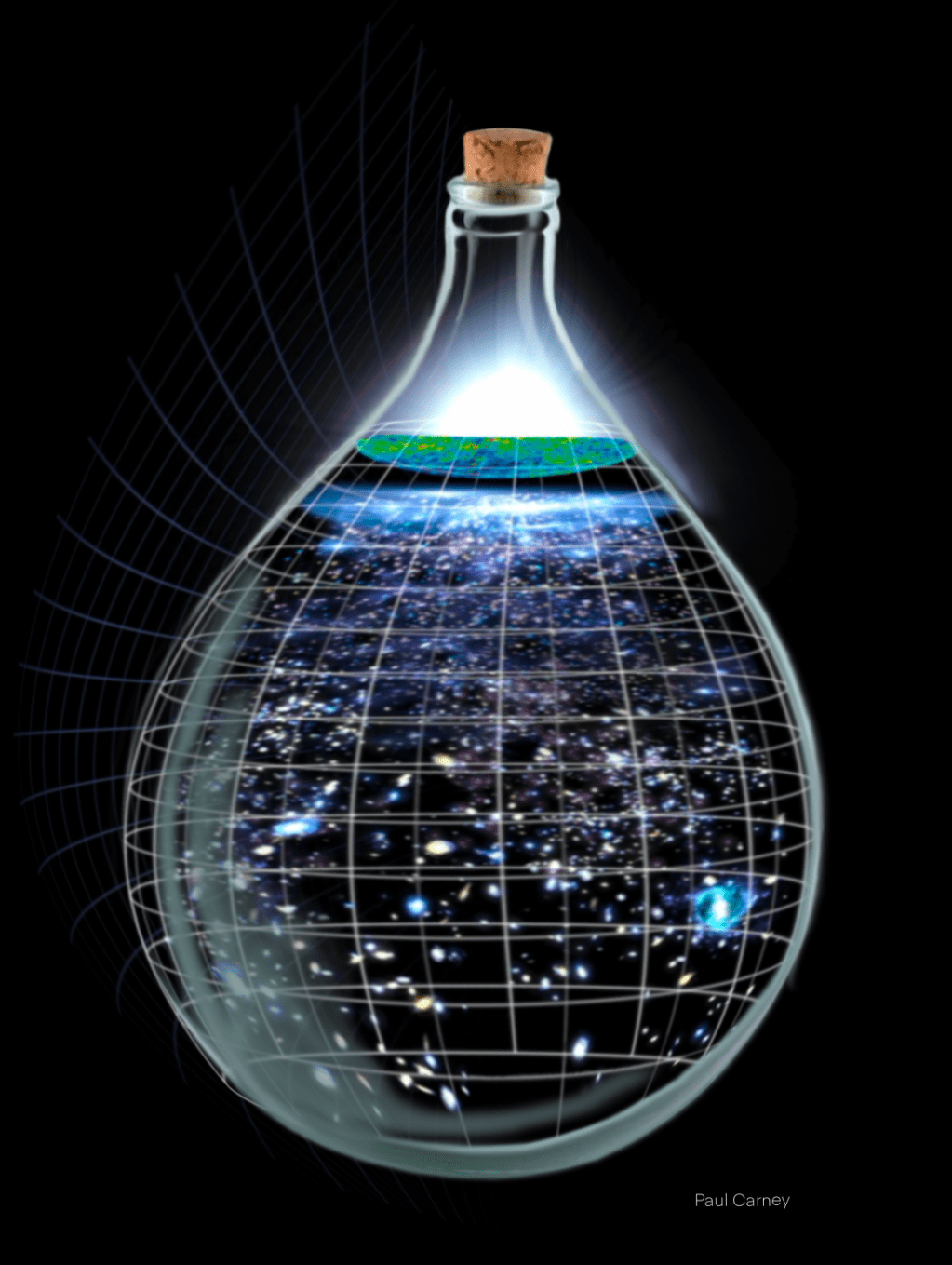
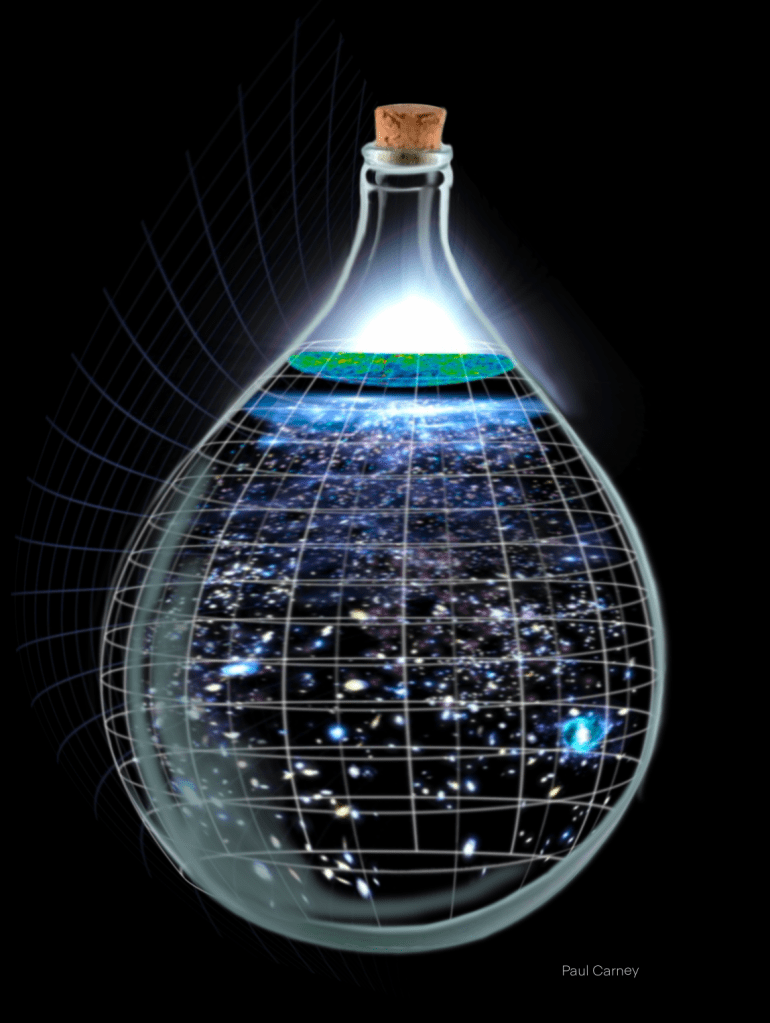
Cosmologists aren’t sure what shape the universe is. And, while this may sound like a pointless thing to think about, it is actually a profound question that has significant implications.
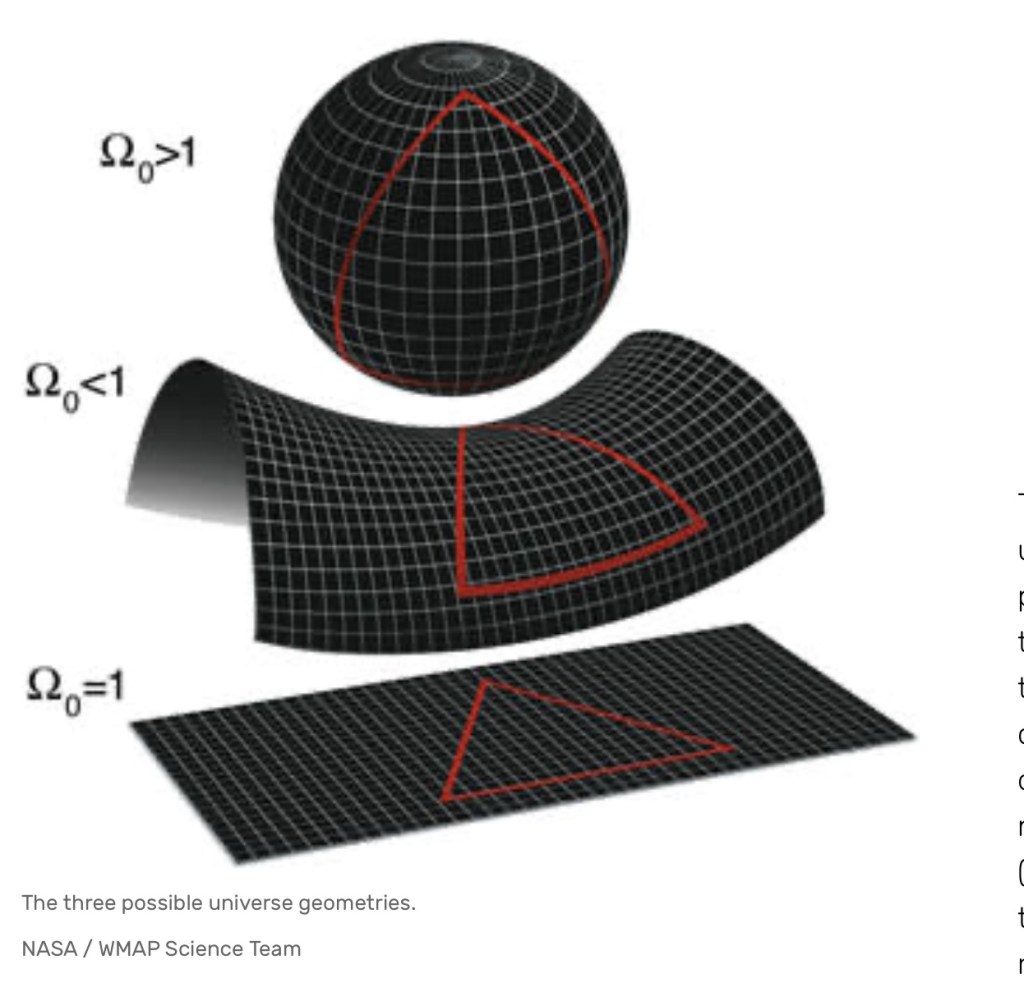
There are three leading models for the shape of the universe:
- Spherical – the Universe has what’s known as positive curvature, and is shaped like a sphere. This is called a closed finite universe.
- Flat – this universe has zero curvature. It has no bounds, will expand forever, and last infinitely. This is called a flat universe.
- Saddle shape – an open universe, with negative curvature and so it must stretch out infinitely, without boundaries.
Flat Ire
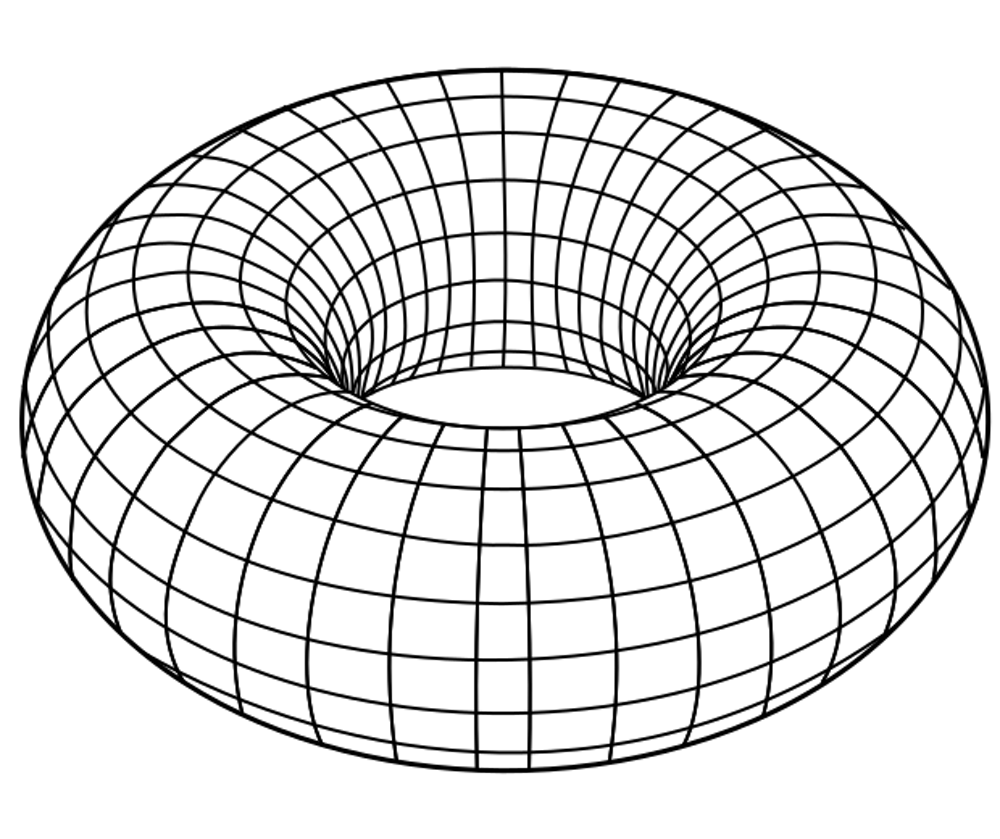
Scientific observations have found that the universe is geometrically flat. Parallel lines stay parallel wherever you go in space. However, if you were to look at the universe as a whole, it could be a more complicated shape, like a giant doughnut, also called a torus.
The flat, open universe model says that in around 100 trillion years, all the stars will have burned out, and all known particles will have decayed, leaving nothing but an endless sea of empty space that lingers on and on. Now, this doesn’t make sense to me. If you’re gonna die, die damn it. Don’t hang around like a hammy actor desperate not to leave the stage. Surely, the universe will end when it ends, not linger on like a sick beast. The universe had a beginning, it went through a series of stages of development, and will gradually diminish, before it slowly dies. So, why then, would it continue on afterwards in an infinite, empty state?
A closed universe, that ends properly seems to make more intuitive sense, but it’s unlikely. If the universe is curved, it must be so colossal that the entire 93 billion light-years we can see, isn’t a large enough portion to reveal the curvature.
The edge of the universe
There is another big question that pertains to the shape of the universe though – does it have an edge? Cosmologists are pretty clear about this. There is no edge to the universe and there is nothing outside of it. There is what’s known as a cosmological horizon however, which is the area of what is possible for us to see. This is the limit of how far light has travelled since the Big Bang. Just as a ship sees a horizon on the ocean but never reaches it, so our universe is on a similar trajectory. If we were to get to the edge of what we can currently see, it would simply extend further because more light would have been able to travel there.
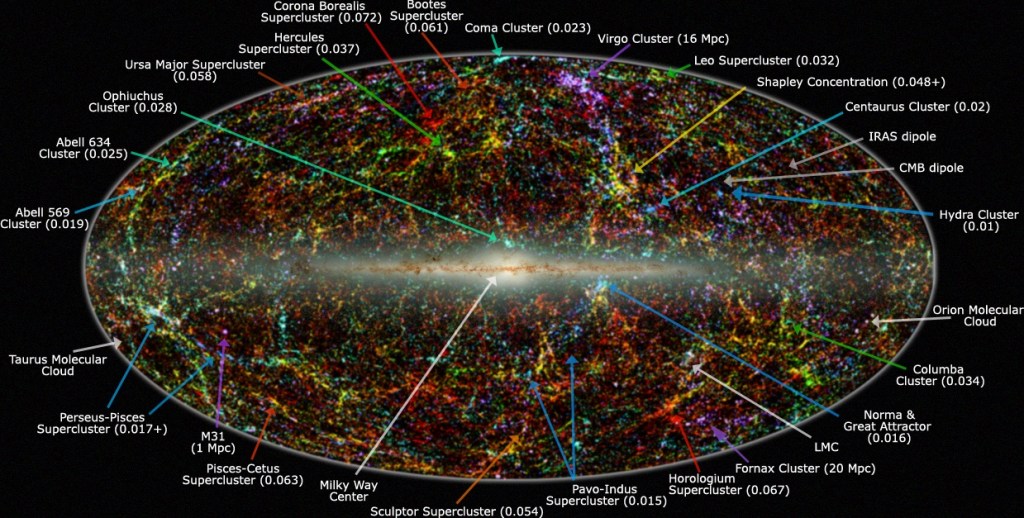
Now, there may not be any edges, but there are some peculiar things going on in our universe. The largest structures in the known universe are huge superclusters of galaxies, dust and gas, stretching for millions of light years, creating impenetrable ‘walls’, permeated by gigantic voids. Whole galaxies are pulled around in these structures, flowing along pathways and routes toward imperceptible focal points, like blood vessels in arteries. Our own galaxy is flowing along one such route called the Great Attractor. Other identified structures include the Great Wall, the Sloan Great Wall, and the South Pole wall, so named because it aligns with our own South Pole.
The purpose of these gigantic structures is unknown, but it seems odd that galaxies would flow along these arterial routes, under the influence of gravity for no reason.
Seeing past the numbers
The Big Bang was not an explosion. It was an exponential expansion. A hugely energised inflation, requiring delicate balances of forces that fluctuated over time. This requires intricate orchestration. By contrast, large explosions create a lot of disorganised mess, with scattered lumps of matter of different shapes and sizes. Explosions are destructive. They destroy. They don’t tend to distribute matter fairly evenly, then start spinning themselves into stars and galaxies. Nor do random explosions create atoms, and matter, and systems that are incredibly similar to living slime moulds. The sophistication required to transform an infinitesimally small singularity into a universe-sized shape, within a split-second, is beyond our capacity to understand.
What all of this is saying to me is that the universe displays signs of agency and purpose, which is beyond mere random chance and chaos. This is humongous order. It is astonishing precision. Not that we should be surprised. The Big Bang itself, also demonstrates profound purpose. At least 93 billion light-years of stuff, all from an infinitesimal particle, is about as purposeful as you can get, and if you subscribe to an infinite number of multiverses, it’s not just purpose, it’s grand design.
To then insist the universe is a pointless, self-creating, meaningless, accidental firmament, is counterfactual, illogical, and miscalculated. There is an old saying that you find what you are looking for. That could apply to me here, an amateur, looking at pieces of evidence he doesn’t fully understand. But it could also apply to scientists who pour over raw data and can’t see past the numbers. Something must be causing all of these effects. Believing that a higher authority did it, does not mean you have to start believing in Revelation or Biblical Gods. There aren’t only two sides to this argument, there might be many, but you do need to be more open minded as to what it all might imply.
References
- NASA What is the shape of the universe? https://starchild.gsfc.nasa.gov/docs/StarChild/questions/question35.html
- The universe is a closed loop https://nautil.us/what-shape-is-the-universe-a-new-study-suggests-weve-got-it-all-wrong-237607
- Is the Universe flat? The Big Think https://bigthink.com/starts-with-a-bang/universe-flat/
- The Conversation: Topology and the shape of the universe https://theconversation.com/whats-the-shape-of-the-universe-mathematicians-use-topology-to-study-the-shape-of-the-world-and-everything-in-it-235635
- The end of the universe https://www.popularmechanics.com/space/deep-space/a43129531/how-will-the-universe-end
- Paul Sutter https://www.space.com/whats-beyond-universe-edge
- The edge of the universe https://www.skyatnightmagazine.com/space-science/does-universe-have-edge
- Cosmic Flows 3: the South Pole Wall https://iopscience.iop.org/article/10.3847/1538-4357/ab9952

 Paul Carney’s Blog
It would be great to hear your thoughts about this