Is matter all there is? The prevailing scientific viewpoint leaves some big unanswered questions.
Materialism is a philosophical and scientific viewpoint that states that matter is the fundamental substance in nature, and that all things, including consciousness, are the result of material things such as energy, physical laws, space and time. It is the dominant view in science and is difficult to find fault with, (not that I would want to). Materialism ties in with my own world view. I want to live in an evidential world, with all of its scientific advances and benefits. I don’t want to be at the mercy of unfounded superstitions, or supernatural entities that operate on a whim.
But, believing only material things exist has other implications. It implies that the universe does not have a Creator, because being a supernatural entity, He cannot be evidenced via material experiments.
So, the scientific story of Creation goes like this: matter created itself, and the universe and everything in it came out of nothingness. 42 billion light years worth of observable stuff, emanating from an infinitesimally small particle, 13.8 billion years ago, all from nothing and all for no reason.
Now, it is an incredible feat of science that we know so many facts about the universe. It is an awesome human achievement that we understand the mechanisms of physics, biology and chemistry to the point where we know many of the secrets of how life evolved and developed. But, that it has no purpose, no ultimate meaning, is a certain kind of nihilism I cannot subscribe to. There has to be a reason why there is something, rather than nothing.
God brings elegant, explanatory power as to why the universe exists. Without invoking a higher entity, we are left with a self-causing, nihilistic void. This isn’t adding a non-material God to a material universe, it’s providing a solution to a universal problem, namely that things that exist must have a cause. Besides, there are other facts about the universe that cause me to believe God must exist.
Why does the universe display purpose?
The universe is not a static, lifeless void, but a vast, dynamic, flowing, cosmic organism that appears to possess purpose and intention.
The universe is structured like a living slime mold. Galaxies are bound in clusters by cosmic filaments: a kind of cosmic artery which acts as a galactic feeding mechanism, pumping gas and dark matter around the universe, and fuelling the growth of new galaxies and black holes.
As well as this, the universe contains vast superstructures that seem to push and pull each other on a colossal scale. Our galaxy is one of 76,000 galaxies that are part of a cosmological feature called the Shapley Concentration. This enormous structure is pulling itself together instead of expanding with the universe. It is pulling in so many galaxies, that it is creating an adjacent void called the Dipole Repeller which is pushing galaxies away from it. Many cosmologists believe an unknown force must be causing this push and pull movement, because they are not moving the direction they should if gravity alone was the sole cause.
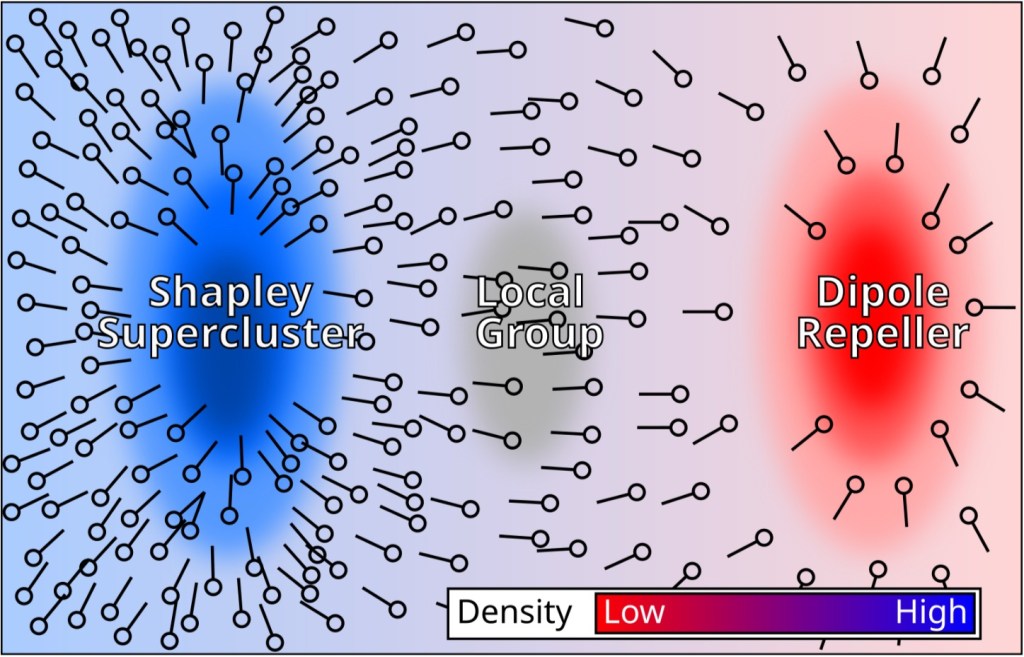
This suggests that the universe has emergent features that cannot be predicted from the galaxies alone. Emergence occurs when a complex entity has properties or behaviors that its parts do not have on their own, and emerge only when they interact in a wider whole. So-called weak emergence is found throughout life on Earth: in the fractals of snow crystals, termite cathedral mounds, and flocks of birds.
Strong emergence describes the action of a high-level system on its components, whereby it is impossible to explain the whole in terms of the parts. The universe appears to be an example of such strong emergence, because it is behaving in autonomous ways we have no reason for, and displays a downward intention we cannot explain.
Although strong emergence is logically possible, it is uncomfortably like magic. How does an irreducible but supervenient downward causal power arise, since by definition it cannot be due to the aggregation of the micro-level potentialities? Such causal powers would be quite unlike anything within our scientific ken. Mark A. Bedau
Invoking God as the cause of the universes’ Creation, does not necessarily mean you have to believe in orthodox religion. I would describe myself as a Deist, who attends a non-denominational, Unitarian church.
However, God brings purpose to existence and meaning to many people’s lives. Whichever God you believe in: Christian, Islamic, Jewish, Hindu, the Buddha or the Tao, doesn’t matter. They are all branches of the same tree of faith which fulfils our lives and helps us realise that there is something in the universe that is bigger and more powerful than we can imagine.
Understanding this helps us become more complete versions of ourselves. This isn’t adding an irrelevant layer to matter, it isn’t adding the non-material to the material, it is providing causality to the very evident effect of life all around us.

 Paul Carney’s Blog
It would be great to hear your thoughts about this