Are religious people deluded? Do we simply invent Gods that don’t exist in reality? Evidence shows that religious belief is actually a natural state of human consciousness. This may actually prove God’s existence, rather than disproving it.
I argue that …. the vast majority of humans are “born believers”, naturally inclined to find religious claims and explanations attractive and easily acquired, and to attain fluency in using them. Justin L. Barrett New Scientist magazine, The Big Questions
In this article in New Scientist, Justin Barrett argues that religious belief is an inherent, conscious, evolutionary trait, rather than from a Divine influence. To show this, he shows that, even young babies can distinguish between the movement of ordinary objects and the movement of non-living agents that act on their surroundings. For example, they know that balls can move if you push them, but people and animals move by themselves.
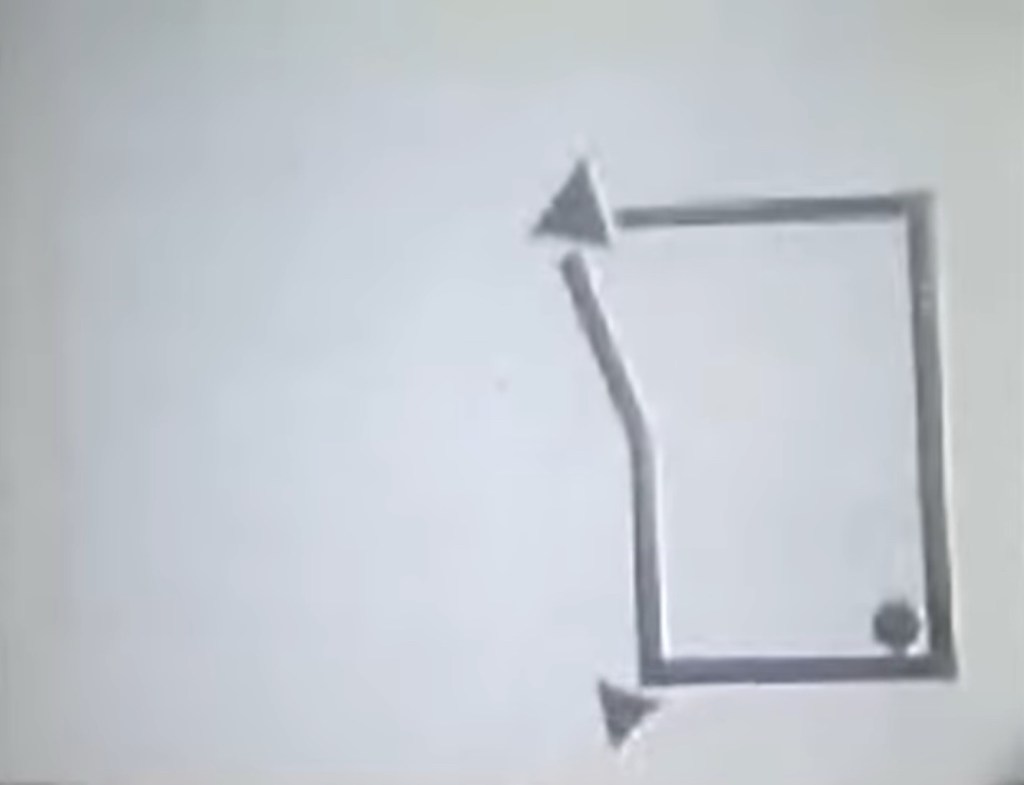
This principle is beautifully illustrated by an old piece of animation by Heider and Simmel from 1944. In this black and white film, a series of small, abstract shapes move in and out of an open, black rectangle. Most people automatically begin assigning personality and emotional attributes to the shapes – typically, that the large triangle is bullying the smaller shapes. It seems as though, by our very nature, we create stories and characters to explain things.
In addition, researchers in Mexico in 2008, found that children will naturally assume that superpowers or invisible forces can explain things, rather than assume they arose for no reason. They asked children what was in a tortilla container. After the children answered tortilla’s, they were shown that in fact, it held a pair of boxer shorts. They repeated the experiment and asked whether various supernatural entities such as the Christian God, the Mayan sun God, spirits, or humans would know what was inside. Younger children said all the agents would know what was inside, whereas the majority of slightly older children said the Mayan sun God would know what was really inside, but humans would think it was tortillas. The researchers concluded that children are very receptive to explanations that invoke supernatural design or purpose:
“Simple indoctrination cannot account for it. Whatever some people say, children do not need to be indoctrinated to believe in god. They naturally gravitate towards the idea.”
Having worked with young children extensively, I can tell you that they will usually tell you what they think you want them to say. That the younger children mostly said ‘all of those things would know what was inside’, backs up my own experience. I think they should have had a response: ‘it’s impossible to know what is inside until you look’, because that would be a good negative correlation.
However, it is certain that human beings are imaginative story-tellers, that much is evident from the vast array of philosophical, theological and fictional texts human beings have produced. It is also certain that human beings have invented a vast array of Gods responsible for all manner of things. It is also certain that people assign supernatural causes to coincidental, natural events. You could say then, that belief largely exists in human minds, rather than in the external world.
We are all born with the natural tendency to believe in God
Another way of looking at it however, is that, far from disproving God as being a natural, by-product of an over-active, imaginative, human brain, you might conclude the opposite – that it shows that believing in God is the natural state we are all born with, and that the form this natural state takes in the adult, is down to human & societal influences. After all, the Heider and Simmel animation was a deliberate attempt to animate inanimate shapes. The makers wanted us to believe the large shape was bullying the smaller ones, using fast, aggressive movements and difference in scale to create those effects. How do we know that this in-born, natural belief state isn’t the work of a Divine Animator?
The researchers themselves conclude that the attraction to religion is ‘an evolutionary by-product of our ordinary cognitive equipment’. Again, interpretation of that definition is largely down to the individual. Some might say it shows that religion is an ‘unfortunate’ evolutionary by-product, while others could just as easily say it shows that belief in God is all part of His evolutionary plan.
Whatever you believe however, it seems that religious belief is a natural state of human consciousness. Faith isn’t a fiction then, or a delusion, as many atheists have cruelly stated. While humans do indeed invent Gods of all manners, they are manifesting something that is inherently part of being human.
When we look at the cosmos and everything in it and wonder: ‘what could possibly have made all of this?’, we are not only responding to something vast and ineffable that is manifest right there before our very eyes, but also to the very essence of being human.
To that end, it doesn’t matter which God you believe in, faith is a tree with many branches. These branches may have different names, but they are the same all over the world: love, community, virtue, peace, worship, ritual, sacrifice and benevolence. Belief in God is simply following our natural instincts to be the best version of a human we can be.


 Paul Carney’s Blog
It would be great to hear your thoughts about this