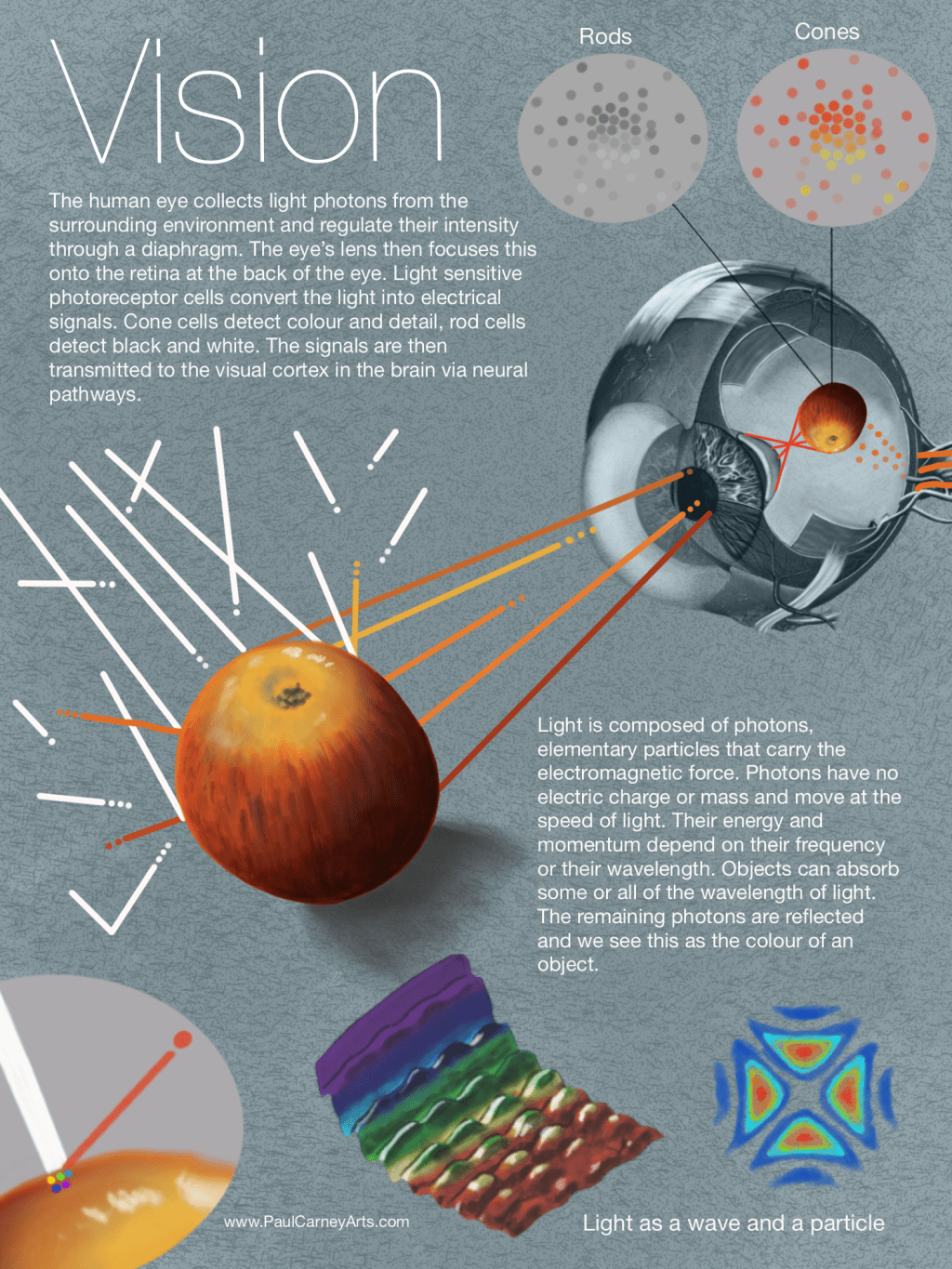
Outside-In model of seeing
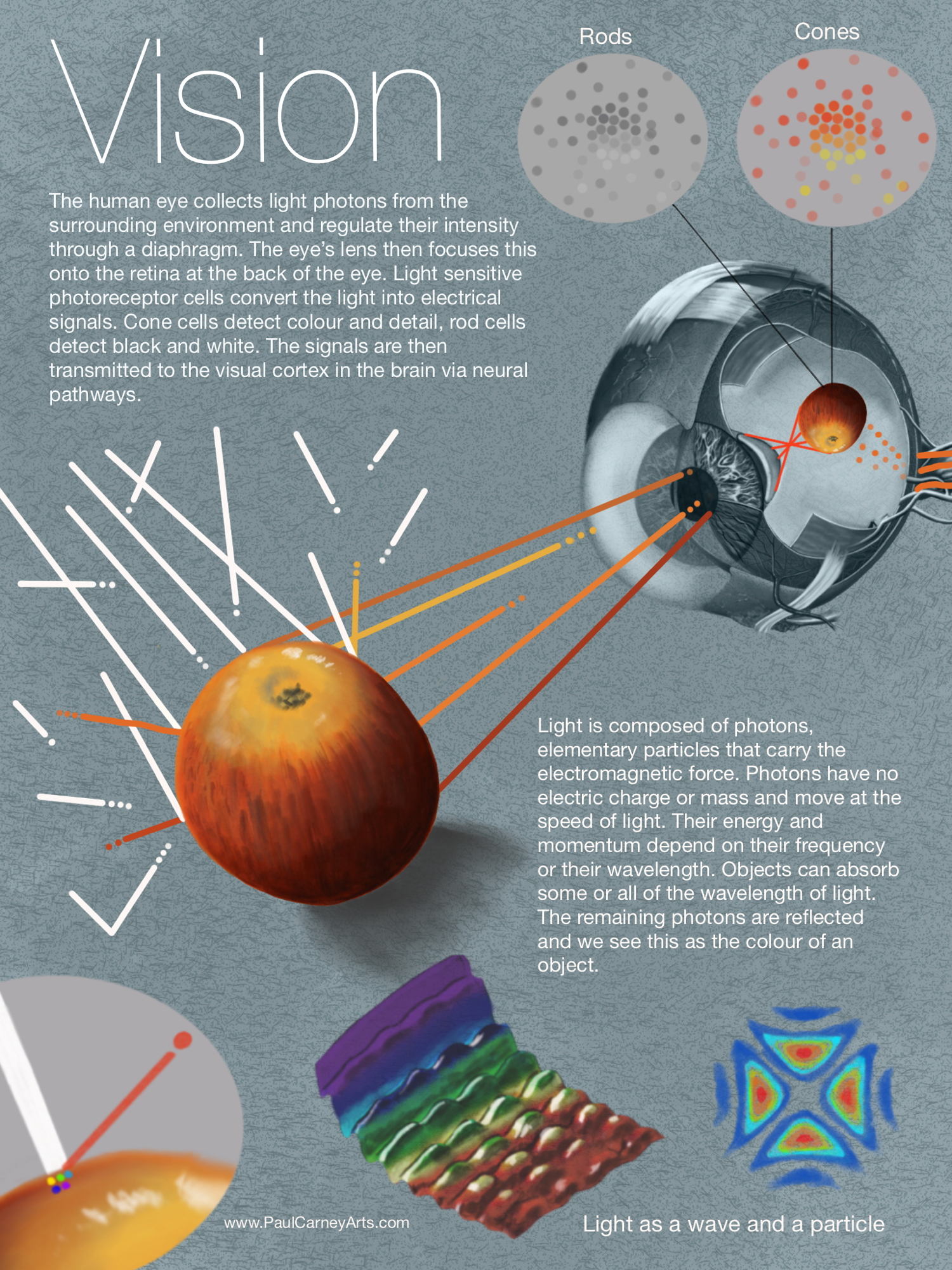
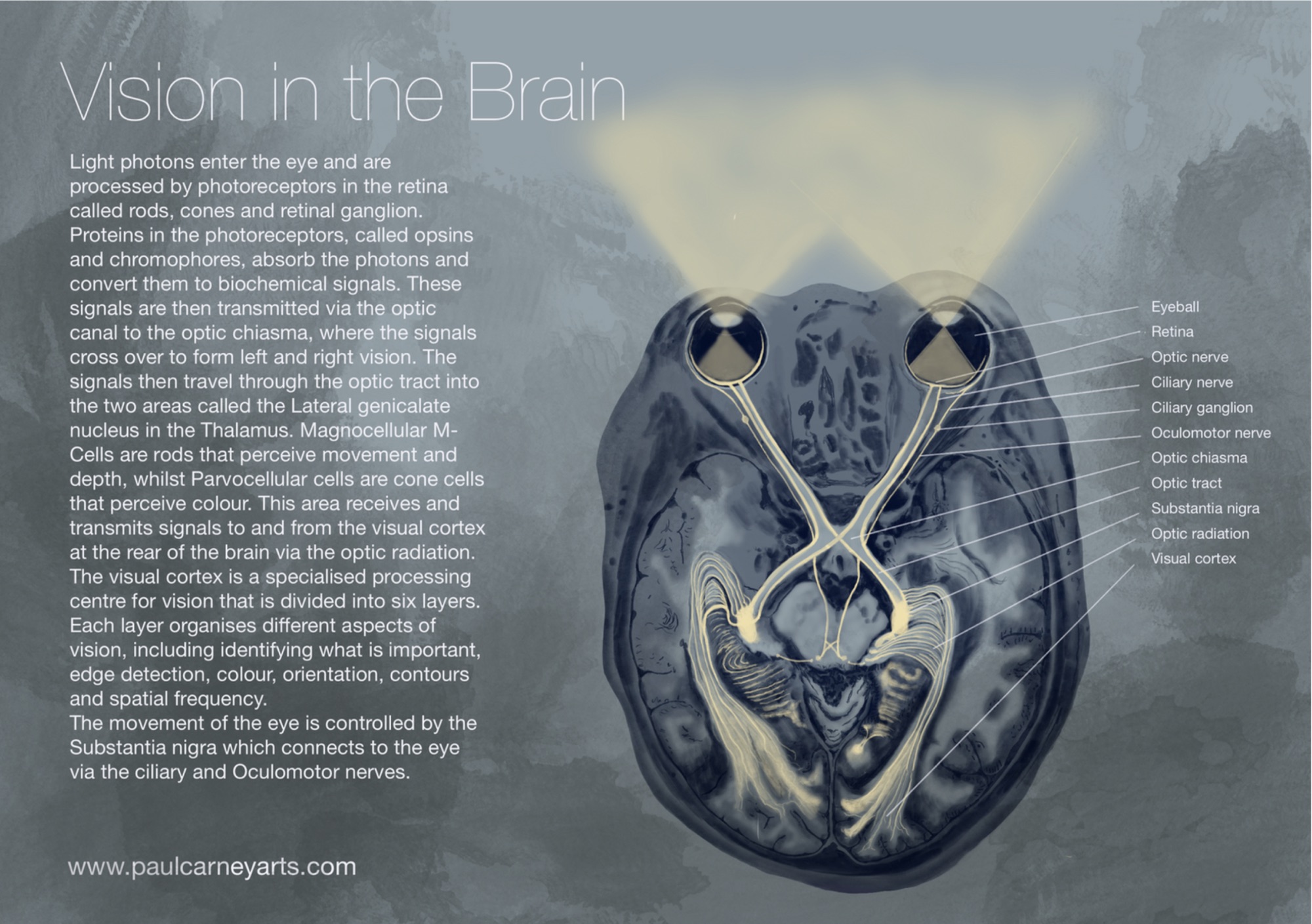
I’ve thought long and hard in the past about vision; how do we see and how is vision processed in the brain? Now, I’m an artist, not a biologist or scientist, but it seems natural to assume that vision is an outside-in model. Light photons enter our pupils, images are focussed onto rods and cones in our retina, which are then converted into biochemical signals, which then travel along the optic canal to the visual cortex. The visual cortex has six layers that process vision; edge detection, colour, orientation, movement, contours and spatial awareness. (Note; some stages have been removed.)
It’s tempting then, to believe this is the full process of vision explained. Except of course, that only around a third of what we perceive is described by the light entering our eyes. For example, we have a blind spot in the centre of our vision and we have to constantly scan our field of view to build a comprehensive picture and fill in the gaps of what we perceive. Also, vision isn’t an isolated experience in our brains. Our other senses are strongly linked to it, and all the while we are interpreting what we see and making inferences from it. This Outside-In model of vision requires there to be a controller in the brain, orchestrating it, establishing the relationship between the outside world and making inferences. Yet such a control centre hasn’t been found and György Buzsáki, a neuroscientist at New York University proposes an alternative Inside-Out model of perception to explain it.
Inside-Out model of seeing
Buzáki says the brain does not see via an Outside-In ‘perception, decision, action’ model. In all experiments, the sequential neuronal firing you would expect to see in this way of seeing doesn’t occur. Instead, the brain appears to fire randomly via an Inside-Out model. The brain sends a dual signal (corollary discharge) that controls both bodily movements and high order thinking about what is happening. If we just look at an object – say a tree for example, we struggle to attain any meaningful information about it by observation alone. It is only by moving, hearing the rustle through its leaves, seeing the nuances of colour in its bark or by watching the dapples of light on its surface, that we properly see it and make high order inferences. Full perception then, is a holistic, sensory, active process, rather than being isolated and reliant on an internal orchestrator.
In addition, the brain is more preoccupied with itself than what is happening outside. It works to sustain its own internal states rather than being controlled by extra-sensory stimuli or even an internal orchestrator. Nothing is new to the brain because it relates everything to what it knows. It generalises, and makes guesses about the unknown. It does this so that it retains its robustness and doesn’t have to reinvent-itself all the time.
Seeing with our eyes closed
In addition to this, more complex systems occur inbetween motor and sensory outputs. These systems allow us to predict, plan future actions and to ‘see’ even with our eyes closed because much of what it is to see is rooted in brain activity. In short, it’s where our imagination kicks in. The same brain circuits that we use to navigate through the world are also used to keep track of personal memories, engage in planning and for imagination.
There aren’t then, distinct places for navigation and separate storage areas for memory. They exist in the same circuits. The same cell can be a memory cell, planning cell or place cell depending on the circumstance.
Learning and perception
When learning, we assume that there is a blank slate model – complexity and understanding grow with experience and new knowledge. However, in the inside out model, the brain is organised in preformed patterns known as neuronal trajectories, which are not governed by experience and which have two groups- a rich club of neurons that govern around half the brains activity and which make quick, good enough assumptions, and a poor club of slow firing neurons that come into play when something important needs to be recorded for future reference.
We can see this in action when we are presented with new information. We scan it, and make quick fire assumptions, trying to fit it into pre-known boxes. To learn something properly however, we have to slow down and assimilate it at a reduced pace. These are examples of our rich club and poor club neuronal trajectories in action.
Interestingly, there is a sharp wave ripple effect after a bout of intense brain activity where the same neurons fire in a kind of learning echo. These ripples are important and help us form our long term memories.
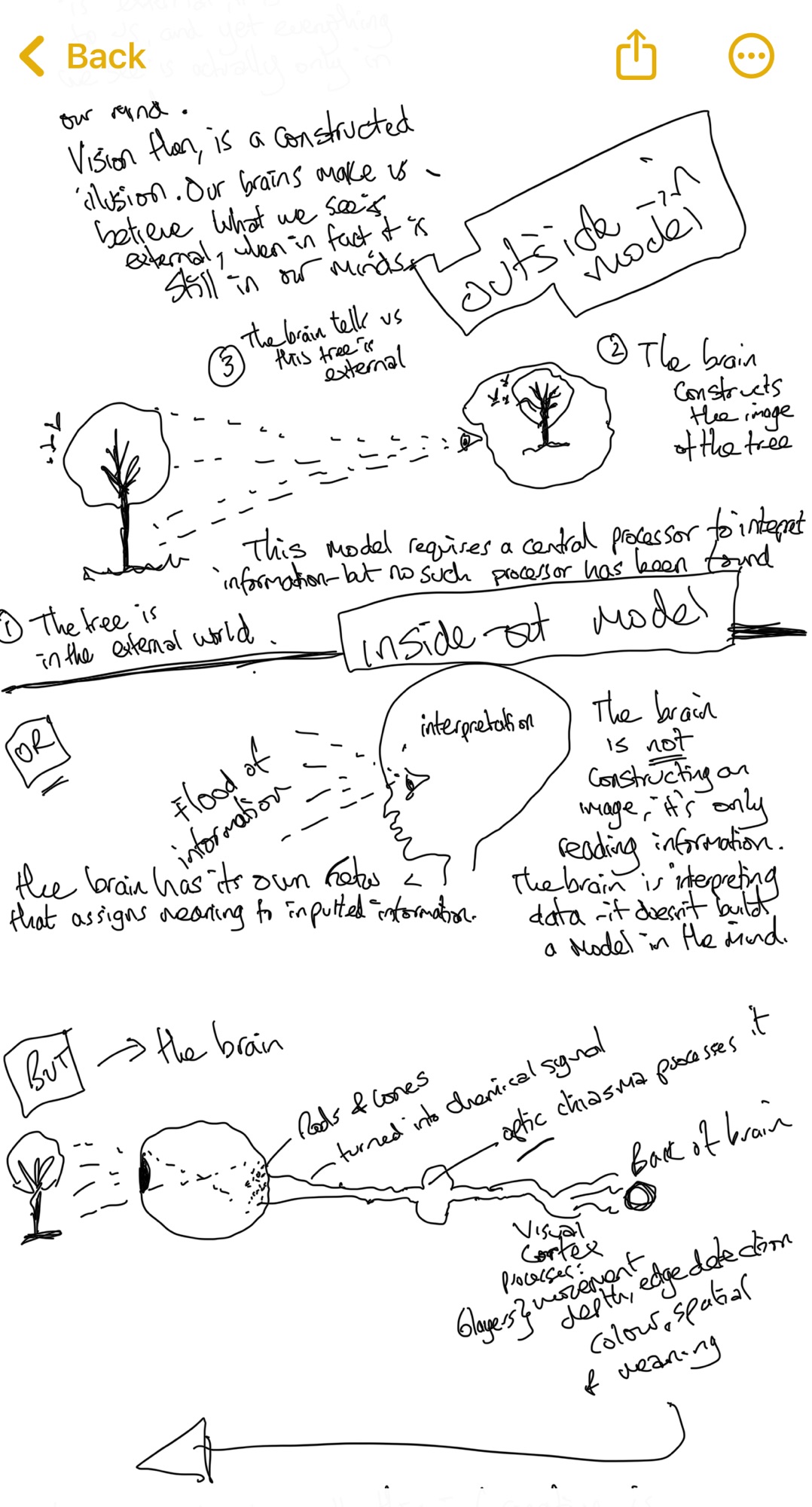
To summarise
Clearly, there is a process of seeing via Outside-In mechanisms, but, rather than being a full description, the outside-in model only accounts for part of our perception. More accurately, vision is a whole brain, full sensory activity that also utilises Inside-Out approaches that do not depend on an internal orchestrator or controller to govern it. Vision is inherently wrapped up in high order thinking and action. These aren’t distinct, separate processes, they are part of a whole body approach to preserving and operating its own internal state while simultaneously engaging in high order thinking and deciding on actions.
Illustrations by Paul Carney
Source https://www.scientificamerican.com/article/how-the-brain-constructs-the-outside-world/

 Paul Carney’s Blog
It would be great to hear your thoughts about this