Art is dead.
Surely, artists are redundant now that we can just pop a few prompts into an AI engine and get a stunning piece of art?
Artificial Intelligence software can produce new images based on a set of parameters given to it by a human. It uses recognition software coupled with its memory of billions of images to do this. AI learns patterns, picks characteristics and observes details to replicate the styles of particular artists, or categories of art, then transfer them to other images.
What the AI is doing:
1. It’s learning about different styles of art and artists. Their technique has been analysed and inputted.
2. It’s applying those artistic styles to images it has available in its memory.
3. It can execute digital art with the appearance of great skill very easily; bypassing the human process of learning skills (albeit digitally).
What the AI can’t do:
1. The AI can’t think of ideas as such.
2. It cannot critically appraise the art it generates to evaluate its usefulness.
3. It can’t qualify its sources to ensure they are of sufficient quality.
4. It can’t spot its errors.
The AI is simply following a series of processes and operations it’s been programmed for. What is breathtaking about what the AI does is not so much the outcome, as the skill and speed with which it does it.
But, in the same way as a totally shaded drawing on paper is an illusion of three dimensions, so the AI generated image is an illusion of skill. There are no skills being demonstrated, no deft, highly trained human hands at work, only photographic pixels being mathematically arranged.
Beat the computer at its own game
What intrigues me, is studying the way AI produces images and then teaching this process. Now we have to concede the first goal to the AI, because the student is in the process of learning skills – the computer doesn’t need to learn skills, it’s just copying digital images it has in it’s memory. But, we can score some goals of our own by learning the way the AI makes art and adopting it ourselves.
Work like an AI: Apply an artistic style
First, you could show the pupils how to take a single object and teach them how to apply different artistic styles to it. There’s even a few funny memes that do the same thing.
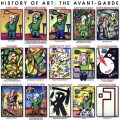
This is exactly one of the processes the AI is doing. You’d need to start small of course, maybe three movements and you’d need to teach pupils what the characteristics of each style are. Minimalism, Abstract and Pop-Art seem easiest and quite fun.
Then over time you could add more and repeat the exercise with different objects. You could use any subject matter, but keep it simple at first then gradually increase the complexity.
You might even begin with a photographic image and use Photoshop filters to apply the styles, before copying the results using traditional media. In this way, the computer is used as a tool to guide the outcomes.
Work like an AI: Conceptual Blending
The AI uses the same Conceptual Blending techniques that I talked about in my Four Types of Play blog post. It takes images it knows and applies them to new situations dictated by the person controlling the software.
I used to do a project like this years ago. In my project, pupils had to write a list of environments such as desert, arctic, jungle etc. These would form a background for the Surrealist art. Then they had to write a list of nouns such as hairbrush, kettle, bottle, flower, carrot and a list of verbs such as wash, eat, fall, grow, jump. They would randomly juxtapose verbs and nouns to create Surreal images to go in their environment – a carrot jumping over an iceberg in the arctic, a flower growing from a kettle in the jungle etc. Pupils would then research photographic images of their chosen ideas to copy, to help them realise the skills they needed for the final piece of art.
Summary
We need to teach pupils to know and understand what AI is doing. It isn’t magic. We should teach pupils how the AI produces images, show them its strengths and weaknesses and let them practice making art in the same way.
Of course, some pupils might use AI to cheat in exams, but I do believe we would be able to spot when they do. On the whole, I think AI will be a good thing. If the AI produces an idea for a piece of art that inspires a pupil to develop their own skills by physically copying it, that’s a great learning tool in my opinion. The danger would come from over-reliance on the AI to do the thinking for them. The AI has to be a springboard from which the pupil gains the confidence to do it themselves.
AI, I hope, will improve the world of art and raise the bar. It is just another tool we can use to make art; like the photocopier, Photoshop and the inkjet printer before it.
It’s losing great teaching that we need to fear most.


 Paul Carney’s Blog
It would be great to hear your thoughts about this