To remember complex words and terminology try the SAD technique that uses a combination of familiar, well-researched memory techniques. I don’t lay claim to inventing the memory techniques, only that I have developed a method of combining them into an accessible academic format.
Evidence behind the SAD memory technique:
1. SAD Utilises the Link Method
One of the most popular ways of remembering anything is the link method. https://www.academictips.org/memory/link.html
This is the practice of associating unusual, elaborate things with the the object you’re trying to remember. So if you’re trying to remember to buy bread in the supermarket you might visualise a huge loaf of bread crashing through the checkouts. The more weird, imaginative and elaborate you can make it the more effective the ability to remember.
The strength of this method lies in the visual associations we make in our heads. It’s weakness is remembering all of those visual associations when you have lots of lists to remember.
2. SAD also utilises Dual Coding
Dual Coding is a well established method of learning. https://en.m.wikipedia.org/wiki/Dual-coding_theory
It was first hypothesised in 1971 by Allan Paivio and relies on verbal and visual associations to aid memory. He argued that using two distinct areas of the brain (visual and verbal) to encode information stimulates cognitive processing and retrieval much more effectively.
There have been controversies regarding dual coding however. It does not take into account that we remember things in ways other than words and images. For example, our other senses are heavily involved in memory formation, so SAD does not rely entirely on Dual Coding.
3. SAD is founded on Drawing
Research has shown that drawing is the most effective way to remember key words and phrases, beating writing and repetition. https://www.edutopia.org/article/science-drawing-and-memory
Drawing something helps us encode it more effectively and if you’re worried that our brains might have limits on the amount of pictures it can hold, don’t be. Our brains can hold thousands more pictures than it can words. https://www.pnas.org/content/95/5/2703
The SAD memory technique
To use this method, select a word to be retained such as Uterosecral Ligament.
Now write the word out.
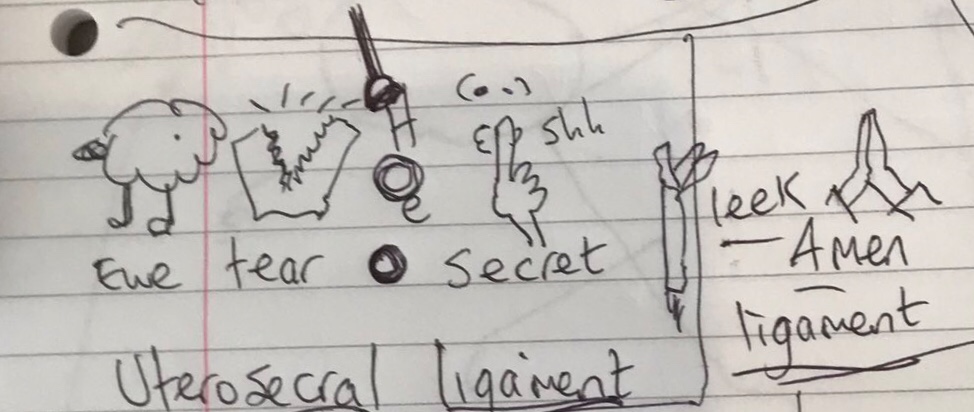
Then study the syllables and sounds of the word to make visual associations. Remember bold, vivid ones are best. So for Utero I broke it down into ‘Ewe-Tear-Hoe’and for Secral I thought of ‘secret’. For Ligament I thought of ‘Leek-Amen’.
Now write the visual associations near the word to be remembered and then draw small rough sketches next to them. A drawing of a Ewe, a piece of paper being torn – a garden Hoe – a finger over the mouth saying Sssh – then a Leek- and hands praying Amen.
For every word I want to remember I invent an imaginative visual association that sounds like the syllables of the word, then I draw pictures and dual code it with writing.
When I need to remember the word, my mind uses the mental visualisations, the dual coding and the drawing combined.
Context
I find this a very powerful way to remember things. I would only add that you need to also learn the meaning and context of the word also. (What it is, what it does and where it is.)
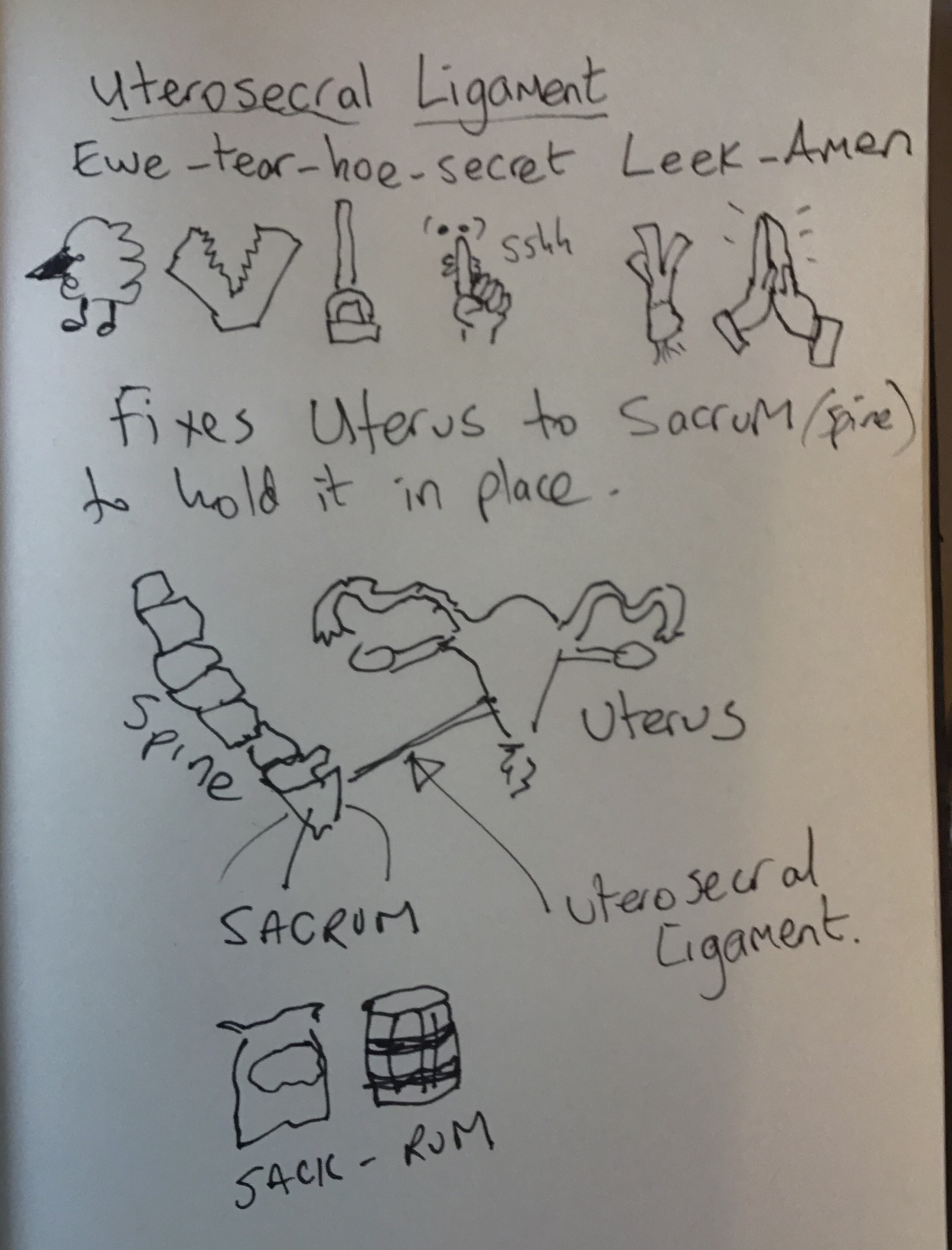
The Uterosecral Ligament is essentially a scaffolding pole that holds the uterus in place by fixing it to the Sacrum (a piece of bone at the base of the spine). So I can remember this using the same method of visual LINKS, DUAL CODING & DRAWING.
Ammendum
I used this technique to learn the cardiovascular system.
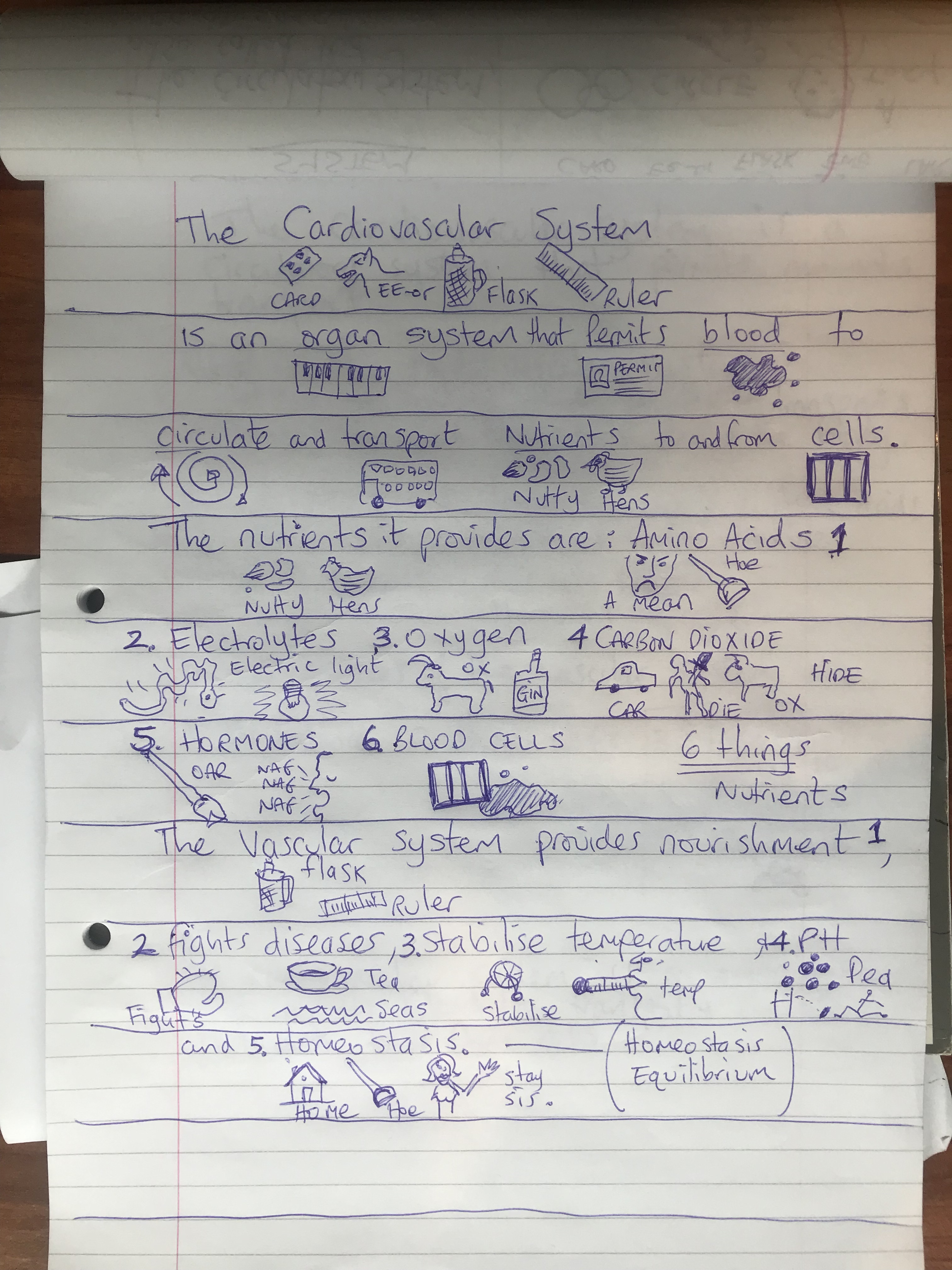
I used Wikipedia to find out about the cardiovascular system and used A4 lined paper to take notes. I found that by drawing horizontal lines every 3 or 4 ruled lines helped enormously.
I used the first line to write the text then drew pictures under key words to aid encoding. I tried to stick to the method of breaking words into syllable sounds then making visual link associations. I then drew these associations under the word to be learned.
I found it extremely effective. I tested myself after 1 minute then 1 hour and found myself recalling using a combination of words and pictures. The drawing certainly helped and with some words it was the drawing that led me to the word.
This method is certainly less efficient than just reading and writing the text. However you have to also take into account how secure the learning is when considering efficiency. If it reduces revision time and reduces re-learning then its efficiency increases.

 Paul Carney’s Blog
It would be great to hear your thoughts about this