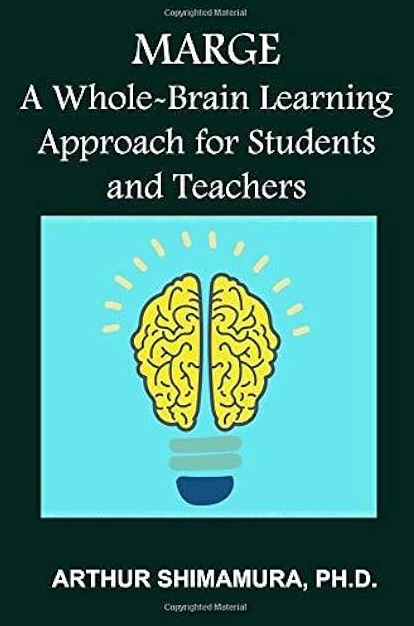
notes from the pdf MARGE
by neuroscientist Arthur Shimamura. Thanks to Daniel Willingham for posting this.
Learning is the ability to acquire knowledge from sensory experiences, where learning is perceptual (reading an x-ray), conceptual (linking new facts & ideas to existing knowledge), and skill learning.
Efficient learning depends on top-down processing which is the active use of the existing knowledge to guide the brain as to what to process.
Bottom up processing is where the teacher distributes facts while the student attempts to rote memorise them. It is the most inefficient form of learning.
A well organised memory system is built around an organised framework, where links are formed between information centres. (White matter to grey matter). The stronger the (white matter) connection the better it is remembered because these links between information are as important as the information itself.
Our brains determine how new facts fit into existing knowledge (schemas) and so memory processing distributes new information according to what we already know.
M – Motivate
The trick to remembering is to expand the spectrum of pleasure-seeking experiences and place ourselves in new learning situations. Placing yourself in a new context is perfect for this because it breaks you away from your habits of mind. Intrinsic motivation of things you are interested in will motivate you to remember them better. Using trips, galleries, stimulating resources, stories (which are organised schemas), personal opinion (which engages emotional brain circuits) and big questions to arouse curiosity will help. Web-based resources are a great entry-level gateway to conceptual information. Learning is best when it is pleasurable and engaging. The best way to encourage active learning is to get moving!
A – Attend (attention)
if we aren’t paying attention and our thoughts are scattered and our ability to process new information is diminished. The most critical problem for new learning is mind wandering and only 40-46% of students are paying attention at any one time. So student engagement is essential at the start of the lesson where you need to consider goal orientated questions, demonstrations or real-world examples. Also, breaking the lesson into sections via demonstrations or new material is important.
Also important is chunking, where we organise information into meaningful smaller units that are easier to remember. If we link these chunks to existing schemas then they become easier to remember.
Mind palaces or journey’s also are a great way to remember complex information.
R – Relate
Conceptual learning requires: 1. Activation of information in working memory 2. Relational binding of that information 3. Memory consolidation by reactivating and relating it to existing information.
This means that we need to relate new information to what we know. Do this by the Three C’s method: categorise, compare and contrast.
So when learning anything new try to recall anything you know of that is related to help you catalogue and assimilate it into what you already know. Learning is facilitated by finding similarities (comparing) and differences (contrasting) between new material and what you already know.
Verbal and Visual mediators are effective to create arbitrary associations to help us remember such as mnemonics, acronyms and visual associations such as wild imaginative mental pictures. Metaphors and Analogies can be used to connect new schemas to existing ones, such as comparing a camera to the human eye.
Another technique is to group information into meaningful hierarchies.
And rather than note taking in lessons, provide partial outlines that includes the main heading, sub-headings, titles, key words, topics. Students then fill in detailed facts.
Concept or mind maps also help to create mental hierarchies though they mustn’t be overly complex.
G – Generate
Think it, say it, teach it. By repeating the information you’ve just learned out loud things will stick better in your memory. Describe it to someone else and you strengthen it even further. You need to repeatedly use and reactivate learned information to create strong neural connections. But it’s not as good to simply restate or repeat what is being taught because you have to re-phrase it into your own words. Re-reading text books and highlighting key sections is a low-value memory exercise. But closing the textbook and trying to retrieve it from memory doubles retention. Rephrase the knowledge in creative, interesting and original ways to learn it best.
E – Evaluate
Metacognition is the ability to evaluate our own mental processes. We are constantly doing this to assimilate what is happening around us and decide on future actions.
There are two types of knowing: familiarity and recall. We don’t naturally recollect everything we learn, so we should test memory at intervals (minutes, hours, days, weeks etc.) Insert opportunities to retrieve information during class time by asking open ended questions that students must reply to individually and discretely. Anything that stimulates active responses such as clickers, mini-whiteboards etc. improves recall.
Of courses mini-quizzes and tests at regular intervals are good but so are other things such as doing a short presentation, speaking, making visuals, diagrams, recording or reading and re-writing the information in your own words.
You can also extend the earlier visual associations and mind palaces by creating flash cards of the information you want to learn then adding imaginative images to them.
Interleaving is where you mix-up and alter the order of learning. Think of it like exercising, where instead of doing thirty minutes on the treadmill then the rowing machine then the exercise bike, you do three ten minute cycles of each one. You learn different topics and subjects then test yourself on previous subject learning not the one you have just learned.
Lastly, you have to be cautious to not over-focus in specific brain regions, such as left or right brain learning.
Another important factor is that the student must be an active participant in learning to create a top-down processing model.

 Paul Carney’s Blog
It would be great to hear your thoughts about this