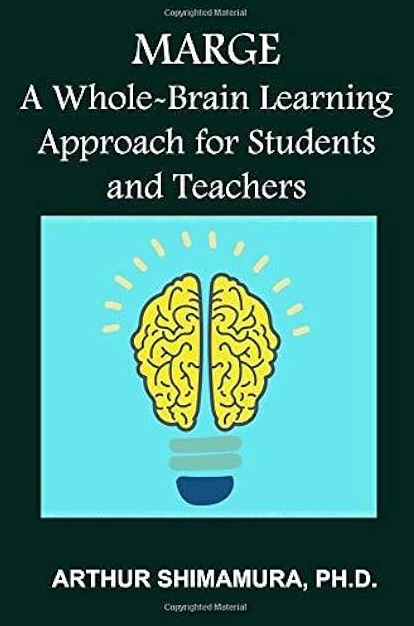
This article is based on an article by Christopher Pappas for the eLearning Industry (Instructional Design -7 strategies for eLearning Professionals) and MARGE by Arthur Shimamura
If we want students to remember our lessons we should try to make them active participants in a top-down learning model. This is the active use of knowledge to guide processing.
Bottom up processing is where the teacher distributes facts while the students attempt to rote memorise them. This is the least efficient form of learning.
Not all students are starting from the same point. Memory is built around a framework of (white matter) links between (grey matter) information centres. Those with strong white matter links will retrieve information much more quickly, but remember, pupils may have great neural networks for maths but not for sport etc.
Our brains usually fit new facts into existing knowledge schemas and so remembering things is dependent on what we know. With difficult concepts, students are much likely to try to access their familiar memories first. They’ll think; ‘oh I know this from somewhere,’ then try to wrack their brains to access their semantic memory for recalling facts.
Arthur Shimamura states there are five key components to memory:
Motivation – you’re more likely to remember the things your interested in.
Attention – Concentration and chunking information into smaller units is important.
Relate – Activate the information in the working memory, bind that knowledge by assimilating it, then compare and contrast it to what is known. To assimilate the knowledge use mnemonics, acronyms, metaphors, analogies, categorise it, mind maps, dual code, imagination, visualisation.
Generate – this is essentially using the knowledge. By drawing things, saying them out loud, describing it, do presentations.
Evaluate – this is metacognition; taking ownership of the knowledge and there are two distinct types of knowing – familiarity and recall, (familiarity is when you say oh I know this from somewhere. Recall is when you actually know the answer. Since we don’t naturally recollect everything we learn I find interval retrieval important here. Repeat the retrieval in spaces of 5 minutes, an hour, a day, a week, a month.
So the more memory techniques pupils use the more likely they are to have good recall. So in no particular order of importance:
1. Involve all the senses. Encode the information into visual forms by writing it down, drawing diagrams, illustrations, charts and maps etc. A VERY efficient and effective way of doing this is through drawing information to be learned.
If you have the time and resources you could also make computer based audio and video presentations, speak, sing or use poetry/rap to verbalise the information, use particular scents and smells to associate with different knowledge domains, make tactile physical movements to form associations. Best for big concepts, or harder, longer more complex information.
Creativity aids memory processing and recall because it increases Motivation.
2. Repeat, repeat, repeat and revisit. This is probably the most effective and quickest way of encoding shorter pieces of information. But the information has to be revisited and recalled at different intervals both in the lesson and at future times in order to be retrieved. We do this through testing of course and testing is a very important way of helping us to remember things. This can also be effectively done by getting students to repeat the information to each other in pairs or small groups because aurally repeating the information out loud helps encoding. Repetition doesn’t have to be dull and boring drilling. Anything that repeats and reiterates the knowledge in our minds helps; including quizzes, games and presentations.
3. Use it! Active retrieval is more effective than merely repeating information. If students don’t use the knowledge or it is considered a low priority to them then students will push the information further down into deeper memories, away from immediate recall.
4. Simplify. Chunking is where you take basic familiar elements and associate them together in a more complex whole. Break complex information into smaller sections. Prioritise information and get rid of unnecessary clutter. Organise the lesson information succinctly. Structure the content to create flow.
Get pupils to make summaries or paraphrase each chunk of information in their own words so they encode the information more effectively and can retrieve it more easily.
5. Visual chunking. Visual chunking is where you associate images sounds and feelings in your mind with the information you’re trying to remember. In fact, drawing is the most efficient and effective way of visual chunking.
6. Utilise Schemas. Use familiar knowledge and concepts to make associations with new information. For example, relating new facts through football to a soccer mad fan might help them remember it more easily. You can of course create new Schemas! Or use analogies and metaphors to familiar things, for example the electrical current is like a water slide, if we add narrower lanes and more loops and turns we increase the resistance.
7. Scenarios and stories help people pair semantic facts with episodic memory and we recall episodic memories much more easily. Why not get students to create stories from sequences of information or use mnemonics. So the order of the planets could be My Very Educated Mother Just Served Us Nachos.
8. Emotions and Motivation are powerful way to remember anything, so if a student is emotionally connected they are more likely to remember something. Make emotional connections that are relatable to help move information more easily into recall. Also, create a positive environment and use praise appropriately and sparingly at opportune times to make students feel good. We remember nice things! (Unfortunately we also remember bad things but we won’t go there!).
9. Time. Give pupils time to process, encode, store new information. Very bright students have strong neural connections that make recall easy, but others need time to embed them. Don’t judge the whole class by the speed of the fastest student to recall it. Some students memorise quickly using only repeat and recall but others need more diverse methods and more time.
10. Stage fright. And to finish I’d like to mention the phenomena of stage fright. I have to remember lots of lyrics and chord sequences to songs for performance. I use lots of techniques to help make them easily able to be recalled and at home I think I’ve got them off by heart. But go onstage look at the audience and the mind can go blank. This can happen in an exam too so try to calm down, settle the fear hormones flooding through your system and focus on something I call an anchor point. For my songs it’s the first line and I’ll construct a visual image in my head of what the the line means. If I’ve got the image in my head I’m fine.

 Paul Carney’s Blog
It would be great to hear your thoughts about this